Synopsis You’re probably paying for MarTech you never use. What is MarTech, which tools actually drive growth, and which ones quietly drain your budget? Find out what to keep, what to cut, and what to skip.
TL;DR: MarTech at a Glance
• MarTech is the software marketers use to plan, execute, and measure marketing activities.
• CRM, marketing automation, CMS, and analytics platforms are common MarTech tools.
• An effective MarTech stack connects tools and customer data to improve marketing performance.
• AI, data integration, and privacy are shaping the future of marketing technology.
What Is MarTech?
MarTech, short for marketing technology, refers to the software and platforms businesses use to manage marketing activities. It includes CRM systems, email marketing platforms, analytics dashboards, and AI-powered tools.
Whether you’re tracking leads, scheduling social posts, or automating emails, you’re using MarTech.
Core MarTech Platform Functions:
| Core Function | Definition & Scope |
| Campaign creation | Develop marketing content, emails, and landing pages. |
| Campaign execution | Deliver campaigns across different channels. |
| Customer data management | Organize customer information and support personalization. |
| Performance measurement | Track results and identify opportunities to improve. |
What Are Examples of MarTech Tools?
MarTech includes several platform categories, each serving a different purpose. According to MarTech’s State of Your Stack survey, CRM platforms appeared in 86.4% of stacks, followed by marketing automation (76.9%) and content management systems (73.4%).
Common examples include:
| Category | What it does | Popular examples |
| CRM | Manages customer relationships and leads | Salesforce, HubSpot |
| Marketing automation | Automates campaigns and customer journeys | Marketo, HubSpot |
| Email marketing | Creates and manages email campaigns | Mailchimp, Klaviyo |
| CMS | Manages website content | WordPress, Drupal |
| Analytics | Measures marketing performance | Google Analytics, Adobe Analytics |
| SEO | Supports keyword research and optimization | Semrush, Ahrefs |
| Social media | Manages publishing and engagement | Hootsuite, Sprout Social |
| Generative AI | Supports content creation and analysis | ChatGPT, Claude |
| CDP | Unifies customer data from multiple sources | Segment, Adobe Real-Time CDP |
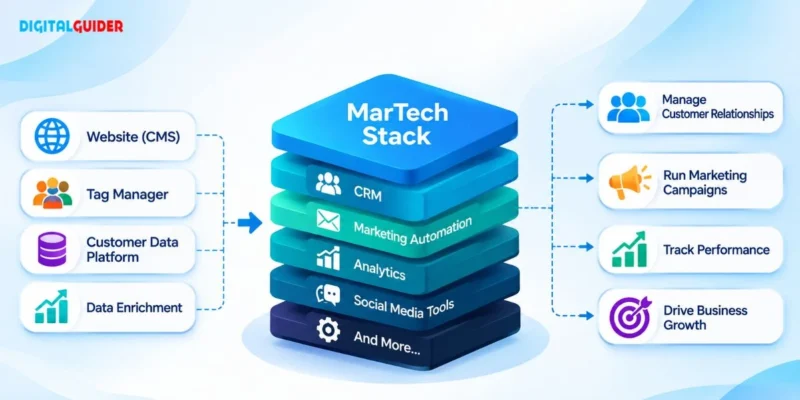
These tools often work together. For example, a CRM stores lead information, marketing automation sends follow-up emails, and analytics measures campaign performance.
What Is a MarTech Stack?
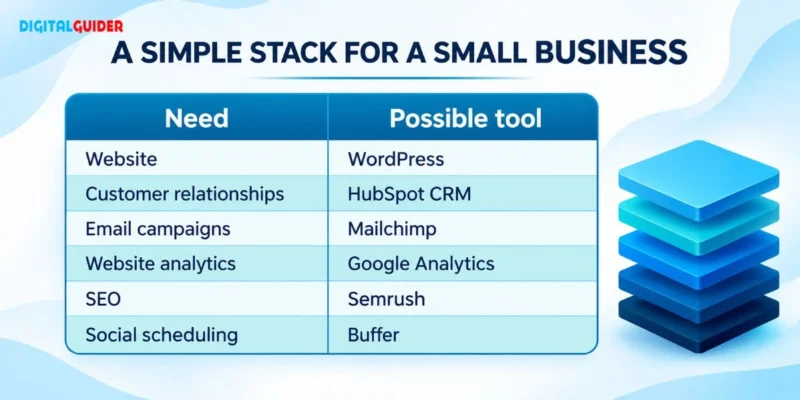
A MarTech stack is the collection of marketing tools a business uses together. A small business might need a CRM, CMS, email platform, and analytics software, while larger enterprises may use hundreds of applications.
The value comes from how well these tools connect. Poor integration creates data silos, duplicate work, and unreliable reporting.
Before investing in another platform, check three things:
• Integration: Does it connect with your existing tools?
• Scalability: Can it support future business growth?
• Return: Does its value justify the cost?
💡 Pro tip: Avoid adding tools just because they’re popular. A smaller, well-integrated MarTech stack can deliver more value than a collection of disconnected platforms.
What Are the Benefits of MarTech?
MarTech helps businesses improve marketing efficiency and make informed decisions. Its main benefits include:
| Time saved.
Automation handles repetitive work like email sends and reporting. | Better customer insight.
Connected data shows who your audience is and what they do. |
| Smarter spending.
Measurement shows which campaigns perform, so budget goes where it works. | Relevant experiences.
Segmentation and personalization help each customer see messages that fit. |
How Do You Build a MarTech Stack?
Building an effective MarTech stack starts with business objectives, not software purchases.
1. Define your goals: Identify what marketing needs to achieve.
2. Audit existing tools: Find overlapping platforms and unused features.
3. Identify gaps: Determine which capabilities are missing.
4. Choose compatible tools: Prioritize integration and scalability.
5. Measure performance: Review results and remove tools that deliver insufficient value.
6. Establish governance: Assign ownership for data quality, permissions, integrations, and platform management.
What Are the Biggest MarTech Trends?
Five developments are shaping marketing technology:
Trend | Traditional Approach | Modern Approach | 🎯 Core Business Value |
Agentic AI | Manual, single-prompt tools. | Operational Scale: Lowers CAC. | |
Generative AI | Generic, static creative assets. | Hyper-personalized text and design. | Speed & Relevance: Speeds production. |
MarTech Consolidation | Disconnected subscription sprawl. | Lean, high-ROI unified toolkits. | Cost Efficiency: Cuts software waste. |
Data Integration | Fragmented data silos. | Single, connected journey views. | Deep Visibility: Clean fuel for AI. |
Data Privacy | Third-party cookie tracking. | Consent-led first-party data loops. | Brand Trust: Bulletproof compliance. |
What does this mean for businesses? Businesses that embrace useful AI, connected data, and privacy-first practices can build more efficient and adaptable marketing operations. |
How Do You Measure MarTech ROI?
MarTech ROI measures whether technology investments support business goals. Important metrics include customer acquisition cost (CAC), customer lifetime value (CLV), lead conversion rates, campaign ROI, and technology utilization.
Regular reviews help businesses identify underused tools and optimize spending.
Final Take: Building a Smarter MarTech Stack
MarTech is more than a collection of software. It helps businesses manage customer relationships, automate marketing, and measure performance.
Start with your goals, evaluate existing platforms, and invest in tools that solve genuine problems. DigitalGuider can help you build a stack that fits how your team works.
FAQs About MarTech
Q. Is Salesforce a MarTech tool?
A. Yes. Salesforce offers CRM, marketing automation, and customer data solutions that support marketing operations.
Q. What is the difference between AdTech and MarTech?
A. AdTech focuses on buying and measuring paid ads, while MarTech manages broader marketing activities like automation, customer relationships, and analytics. Both help businesses attract and retain customers.
Q. What is the difference between CRM and CDP?
A. A CRM manages customer relationships and interactions, while a Customer Data Platform (CDP) unifies customer information from multiple sources to create more complete customer profiles.
Q. Can small businesses benefit from MarTech?
A. Yes. Small businesses can use affordable CRM, email marketing, automation, and analytics tools to manage campaigns and understand customers more effectively.
Share This Article
About the Author: Adrian Thorne

Related Articles
 November 9th, 2026 | 7 minutes read
You publish a blog post, it starts ranking on Google, brings in consistent traffic, and becomes one of your website's
 November 2nd, 2026 | 6 minutes read
Why does a customer three blocks away get the same marketing message as someone three miles away? They shouldn't. While
- October 26th, 2026 | 9 minutes read
Most customers don’t buy the first time they visit a website. They may need a reminder, helpful information, or a
- October 22nd, 2026 | 9 minutes read
Finding a dentist used to start with a recommendation. Today, it often starts with a search. When patients face any