Synopsis Someone is asking AI for a recommendation in your industry right now. If it doesn't trust your website, you vanish. Will AI choose your business or your rival? Read about what AI optimization is to find out how to make AI choose you.
If someone asked ChatGPT about your business today, what would it say? Would it recommend your website, name your rivals, or say nothing at all?
This is how search works now. These tools read the web, combine the facts, and generate AI generated answers. They only link to a few trusted sources.
🎯 Your goal is to ensure AI can find, understand, and trust your content. This is where AI Optimization comes in.
This blog answers the questions: what is AI optimization, and how to optimize content and websites for AI search.
What is AI Optimization?
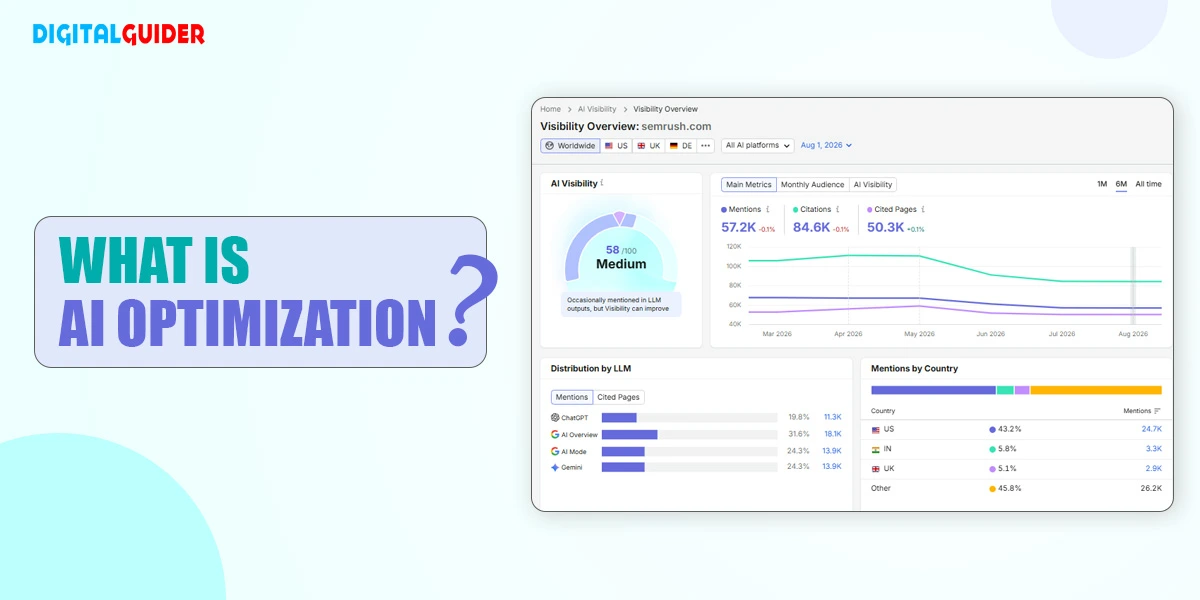
AI Optimization means making your site easy for AI search tools like ChatGPT, Google AI Overviews, and Perplexity to find, trust, and recommend. Traditional search lists links, but AI combines websites into one direct answer.
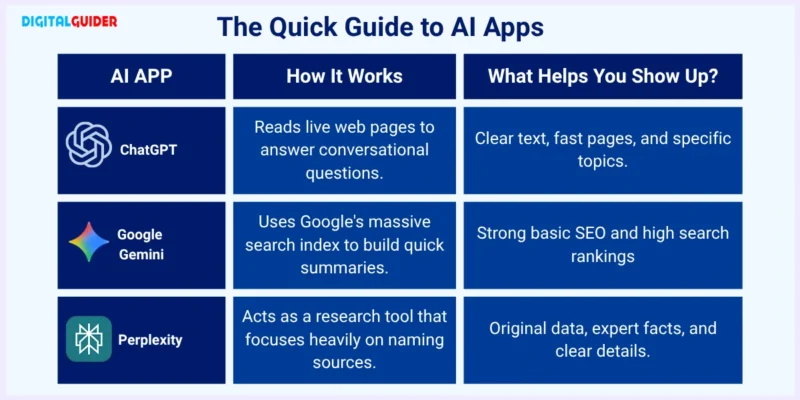
ChatGPT, Google Gemini, and Perplexity use different approaches to find and present information. Here’s what helps your content get discovered.
AI Optimization: Where SEO, AEO, and GEO Fit In
You might hear different letters used for search today. They are not separate strategies. They all work together to help your website get found.
| Term | What It Means |
| SEO | Helping your website rank on standard search pages. |
| AEO | Writing text that directly answers specific questions. |
| GEO | Getting your site mentioned inside AI answers. |
| AI Optimization | Combining all three steps to win across new AI tools. |
AI Optimization builds on strong SEO fundamentals.
How AI Search Builds Answers
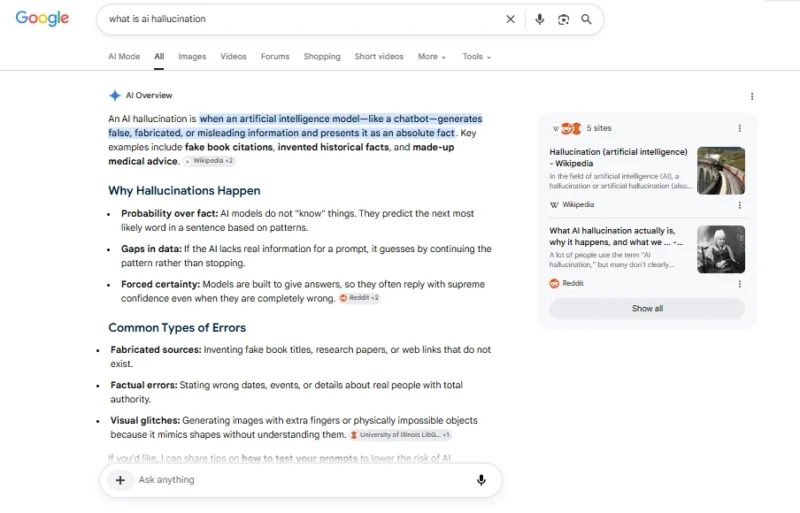
AI generated answers are generated in four steps to create a direct answer.
Step 1: Understanding Questions
The AI finds the real meaning behind your casual question.
Step 2: Finding Facts
The AI searches trusted websites to pull out short paragraphs.
Step 3: Testing for Quality
The AI ranks the paragraphs by truth, accuracy, and source safety.
Step 4: Writing Answers
The AI blends the best facts into one clear reply with links.
How to Create Content AI Search Can Understand
How do you write content that AI search tools will recommend?
💡The answer is simple: Do not write for machines. Just write clear, helpful text that both people and AI can easily understand.
Follow these simple rules:
Follow these simple rules:
| Content Rule | Why It Matters | What To Do |
| Know Your Readers | AI search focuses on user questions. | Find out what your audience wants to know and what they would ask an AI. |
| Answer Quickly | AI tools look for direct answers | Give the main answer first, then add details and examples. |
| Use a Clear Structure | Organized pages are easier for AI to read. | Use clear headings, short paragraphs, bullet points, and an FAQ section. |
| Write Naturally | AI looks for meaning, not repeated words. | Use simple language, explain hard terms, and avoid heavy jargon. |
| Add New Ideas | AI can easily copy old text, so unique facts stand out. | Share your own examples, expert choices, real data, and fixes. |
| Make Your Page Easy to Browse | Clear websites help AI connect the dots | Link related pages together, describe your images, and keep your site fast. |
How to Optimize Your Website for AI Search
Learning how to optimize for AI is simpler than it may seem. Start with traditional SEO rules to help you show up in AI search results.
Focus on these three areas:
1. Easy Access for AI Bots
Before AI tools can share your content, they must be able to open and read your pages.
● Do not block search bots.
● Keep pages fast and mobile-friendly.
● Link related pages so bots see how they fit.
2. Optimize On-Page Content
AI systems work best when your content is out in the open.
● Keep important information in plain text.
● Avoid hiding text in dropdowns.
● Don’t rely too much on images.
3. Schema Code Is Necessary
Your ultimate goal is to make helpful content that is easy to read.
● Use standard background code (Schema Markup) to label your data clearly for bots. (like prices or FAQs).
● Files like llms.txt help bots but are not required.
⚠️ REMEMBER:
Technical elements should support your content, not replace it
✅ Quick Checklist: Are You AI-Ready?
Before you publish, use this SEO checklist to ensure your page is optimized for both users and AI bots.
How to Optimize for AI Citations
To earn AI citations, your website must prove it is accurate, helpful, and trusted. Focus on two main areas:
1. Climb the Search Rankings
Strong SEO improves your search rankings. This helps AI systems find and use your content.
High-ranking pages that update regularly and clearly answer specific questions are much more likely to be chosen by AI tools.
2. Backlinks, Credibility, and AI-Ready Content
Earn high-authority backlinks and citations to prove your credibility. Ensure your page is AI-ready by using structured formatting, clear trust signals, and direct answers to optimize for both users and search bots.
Want to rank in answer boxes? Read our AEO guide now. Want AI answers to link to your site? Read our GEO guide.
Tools & Measuring Results
AI optimization requires tracking more than regular SEO traffic. You must use tools to check how often AI tools cite your brand, mention your name, and send readers to your site.
Best AI Optimization Tools
No single tool handles every part of AI Optimization. Choose tools based on your immediate needs.
| Tool Name | What It Helps With | Best Feature |
| Semrush | Finding the right search topics | A Keyword Magic Tool that groups words by what users want. |
| Surfer SEO | On-page SEO | A live Content Editor that rates your text against top sites. |
| ChatGPT / Gemini | Research and ideas | Finds hidden human problems and questions other tools miss. |
| Screaming Frog | Fix website code errors | Scans your site to find tech bugs that block search robots. |
| Ahrefs | Competitor Research | Find websites that link to your rivals so you can get links too. |
| Jasper AI | Writing long articles | Writes in your brand voice and links directly with Surfer SEO. |
| Frase.io | Answering AI search questions | Automatically builds helpful Q&A sections for your website. |
| Google Trends + AI | Finding topic trends | Mixes live Google data with AI to catch trends before others do. |
| BrightEdge | Managing huge company sites | Uses data to guess your future search rankings and profits. |
💡 Tools speed up your workflow, but original, fast, and trustworthy content is what actually gets you noticed by AI.
Track AI Traffic & Citations
Track how often your brand appears in AI answers, which pages get cited, and where competitors gain visibility.
| Tool | What It Does Best | Key Benefit |
| Semrush AI Toolkit | Tracks mentions and rivals | Shows the prompts where competitors beat you. |
| Profound | Monitors conversations | Identifies the exact sources AI platforms use. |
| Rankscale | Measures tech health | Combines tracking with technical readiness scores. |
| Surfer AI Tracker | Links data to writing | Connect your citation data to content tools. |
| HubSpot Grader | Quick free checks | Gives a fast snapshot of your overall AI visibility. |
| Yext Scout | Helps local shops | Tracks physical business locations across bots. |
| Scrunch | Checks facts and errors | Alerts you if an AI shares wrong info about you. |
What should you measure?
◇ AI CITATIONS show that AI tools trust your website.
◇ SHARE OF VOICE shows if AI talks about you more than others.
◇ REFERRAL TRAFFIC counts how many people visit you from AI answers.
◇ CITATION GAPS shows questions where your rivals win, and you lose.
◇ BRAND SENTIMENT makes sure AI talks about you in a good way.
AI Optimization Mistakes to Avoid
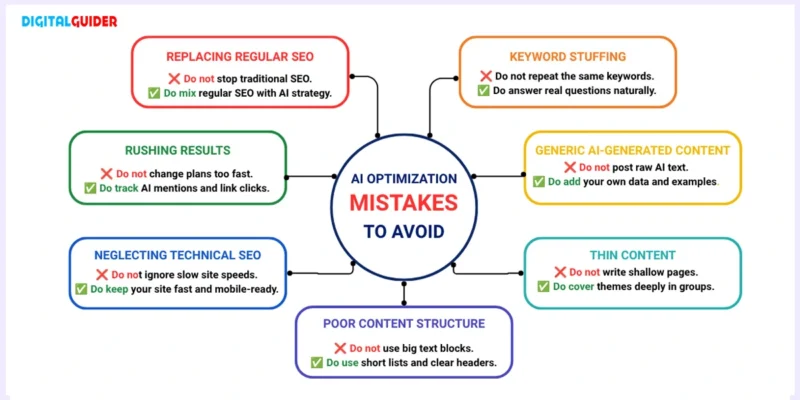
Many companies accidentally hide their websites from AI search engines. They use messy layouts or leave out clear facts, so AI bots cannot find or share their work. Avoid these common mistakes:
1. Keyword Stuffing
❌ Avoid repeating keywords or creating multiple pages for minor phrase variations.
✅ Do build comprehensive content that naturally answers conversational questions.
2. Creating Generic AI-Generated Content
❌ Avoid publishing unedited AI-written content.
✅ Do add original data, real-world examples, and unique data.
3. Thin Content
❌ Avoid covering a subject superficially or leaving pages disconnected.
✅ Do create structured topic clusters that fully explore a main theme.
4. Poor Content Structure
❌ Avoid hiding important facts in long paragraphs or using vague headings.
✅ Do use clear headings, short paragraphs, lists, and direct answers.
5. Neglecting Technical SEO
❌ Avoid neglecting slow speeds, broken links, or content hidden behind interactive elements.
✅ Do maintain a fast site with responsive mobile design and structured data.
6. Expecting Immediate Results
❌ Avoid shifting strategies prematurely or tracking only traditional rankings.
✅ Do evaluate performance using AI platform mentions and referral traffic.
7. Treating AI Optimization as a Replacement for SEO
❌ Avoid dropping regular SEO to focus only on AI.
✅ Do combine both strategies, using a healthy website to build trust.
What to Do Next?
AI optimization means making your website easy for AI tools to find, trust, and share. You can do this by writing clear answers to real user questions. Use clean layouts, unique facts, and helpful examples.
You also need to fix your technical SEO so AI bots can read your pages. AI changes fast; you must keep updating your site.
DigitalGuider builds the right strategy, technical setup, and trusted content to future-proof your search traffic.
Ready to get noticed in AI search?
Get a Free Consultation with DigitalGuider today.
AI Optimization FAQ
Q. Can small businesses benefit from AI optimization?
A. Yes. Small businesses can compete with larger brands by creating highly specific, local content that answers niche customer questions.
Q. Does domain authority affect AI search visibility?
A. It can. Strong website reputations and quality backlinks provide good trust signals, but authority alone does not guarantee AI recommendations.
Q. Does brand reputation influence AI recommendations?
A. AI systems check multiple sources, including reviews, media coverage, and third-party mentions, to decide if a business is trustworthy.
Q. Can AI search engines understand video content?
A. Yes, but with help. AI can extract info from video, but you must provide text transcripts, summaries, and clear titles so the content is easily discovered.
Q. Should businesses optimize their social media profiles for AI search?
A. Accurate and consistent information across major social platforms helps build a clear, reliable online presence for AI systems.
Q. How important are customer reviews for AI optimization?
A. Very important. Reviews are critical for local or product recommendations. You should encourage real customer feedback on major platforms.
Q. How does local SEO connect with AI optimization?
A. Directly. When users ask AI for nearby services, the system relies on your accurate business details, location info, and local listings to recommend you.
Q. Should I remove old pages that get no AI traffic?
A. Not automatically. A low-traffic page might still bring in regular search traffic, backlinks, or support other pages. Evaluate its overall value first.
Q. Does website hosting affect AI optimization?
A. Indirectly. Hosting is not a direct AI ranking factor, but it affects page speed, security, and uptime. Good hosting ensures AI crawlers can always reach your site.
Thanks for reading!
Share This Article
About the Author: Kenji Tanaka

Related Articles
 October 22nd, 2026 | 9 minutes read
Finding a dentist used to start with a recommendation. Today, it often starts with a search. When patients face any
- October 19th, 2026 | 8 minutes read
The next patient for your dental office is probably already searching for you. The question is: Will they find you
- October 12th, 2026 | 6 minutes read
Imagine someone needs a lawyer today. What do they do? They pull out their phone, search Google, compare a few
- October 5th, 2026 | 7 minutes read
“Why isn’t my law firm showing up when potential clients search for an attorney?” Imagine, as a law firm owner,