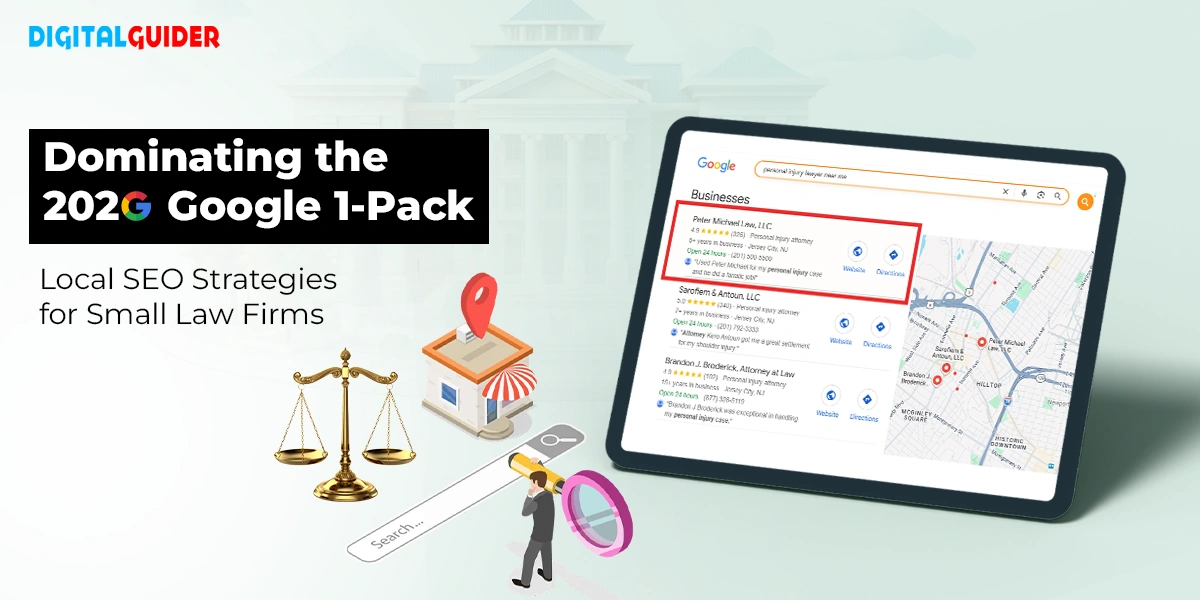
Synopsis In the 2026 legal market, second place is just the first loser. When a potential client searches for an attorney, Google no longer offers a "menu" of options; it offers a solution. With the move toward a Google 1-Pack, the old traditional 3-pack model won't exist anymore, and the "Winner Takes All" will rule. For small law firms, being in Google’s 1-Pack requires the perfect local law firm seo. This guide will take you through all the SEO strategies to get your business built trust, rank in the Google 1-Pack, and optimise your site for Zero-click results.
In this blog, you will learn:
✔️Local SEO for Small Law Firms
✔️The “Google 1-Pack” Reality
✔️ Why your Google Business Profile is now more critical for conversions
✔️How to build “Neighbourhood-Specific” pages
✔️ Strategies to capture leads directly from AI Overviews
✔️ How to use technical Structured Data to feed Google
✔️ The 90-Day Roadmap
Local SEO for Small Law Firms
Local SEO for small law firms helps attorneys appear in Google Maps, Local Pack results, and location-based legal searches when potential clients look for nearby legal help. In 2026, local visibility matters more than traditional rankings because most legal searches now end directly inside Google’s ecosystem before a client even visits a website.
When someone searches for terms like “personal injury lawyer near me” or “divorce attorney in Chicago,” Google prioritizes firms with strong local trust signals, recent reviews, accurate business information, and neighborhood relevance. For smaller firms, this creates an opportunity to compete with larger legal brands by focusing on hyper-local authority rather than massive marketing budgets.
A well-optimized local SEO strategy for law firms usually includes:
- Google Business Profile optimization
- Consistent client reviews
- City-specific legal service pages
- Local backlinks and citations
- Mobile-friendly website experience
- Schema markup for legal services
- Neighborhood-focused content
Many law firms still rely heavily on traditional websites, but client behavior has changed. Someone searching after a car accident late at night usually calls directly from Google Maps without browsing multiple websites. That shift is exactly why local SEO has become one of the biggest lead-generation channels for small law firms in 2026.
Before we move ahead, it’s important to understand what the “Google 1-Pack” actually means. Most business owners and law firms still assume it’s just another normal Google listing that can be ranked easily. In reality, the 2026 Google 1-Pack works very differently and has become one of the most competitive positions in local search. So before diving deeper into strategies, let’s understand how it really works.
What is Google 1-Pack? (2026 Local SERP Evolution)
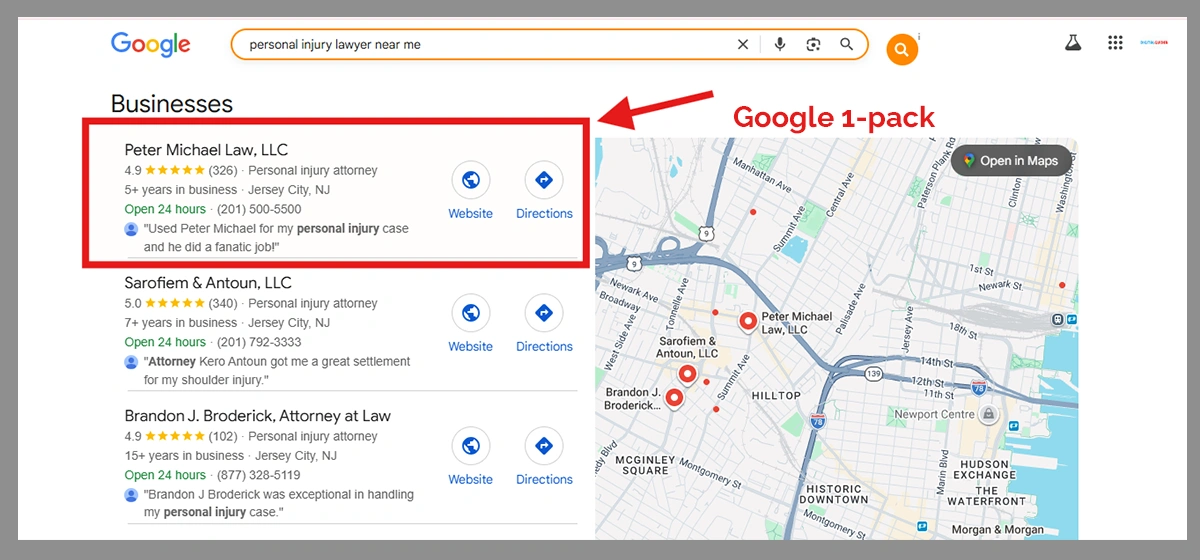
Google 1-Pack refers to the first group of local business results that appear in Google search results when you search for something nearby. It is a part of Google Local Pack.
The Google 1-Pack represents the pinnacle of local search visibility in 2026. The traditional 3-pack still exists, but now the Google algorithm has shifted toward a “Winner-Takes-All” model. With the advancements of AI overview and voice-activated search, Google prefers the best match for high-intent queries like ‘personal injury lawyer near me’, and more. To master law firm seo, you need to understand the effects of Google 1-Pack on legal searches.
Why are Legal Searches most affected by the 2026 1-Pack?
Legal searches are most affected by the 2026 Google 1-Pack reality because they are considered a critical service, not just a business.
- They belong to a high-stakes category Google calls YMYL (Your Money Your Life).
- This shift has affected the legal searches the most, as people search with strong local intent, such as “divorce lawyer near me” or “car attorney in my city”.
- These searches often trigger the local map results, and if only one business appears instead of several, that single law firm receives most of the visibility, clicks, and calls.
- Small rankings matter most in a highly competitive legal industry, as they can affect a firm’s leads and revenue.
- As a result, when the local pack is reduced to a single listing, most law firms lose prominent placement, making legal searches particularly affected by the 2026 1-Pack change.
Core Google Ranking Factors for Local Legal SEO in 2026
In 2026, Google continues to prefer various key factors to decide which law firms appear in its Local Pack. You must understand the following factors to improve your firm’s visibility and lead generation:
- Google Business Profile Optimization
As a small law firm, you must update your GBP, like your firm name, correct legal service categories, working hours, address, contact, professional photos, and client reviews. Ensure all information is in one place, and everything aligns with one another.
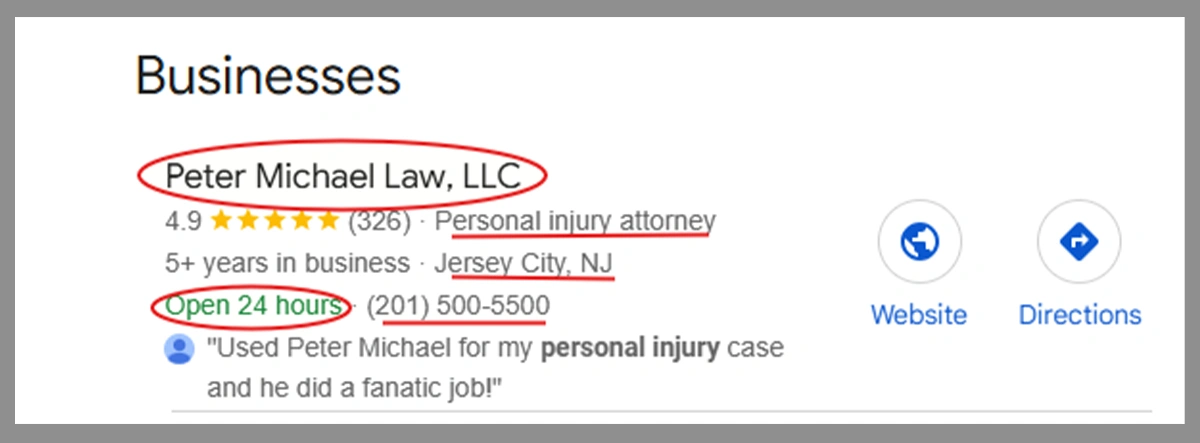
Google Business Profile Optimization example
- Relevance to search query
If your client needs a legal service, they are going to have great intent behind their search. A common example would be “divorce lawyers near me” or “criminal lawyers in Boston. Therefore, your Google Business Profile (GBP), service pages, and content must adequately communicate your legal practice area(s), as well as contain appropriate keywords associated with the market to improve search relevance.
- Proximity to Searcher
Local Pack results displayed by Google are based on the distance of the law firm from the person searching. Maintain accurate address information, embed Google Maps on your website, and maintain consistency with your location information across all the various directories that exist to support proximity signals.
- Client Reviews and Ratings
Client reviews significantly impact local search results and also establish credibility. It is important to encourage your happy clients to leave you genuine client reviews and to respond to both positive and negative reviews professionally so you can build trust and improve your visibility.
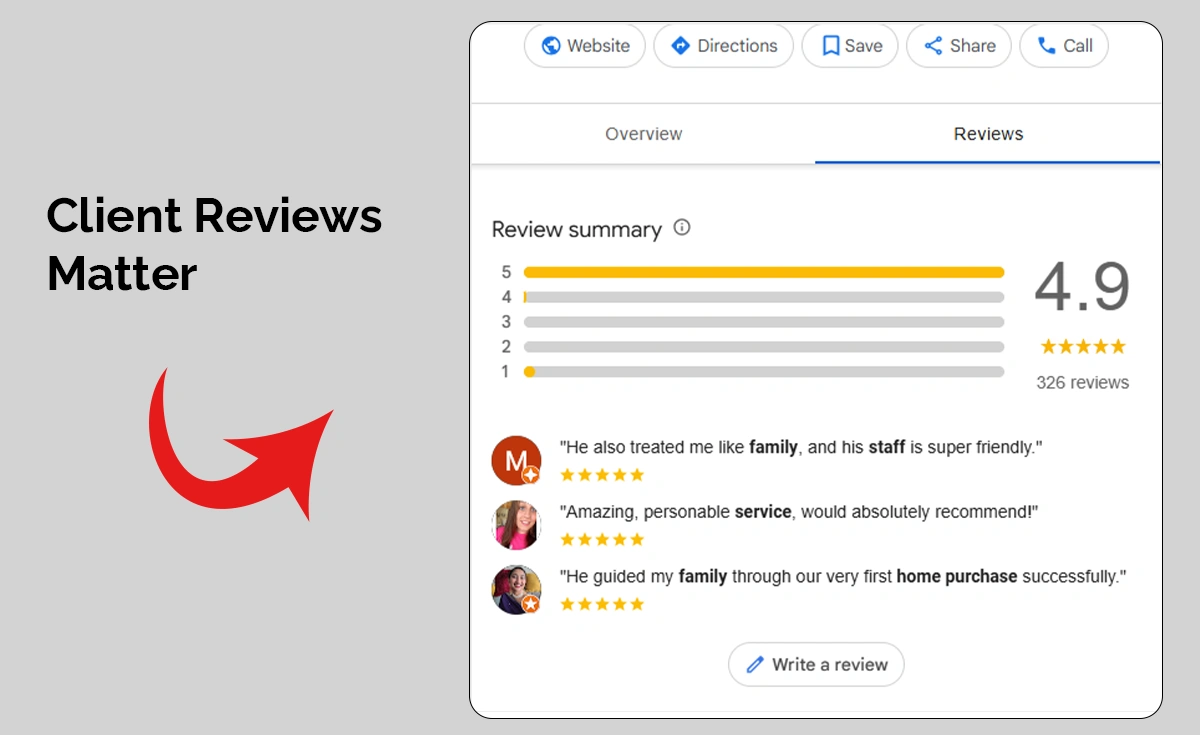
Trusted by clients across the city for dependable legal support and proven case results
- Website Quality & Local Content
Having a website that loads quickly, is mobile-friendly, and contains a significant amount of high-quality content or legal resources will positively impact your search engine optimization performance. By creating blogs, frequently asked questions (FAQs), and location-based pages, you can establish your authority and attract local search traffic.
- Backlinks & Legal Citations
Having backlinks from authoritative websites and being listed in well-regarded online legal directories helps to increase the authority of your law firm. Furthermore, having consistent citations across multiple platforms will assist with validating your law firm’s legitimacy and, in turn, improve your local search engine optimization rankings.
How Small Law Firms Can Optimize Their Google Business Profile
Small law firms can optimize their Google Business Profile by keeping business details accurate, choosing the right legal categories, adding real office photos, collecting consistent client reviews, and regularly posting updates.
Most small law firms believe their website is their most important asset, but they are wrong. In 2026, 60% of legal “conversions” (calls and clicks) happen before any client ever reaches your homepage. All this is done in the ‘Map Pack’. Your Google Business Profile is the most important thing to master local SEO and rank in the Google Map Pack.
Here’s how you can optimize your GBP:
The 3-Step “Map Pack” Audit
| ➡️The “Signal of Life” Test Google’s AI prioritizes recency over volume. You must optimize your GBP profile with all the latest information. Having 100 five-star reviews from 4 years ago will be neglected by Google. Strategise your ‘review velocity’: two reviews a month are sufficient rather than posting fifty once a year. Pro Tip: Reviews like ‘Great Job’ won’t work, ask your clients to write reviews like ‘The firm handled my divorce case really well in Texas. |
| ➡️ Upload “Real World Visuals” Google’s 2026 vision for real-world photos. Your firm’s office space, your lobby, and most importantly, your team’s faces, should provide proof of your human presence and should not look like a ‘virtual office’ scam. Most clients will wonder whether you are a real firm or not. To verify this, make a 30-second video of your firm as a walkthrough of your office. |
| ➡️ The FAQ ‘Seed’ technique Answering your client’s question is important before they struggle and waste time asking in the Q&A section. Use the Q&A section as your own mini knowledge base. Post at least 5 questions (from your personal account) that you get during consultations. Questions like, ‘How much does an initial consultation cost?’, etc, and then answer them officially through your law firm profile. |
By creating city-based pages for local authority development, small law firms have a great opportunity to rank higher than large competitors with a broad state-wide presence. Below are key points for developing local authority through city-focused pages:
1. Develop Content with Hyper-locality (Not Just “Find-replace”)
- Copying what you already have into another area and only changing the name of the city is a common mistake. Google expects original value according to its ‘Helpful Content standards’.
- Provide information about specific areas. Include references to specific neighbourhoods, prominent intersections, or popular parks in the city.
- Discuss specific courts. Provide information about which city has a municipal and/or a county courthouse to address cases in that city.
- Talk about local customs. Discuss your experience with a legal issue if the issue is routinely seen in that city.
2. Use City-based Social Proof
Building a local authority means you need to demonstrate that you have successfully assisted people in that city or community.
- Provide Local Reviews: Provide testimonials from individuals who live or work in that city that resulted from your assistance.
- Provide Case Results by Jurisdiction: Provide examples of cases you have successfully resolved in the jurisdiction; however, do not disclose any confidential information.
3. Optimize On-Page Geographic Signals
Indicate where exactly in the world this page is located for search engines.
- Title Tags & H1’s with Local Context: Use a standard form like this – [Practice Area] Lawyer located in [City], [State] | [Firm’s name].
- Maps: If applicable, you can embed a Google Map showing your location within the larger city that you are serving and/or include a smaller map showing the greater service area of your city.
- Correctly list all of the details for that location you are claiming (NAP), including what is displayed in your Google Business Profile.
4. Add “LocalBusiness” Schema Code
- Use SEO best practices to communicate with search bots directly.
- Don’t just tell Google where you are located; instead, use a schema code to tell your exact location.
- Your code should include structured data (example Schema.org) to signify the legal service authority related to that city, greatly increasing your chances of showing in Local Search Results.
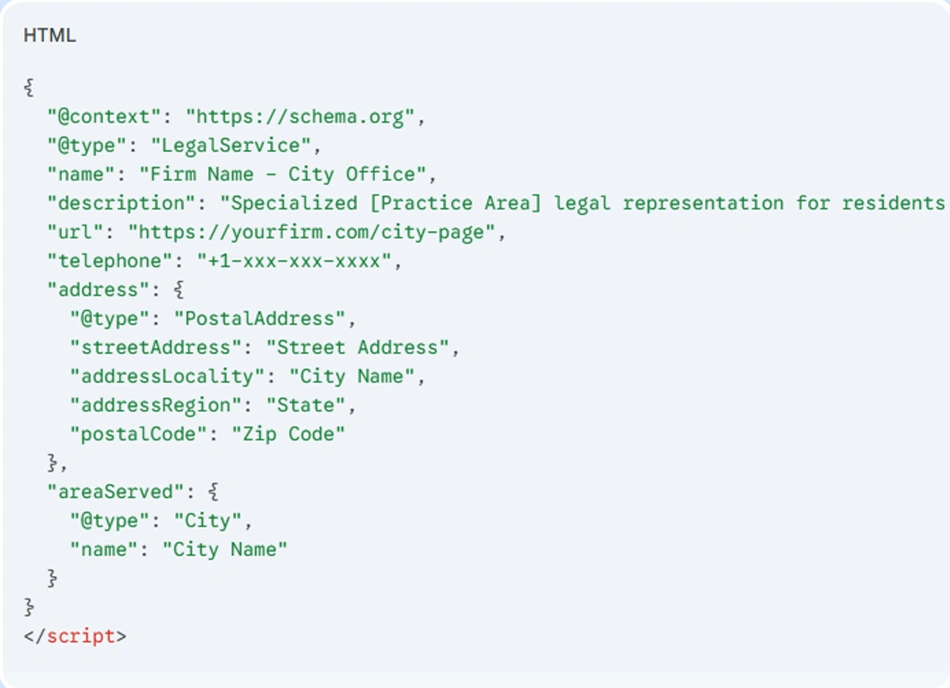
Law firms using schema markup often stand out with enhanced listings in search results
5. Build Local Links: Internal and External
Associations build authority by:
- Internal Linking: From your main Practice Area pages, create links to your city pages to pass page rank (link juice).
- External Linking: Obtain links to your specific city page from local city directories, through sponsorship of youth sports teams, and/or community blogs that can provide you with a link to your specific city page.
- When you want to build up authority in your local area, you must show that your law firm is a trusted member of the community. Instead of getting any kind of link wherever you can on the internet, seek local link opportunities.
- Examples include sponsoring a local Little League team, signing up for your city’s Chamber of Commerce, or giving out a small scholarship to a local high school.
- When these local entities have links to your website from theirs, it sends a signal to search engines that you are a legitimate and credible professional within that particular location.
- You can think of this as a digital form of word-of-mouth. By partnering with other local professionals (e.g., realtors or CPAs) and being mentioned in local newspapers, you create a “web of trust.”
Local Services Ads (LSAs): The “Fast Track” to the Top
While Law Firm SEO is a long-term play, Local Services Ads (LSAs) allow small law firms to appear at the very top of Google Search results, even above traditional PPC ads. For a small firm, this is the most effective way to gain immediate visibility:
- Pay-Per-Lead, Not Per-Click: Unlike standard Google Ads, you only pay when a potential client actually calls or messages you through the ad. If the lead is spam or a “wrong number,” you can dispute the charge.
- The “Google Verified” Badge: To run LSAs, your firm must pass a rigorous background check and license verification. Once cleared, you receive a Google Verified (formerly Google Screened) badge, which serves as a massive trust signal.
- Proximity Power: LSAs are heavily weighted by location. Even if a large firm has a bigger budget, Google often prioritizes your firm if you are physically closer to the person searching.
- Operational Ranking: Your ad’s position isn’t just about your bid; your responsiveness determines it. If you answer the phone quickly and manage your leads in the LSA dashboard, Google rewards you with higher placement.
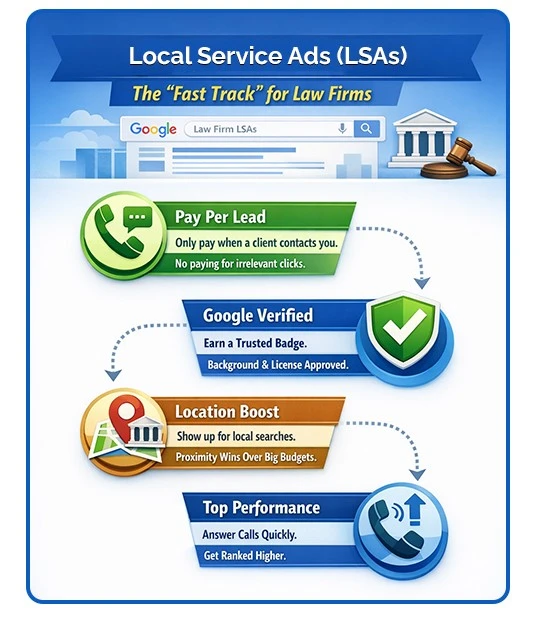
Artboard showing Steps of Local Service Ads
How AI-Driven Search & Voice Queries are Changing Small Law Firm SEO
- AI-powered search often provides full answers or a single spoken response, so the user doesn’t have to click through to a website. This is known as a zero-click result.
- The Shift: To stay visible, you want to be the source the AI cites in its summary.
- The Action: Structure your data using Schema Markup (code that helps AI understand your firm’s details) and use clear, bulleted lists that AI “answer engines” can easily grab and read aloud.
- Hyper-local GEO optimisation helps AI search understand location very well. It doesn’t just look for a city name; it looks for “Geographic Experience” (GEO).
- The Shift: AI prioritises firms that demonstrate strong local engagement and verified physical presence.
- The Action: Keep your Google Business Profile active with local photos and neighbourhood-specific content. The more local information you include, like mentioning nearby courthouses or places, the better chance an AI assistant has of suggesting you to someone who is close by.
- Authority is the new algorithm. Traditional SEO relied heavily on technical tactics, whereas AI search focuses more on E-E-A-T (Experience, Expertise, Authoritativeness, and Trustworthiness).
- The change is that AI looks at your business across the whole web directories, news sites, and social media to check if you’re seen as a reliable expert. The thing to do is make sure your business name, address, and phone number (NAP) are the same everywhere. If an AI encounters conflicting information, it will lose “confidence” in your firm and recommend a competitor instead.
Common Local SEO Mistakes Small Law Firms Must Avoid
- Vague Categories: Choosing “Lawyer” instead of a specific niche (e.g., “Bankruptcy Attorney”).
- Keyword Stuffing: Adding cities/services to your official business name on your GBP.
- Virtual Office Use: Listing P.O. Boxes or unstaffed spaces as physical offices.
- Ignoring GBP Posts: Treating your profile as a static listing rather than an active feed.
- Inconsistent NAP: Having different Name, Address, or Phone formats across the web.
- Stock Photo Reliance: Using generic “gavel” images instead of real team photos.
- Unanswered Reviews: Failing to respond to client feedback.
- Poor Mobile UX: Having a slow site or hard-to-find “Call Now” buttons for mobile users.
90-Day Local SEO Action Plan for Small Law Firms
This 90-day roadmap provides a structured, three-phase approach for small law firms to dominate local search results. As outlined in the table below, the plan begins with:
- First 30 Days, focus on core identity and Google Business Profile verification to build immediate trust.
- …60 Days shifts to technical authority, utilising city-specific landing pages and specialised legal schema to signal geographic expertise. The plan concludes in
- …90 Days: drive engagement through local backlinks and active review management, ensure your firm maintains a high-ranking position in the competitive Map Pack.
| Phase | Strategic Focus | Primary Tasks |
| First 30 Days | GBP Setup | Claim Profile, NAP Audit, Category Selection, Pro Photos |
| …60 Days | On-Page / Data | City Pages, Legal Schema, Site Speed, Review Requests |
| …90 Days | Authority | Local Backlinks, Weekly Posts, Review Replies, Map Tracking |
Don’t Get Left Behind in the 3-Pack Era. The shift to the Google 1-Pack isn’t just a minor update; it’s a total consolidation of legal leads. In 2026, if you aren’t the definitive answer, you’re invisible. You’ve seen the 90-day roadmap; the question is whether you have the time to execute it while managing your caseload.
Ready to turn your firm into the local authority? Let’s implement your Schema Markup and GEO strategy now.
Frequently Asked Questions
Ques1: What is the difference between the Google 3-Pack and the 1-Pack?
Ans: The 3-Pack lists three local options, while the 1-Pack is a “Winner-Takes-All” AI result. It highlights a single, definitive firm for high-intent searches, dominating voice and mobile queries.
Ques2: How does “Zero-Click” search affect my law firm?
Ans: Users get answers directly from AI without clicking your site. To win, your firm must be the cited source for these answers, positioning you as the primary recommendation for follow-up consultations.
Ques3: Does my law firm still need a website if most conversions happen on Google Maps?
Ans: Yes. Your website is the “data anchor.” AI scans your site’s Schema and local pages to verify your Google Business Profile. Without it, Google lacks the “confidence” to rank you in the 1-Pack.
Ques4: Why are my older Google reviews not helping my rank?
Ans: Google’s “Signal of Life” Test prioritises recency. A steady stream of 10 recent reviews is more valuable to the 2026 algorithm than 100 stagnant reviews from years ago.
Ques5: Why is “Review Velocity” more important than total reviews?
Ans: Google’s 2026 “Signal of Life” test prioritises recency. Five reviews from the last month prove you are active; 100 reviews from three years ago signal a stagnant business.
Share This Article
About the Author: Maria Delgado

Related Articles
 October 1st, 2026 | 8 minutes read
Growing your business online sounds simple until you see how many marketing options there are. SEO? Social media? Paid ads?
- September 28th, 2026 | 9 minutes read
Chicago businesses don’t all compete in the same way. A local restaurant in River North, a growing company in Fulton
- September 21st, 2026 | 8 minutes read
Someone nearby is searching for a cannabis dispensary right now. They may want a specific strain, need to check store
- September 17th, 2026 | 8 minutes read
Austin is a competitive market for local businesses, tech companies, startups, and growing brands. The right agency can help you