Synopsis Is your medical website missing out on new patients? Find out how Google decides which clinics to show first and learn the 5 simple steps to put your practice on the map and get more appointments.
Are you missing out on new patients in your city?
Google is now the front door to healthcare providers. When patients search for local specialists like “cardiologist in Chicago,” “pediatrician near me,” or “emergency dental clinic open now,” your practice has to show up. If it doesn’t, searchers will easily skip right over your services.
Bridging this gap requires a focused digital marketing strategy, which is where local SEO for doctors comes into the picture. It connects your medical expertise with active searchers. It also boosts your online credibility and turns clicks into booked appointments.
This blog breaks down:
- how local SEO works for medical practices
- common mistakes doctors need to avoid
- proven medical SEO strategies to attract local patients
Traditional SEO vs Local SEO: For Doctors
Traditional SEO focuses on general topics worldwide. While local SEO focuses only on your locality.
For doctors, this difference is important. Healthcare is local. Patients do not want a doctor three states away. They want an expert close to home, work, or school. Implementing a strong local seo strategy ensures you are the one they find first.
Here is a simple look at how the two compare:
| Features | Traditional SEO | Local SEO |
| Reach | Helps users find you nationwide or globally | Finds patients in a specific location |
| Placement | Improves organic website rankings | Puts your practice on Google Maps and the Local 3-Pack |
| Optimization Focus | Focuses on website content and technical SEO | Optimizes Google Business Profile |
| Keywords | Uses general keywords like “teeth whitening” | Uses location-based keywords like “best dentist in Boston” |
| Trust Building | Relies more on backlinks | Builds trust with reviews, citations and local authority |
How Google Ranks Doctors in Local Search
Your practice does not show up on Google by chance. Google uses a set of rules to decide which doctors appear first.
Google looks at three key local SEO signals:
Search Intent, Map Distance, and Local 3-Pack Visibility.
Let’s see how each of these signals affects ranking.
1. Search Intent: Match Patient Searches
Google wants to show patients the best doctor for their needs. It reacts to your website and profile to see if you have the right specialty.
If a patient searches for a “pediatric dermatologist,” Google will not consider a general clinic and show a specialist.
To help Google understand you, focus on these main medical SEO areas:
| Optimization Area | What to Focus On |
| Google Business Profile | Choose the exact medical categories and list every service. |
| Website content | Create separate pages for your specific treatments. |
| Local keywords | Use local phrases patients actually search. |
| Medical services | Name the exact procedures and conditions you treat. |
2. Map Distance: Showing Up on Google Maps
Google shows the practices that are closest to the patient first. If someone searches for an “orthodontist in Austin,” nearby clinics will appear before clinics that are farther away.
To show up on Google Maps:
✔ ️ Make sure your address is correct and the same across your website and directories.
✔ ️ Do not create pages for cities where you do not actually treat patients.
✔ ️ Create a separate page and online profile for each clinic if you have more than 1 location.
| 📍 Remember: Do not try to reach every city on the map. It actually hurts your visibility. Google rewards practices with real, honest connections to the areas they serve. |
3. Pack 3 Results: Standing Out in Local Searches
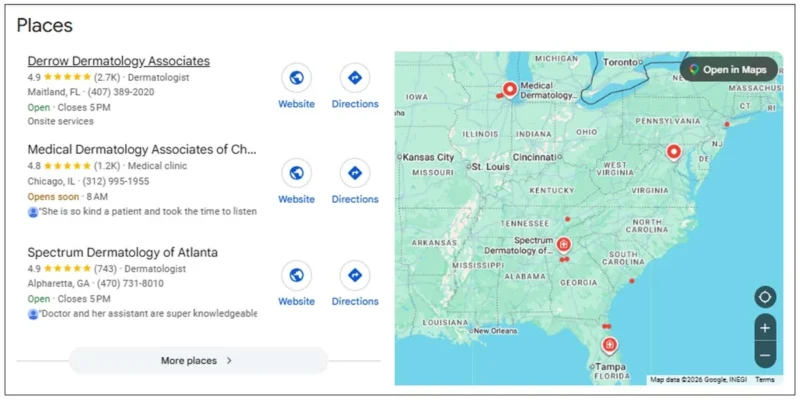
Ranking in Google’s Local 3-Pack helps more patients trust and choose your clinic.
Showing up in Google’s Local 3-Pack results puts your clinic right in front of the patients.. To give you this prime spot, Google checks your online reputation and trust.
To help your clinic win these top spots, focus on these areas:
| Local 3-Pack | Why It Matters |
| Patient reviews | High ratings prove your practice is reliable. |
| Medical citations | Listings in healthcare directories show your business is real. |
| Backlinks | Links from other reputable websites show your expertise. |
| Online visibility | Consistent information across the internet builds trust. |
Getting regular patient reviews, keeping your clinic details correct, and sharing helpful medical articles will build your online trust. This helps your practice show up in the Local 3-Pack.
| 💡 Key Takeaway: Google rewards medical practices that are relevant, close by, and trusted. These are the exact same things patients look for when they choose a doctor. |
Some Additional SEO Rules for Doctors
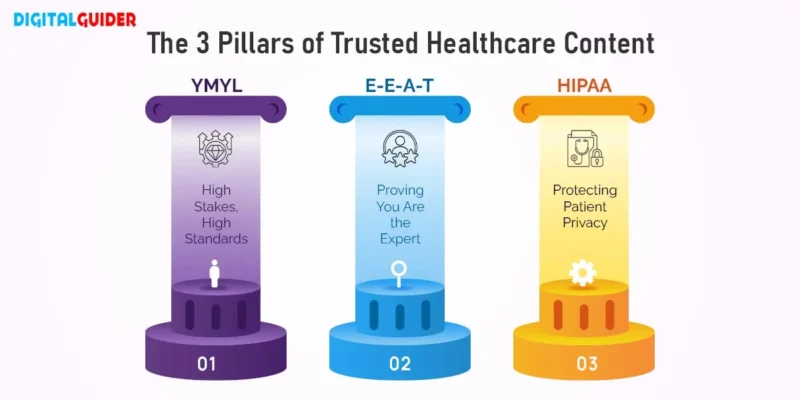
Three rules make local seo for doctors safe, trusted, and privacy-compliant
Local SEO for doctors is different from ranking a small business or restaurant.
Since it affects their well-being, Google demands high quality, accuracy, and trust from medical websites. To rank safely, your execution of a Local SEO Strategy for Doctors must follow three strict rules.
In healthcare SEO, visibility gets you noticed, but trust is what wins the patient.
1. YMYL: High Stakes, High Standards
YMYL (Your Money or Your Life) is a Google category for health content that directly impacts well-being. Bad advice causes real harm, so Google double-checks your pages before patients see them.
To win Google’s trust, your site must provide
Perfect Accuracy
✓ Match content with current medical standards and guidelines.
Qualified Authors
✓ Ensure doctors or licensed professionals write or review the text.
Trusted Sources
✓ Back up your health claims with links to official studies.
Fresh Updates
✓ Regular updates for pages as medical facts change.
Your health blog about symptoms or treatments is an extension of your medical license. It shapes how patients make real health decisions.
2. E-E-A-T: Proving You Are the Expert
Google uses a scorecard called E-E-A-T to check if your content is reliable. For doctors, this is vital. Patients must know you are a qualified expert they can trust with their health.
How to Build E-E-A-T Score:
| 🩺 Experience | 🎓 Expertise |
| Show your daily clinical work and patient care. | Highlight medical qualifications, board certifications, and specialty. |
| 🏥 Authoritativeness | 🔒 Trustworthiness |
| List your hospital affiliations, medical memberships, publications, and recognition. | Keep your clinic information accurate and display real patient reviews. |
3. HIPAA: Protecting Patient Privacy
Local SEO brings patients to your clinic, but your online marketing must always protect patient privacy. You need to be helpful online without sharing private health details.
Even a friendly reply can break the law if it confirms someone is a patient or mentions medical issues.
The Wrong Way vs. The Right Way
❌ Not HIPAA-compliant: Thank you for visiting us for your knee surgery. We hope your recovery goes well!”
(This breaks privacy rules by sharing their treatment.)
✅ The Compliant Way: “Thank you for your feedback. We appreciate your words and aim to provide excellent care to everyone.”
| Quick HIPAA Guidelines for SEO 1. Review replies: Never confirm someone is a patient. Keep responses general. 2. Patient stories: Only post stories if the patient signs a formal form. 3. Website tracking: Ensure appointment forms and tracking tools keep details safe. |
Common SEO Mistakes Doctors Make
Even the best doctors can miss new patients if their medical SEO strategy and online profiles have hidden errors. Small website errors can stop your clinic from showing up on Google.
These problems are easy to fix once you find them.
Mistake #1: Missing Doctor Credentials
Healthcare SEO depends entirely on trust. Google and patients need clear proof that qualified professionals run your practice.
Your doctor profiles should show: Medical degrees and licenses.
🔹Board certifications and specialties.
🔹Hospital roles and experience.
🔹Medical group memberships
Mistake #2: Putting All Services on One Page
A single page for all services can hide your clinic from patient searches. People rarely search for general terms like “medical services.” Instead, they search for specific treatments and conditions.
Create separate pages for:
🔹Individual treatments and procedures.
🔹Medical conditions you treat.
🔹Specific specialties and services.
Mistake #3: Overlooking Patient Reviews
Online reviews affect both Google ranks and patient choices. A clinic with regular positive reviews builds quick trust. Improve your reviews by:
🔹Asking happy patients to share feedback.
🔹Answering all reviews politely.
🔹Do not share private health details.
Mistake #4: Slow Mobile Website
Most patients search for doctors on their phones. A fast mobile-friendly website creates a better experience that encourages more patient inquiries.
A good phone website must include:
🔹Fast loading speeds.
🔹Easy appointment buttons.
🔹Clear phone numbers and addresses.
🔹Simple menus.
Mistake #5: Missing Website Schema Code
Website code helps Google read key details about your clinic. Without it, Google might miss information that helps you rank higher.
In medical SEO, this code highlights:
🔹Your medical specialty
🔹Doctor backgrounds
🔹Office locations
🔹Patient reviews
🔹Frequently Asked Questions (FAQs)
| 💡 Key Takeaway: Most medical SEO fails because your website hides your skills from Google and patients. Fix your online presence to transform web searchers into real appointments. |
Google Performance Doctors Should Track
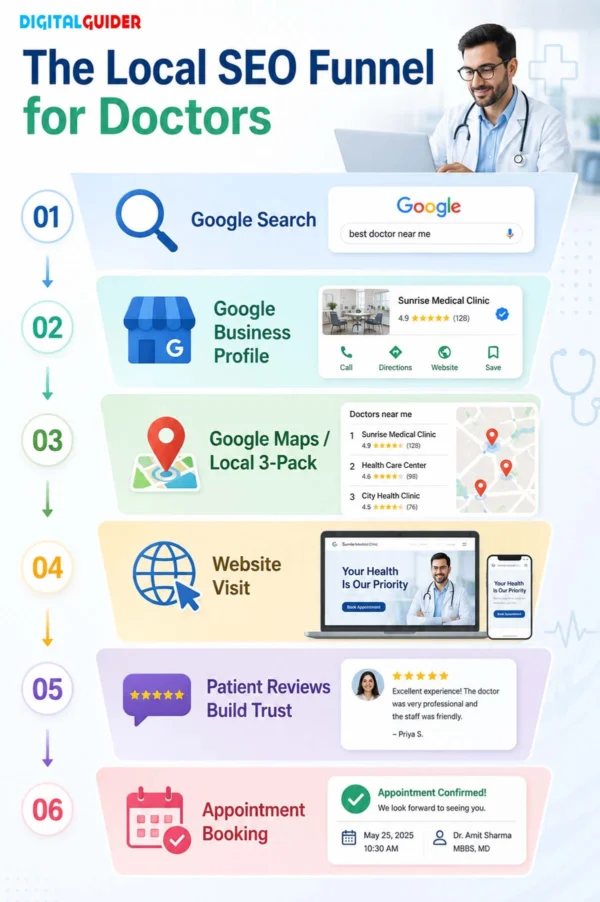
A step-by-step look at how local SEO helps patients find your clinic, trust your doctors and book appointments. (Created with AI)
A good local SEO strategy brings real patients to your clinic. Checking your data shows you exactly what works and what needs a fix.
Watch these five main details:
☐ Local Rankings ➔ See where you show up when people search for care near them.
☐ Organic Traffic ➔ Count the visitors finding your website through Google.
☐ Profile Insights ➔ Track your direct calls, map directions, and clicks.
☐ New Inquiries ➔ Measure phone calls and online appointment forms.
☐ Patient Reviews ➔ Track your overall rating and new reviews..
| 💡 Pro Tip: Good medical SEO takes time and effort. Stop worrying only about search ranks. Measure your success by counting real patient calls, booked appointments and clinic growth. |
Book More Patient Appointments Today
Ranking high on Google means the right patients find you the moment they need care.
To win, you must blend a sharp Google profile, local web content, accurate listings and positive reviews.
Local SEO for doctors requires technical skills, privacy compliance, and trust. DigitalGuider can help you:
- Rank higher: Put your clinic at the top of local search results.
- Improve your profile: Make your Google Business Profile attract more patients.
- Get custom plans: Create marketing strategies built around your goals.
- Stay safe: Keep your marketing legal and protect patient privacy.
Ready to make your clinic the top choice in town? Partner with DigitalGuider today to master local SEO for doctors, upgrade your digital presence and fill your schedule with new patients
Local SEO for Doctors Key Questions
1. How long does it take local SEO to show results?
It takes time. You might see changes in a few months, but staying at the top requires regular updates.
2. Should doctors hire an SEO agency or handle it themselves?
You can update your own profile. However, an agency like Digital Guider saves time by handling complex website code, writing and privacy laws.
3. What keywords should I target for local SEO?
Use phrases patients type when they need care, like “[specialty] near me” or “best [doctor type] in [city].”
4. What should I do if my practice moves to a new address?
Update your address on your Google Business Profile and medical directories immediately. Conflicting address data drops your Google rank.
5. Do negative reviews hurt my local medical rankings?
Not always, but ignoring them does. Respond to all reviews professionally and privately without sharing any health details.
6. Does voice search affect how patients find my clinic?
Yes. Patients speak naturally to Siri or Google Assistant. Your site must use conversational phrases to match these spoken searches.
7. Will AI search overviews affect how patients find our practice locally?
Yes. AI pulls answers from complete, highly accurate profiles. Sites with poor reviews or thin content will lose traffic.
8. How can I test if my website is actually slow on mobile phones?
Paste your website link into the free Google PageSpeed Insights tool. It shows your exact speed score instantly.
9. Does blogging help local SEO?
Yes. Answering basic patient health questions builds local website traffic and authority.
10. What are medical citation directories and which ones matter most?
They are online medical phonebooks. The most important ones are WebMD, Healthgrades, Vitals, and Zocdoc.
Thanks For Reading!
Share This Article
About the Author: Carlos Ruiz

Related Articles
 July 20th, 2026 | 5 minutes read
Every day, people search for dispensaries, CBD products, cannabis delivery, and answers to cannabis-related questions. If your business isn't appearing
- July 13th, 2026 | 5 minutes read
Ever searched "best cannabis SEO agency" and ended up opening ten different tabs that all say the same thing? Yeah,
- July 9th, 2026 | 9 minutes read
SEO can often feel like a marathon without an end goal. You are constantly tweaking minor codes, creating endless keyword
- July 6th, 2026 | 13 minutes read
Let’s be honest, running a business in Columbus in 2026 is not the same as it used to be. Our