SEO can often feel like a marathon without an end goal. You are constantly tweaking minor codes, creating endless keyword lists and fixing website errors , still your traffic barely increases. I know how exhausting it can be to put in so many efforts and still get almost no returns.
You might be wondering, “What is the best way to grow my website?”.
What if the secret is not to work more, but intentionally working less?
What is the 80/20 Pareto Principle In SEO?
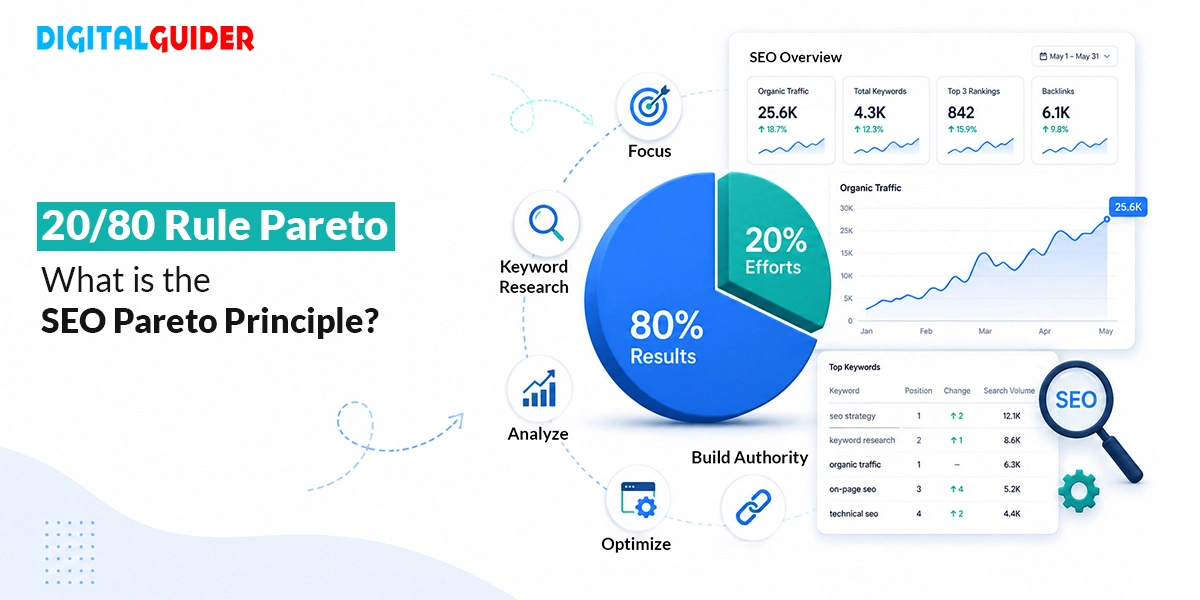
In 1906, Vilfredo Pareto, an economist, suggested a simple truth, “ 80% of your outcome depends only on 20% of your inputs.” This rule is known as Pareto Rule.
If you think about the apps on your smartphone, you will likely have dozens of applications installed. Still 80% of your screen time goes only to three to four apps.
To completely change how you approach your website you need to apply this principle onto your SEO. Here, in this blog we will help you understand how to pinpoint exactly that 20%, which will result in 80% growth of your website.
How To Identify 20% That Drives 80% Of The SEO Results?
To find 20% that holds real value for your website you need to stop chasing numbers. All types of website traffic do not hold equal value. In a real life scenario, from 1000 visitors who glance at your website, not more than 50 visitors actually sign up or buy your product. To identify this segment of customers you can use tools such as Google Analytics or Google Search Console. Through this, you can find out specific pages that generate actual leads or sales.
If we look at the example of a local bookstore, we might find thousands of different books, but only a handful of bestsellers. Only such books are displayed on the main windows, as they bring their actual daily revenue.
In SEO, your “bestsellers” are the pages of your website that target high intent keywords. You need to identify these pages and double down on them to make 80/20 Pareto Rule actually work on your website.
Old SEO Vs New SEO: Why 80/20 Pareto Rule Prioritizes Change?
Earlier, SEO was a predictable checklist. You only needed to stuff a few keywords within your text, buy a few cheap links and watch your rankings climb higher. This was a tedious task but it worked. Today, SEO has changed 360°. Constant core updates and AI Overviews have changed the way SEO used to run.
The 80/20 Pareto rule is your escape route. It helps you shift from the old mindset of “do as much as possible” to the new mindset of “do what actually works.”
Let us try to understand a clear difference between Old SEO and New SEO:
| Feature | Old SEO (The 80% Wasted Effort) | New SEO (The 20% That Works) |
| The Main Goal | Massive Volume: Writing dozens of quick, thin pages and hoping for the best. | High Quality: Creating only a few deep, helpful pages that build real trust. |
| Picking Keywords | Using High Volume Keywords: Targeting general words just because lots of people search them. | Solving Real Problems: Targeting specific words used by people who are ready to buy. |
| Writing Style | Copying Others: Rewriting what is already written on Google and using boring, repetitive text. | Fresh Ideas(Information Gain): Sharing your own unique knowledge and real world experiences. |
| Site Cleanup | Building Junk Pages: Keeping thousands of old, useless pages on your website. | Keeping It Clean: Focusing only on a small group of highly expert pages. |
| What You Track | Chasing Numbers: Counting total views, even if those visitors never buy anything. | Real Business Growth: Counting actual sales, email sign ups, and money earned. |
To put it simply, Old SEO was about quantity but the New SEO is about creating impact.
How To Apply 80/20 Pareto Principle In SEO?

Clear actionable steps to implement the 80/20 rule into your SEO calendar, helping you cut out time-wasting activities and double down on proven wins.
Till now we have understood what the 80/20 Pareto Principle is and why it works. Now is the time to know how to actually use it in SEO. Following are four major steps through which we can apply this rule to achieve our SEO goals:
1. Identifying Your Goal
Before writing a single word or creating any link, you need to know what exactly are your goals. “Getting more traffic” will get you nowhere. As per 80/20 Pareto rule, your goal needs to bring real business value, such as:
- Getting More Sales
- Earning Qualified Leads
- Increasing Newsletter Signups
To achieve these goals, you need to focus on Search Intent Alignment. This simply means to understand, “Why” a user types a word on Google. Is the user looking to learn something? or Are they ready to instantly buy a product or service?
- Low Value Keywords(The 80%): If the user searches for a term like “shoes”, they might just be looking for pictures.
- High Value Keywords(The 20%): If the user searches, “buy men’s waterproof running shoes size 10”, they are ready to buy at this moment.
Ways To Identify Your Goal
Using tools like Google Keyword Planner will help you identify and target high intent keywords. You need to focus only on those keywords which the user requires to take real action. This will instantly help your business.
2. Filtering Out 80% That Lowers Value
To focus on 20% that helps you win, first you need to identify and cut 80% of tasks. To put it simply, if a task does not help you gain high quality leads or sales, you need to cut it.
Following are the top three tasks where you might be wasting your time and they need to be cut immediately:
- Overthinking About Meta Descriptions: Google frequently rewrites meta descriptions. Therefore, spending hours on creating it will not improve your rankings on Google SERP. You need to utilize your time on building great content.
- Publishing Thin Content: Writing short or rushed articles just to stay active will lead you nowhere. Google values pages which are deep and brings value instead of hundreds of weak, filler posts.
- Chasing Links: You do not need to buy hundreds of cheap and random backlinks. Instead of promoting, they will penalize your website. You need to create a quality backlink from a trusted and relevant website which is worth more than a thousand spammy ones.
3. Focusing on 20% That Bring Real Results
After filtering 80% of your tasks, now is the time to focus on 20% that will bring actual value. If you are a business owner, you need to know the “Vital 20% of SEO” which are stated as follows:
- Upgrading your best pages: Writing and posting ten “new” average blog posts is an Old SEO strategy. Instead you need to identify one page and create topical authority of that page to get visitors. You can take fresh pictures, add helpful videos or a FAQ section to do this.
- Giving Customers what they want: You need to analyse what Google shows about your service in SERP. If customers are actively searching for a service like AC repair, you do not need to write a 3000 word blog. Give them quick and direct answers.
- Making your website fast and Phone Friendly: You need to make sure your website loads instantly on a smartphone. If your website takes too long to load, customers will leave even before finding your service.
- Making “Contact Us” And “Buy Now” Pages Easily Available: You need to find the most popular pages on your website and add clickable links that go directly to your “Contact Us” or “Buy Now” pages. This is one of the easiest tricks.
4. Continuing to Optimise and Tweak For Maximum Impact
Applying 80/20 Pareto Rule is not a one time action but it is a habit. After identifying 20% of your website driving real results you need to continue working on it. Marketing expert Seth Godin explains this perfectly with a simple story:
“A woodpecker can tap twenty times on a thousand trees and get nowhere, but stay busy. Or he can tap twenty thousand times on one tree and get dinner.”
Same is the case with SEO. Many business owners focus on thousands of different tasks like random posting, changing colours and building thousands of random backlinks but this gets them nowhere. To create maximum impact, you need to find only “one tree”(your high performing pages) and continue to work upon them.
How To Apply Pareto Principle In SEO Content?

Learn to separate high-leverage strategic content that creates compounding value from low-leverage tasks that belong in the deprioritized pile.
Modern Google search engines will not care how many articles you publish weekly. As AI search is growing, Google now rewards content that brings true value instead of large volume. To develop content strategy, applying the 80/20 Pareto rule will be the best call. This will help you to redirect your energy towards pages that drive real growth.
Prioritizing Actions On High Leverage Content
High leverage content consists of pages with specific services or products that target buyers who are ready to buy at the very moment. For the maximum return you need to focus on:
- Targeting Specific Pain Points: You need to target keywords that address a customer’s actual problems. Even if the people who are searching for them are few. Promising customers are worth more than a traffic of thousand random shoppers.
- Bringing Unique Value: Google always rewards fresh and original insights. You need to add your real world experience, actual photos and transparent pricing. One high expert page will generate better results than 50 AI generated articles.
Deprioritizing Actions On Low Leverage Content
Low leverage content is the content that does not provide users any value and has minimum traffic. If you want to stop it from lowering the authority of your website you need to:
- Quality Over Weekly Posting: Do not write basic, boring articles just to complete your weekly posting quota.
- Protect Your Website’s Reputation: Publishing hundreds of weak pages will lower your website’s authority and be a waste of your time.
Common Mistakes When Using the 80/20 Rule
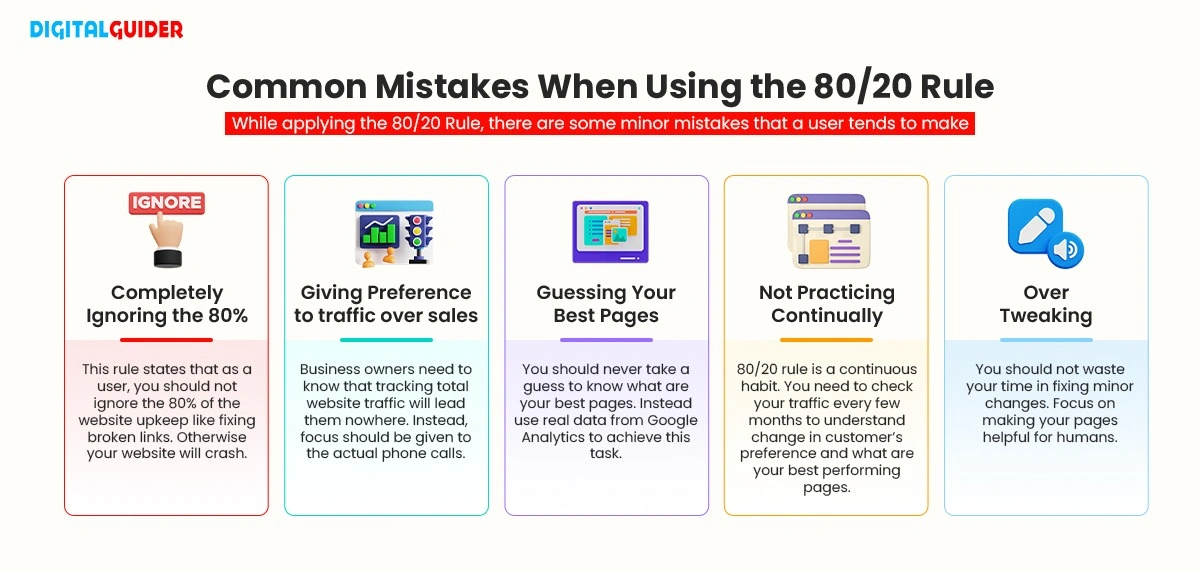
Keep an eye out for these five common optimization mistakes to ensure your website remains technical stable while prioritizing sales conversions.
While applying the 80/20 Rule, there are some minor mistakes that a user tends to make:
Completely Ignoring the 80% : This rule states that as a user, you should not ignore the 80% of the website upkeep like fixing broken links. Otherwise your website will crash.
Giving Preference to traffic over sales: Business owners need to know that tracking total website traffic will lead them nowhere. Instead, focus should be given to the actual phone calls.
Guessing Your Best Pages: You should never take a guess to know what are your best pages. Instead use real data from Google Analytics to achieve this task.
Not Practicing Continually: 80/20 rule is a continuous habit. You need to check your traffic every few months to understand change in customer’s preference and what are your best performing pages.
Over Tweaking: You should not waste your time in fixing minor changes. Focus on making your pages helpful for humans.
Future of SEO and the 80/20 Pareto Rule
As the AI search engine is rising, rules of the internet are changing fast. Google’s AI Overviews do not go through thousands of pages. It finds information from highly trusted sources to summarise direct answers for the user. The practice of publishing new posts daily is of no use right now.
In the upcoming future, actual winners of Google SERP would be those who create few but impactful and deeper pages. To get your website page to AI overview you quality of content should be precise and it needs to answer for a specific problem. By dropping 80% of thin and repetitive content you will be able to invest your time in the 20% of content that AI engines will actually trust and cite.
Conclusion
You need to stop wasting your budget on creating thin content and bring unnecessary traffic to your website. DigitalGuider is here to fix your SEO for you.
Our experts use a smart 80/20 approach instead of chasing numbers. Our experts only focus on the top keywords that will actually turn your traffic into paying customers. Whether you are a B2B, SaaS, or enterprise brand, DigitalGuider delivers results to take your annual turnover to the next level.
Connect with us to start growing your real revenue today!
Frequently Asked Questions
1. What is the 80/20 rule in SEO?
SEO Pareto Principle(or 80/20 rule) means 80% of your blog’s traffic comes from only 20% of the content. Instead of fixing everything at once, you need to focus on high impact keywords. This will help you bring real results.
2. What is the way I can find my top performing blog?
You can easily find your “vital 20%” pages using Google Search Console. You need to look at the data of traffic over 90 days and find the page that currently rank on page one or two. Upgrading these pages is the best way to boost traffic.
3. Why does Google ignore my shorter blog posts?
Google ignores “thin content” because it does not give readers unique value. To fix this, you will need to delete your low value pages or update them with deep information so that Google can focus on your best content.
4. How does DigitalGuider apply the 80/20 rule to grow my business?
DigitalGuider will identify the critical 20% of money keywords that have high buying intent for your business, instead of wasting your money on low value keywords. Their experts will fix your thin content and clear all of the technical issues to drive real growth and revenue.
5. How do I optimize my blog for AI search engines?
Traditional SEO focuses on Google links but AI Search (like Gemini and Perplexity) provides direct answers. You need to format your content with clear Q&A sections, data tables and bullet points. In 2026, AI will prefer clear and authoritative answers over repeated keywords.
Share This Article
About the Author: Victor Laurent

Related Articles
 October 5th, 2026 | 7 minutes read
“Why isn’t my law firm showing up when potential clients search for an attorney?” Imagine, as a law firm owner,
- October 1st, 2026 | 8 minutes read
Growing your business online sounds simple until you see how many marketing options there are. SEO? Social media? Paid ads?
- September 28th, 2026 | 9 minutes read
Chicago businesses don’t all compete in the same way. A local restaurant in River North, a growing company in Fulton
- September 21st, 2026 | 8 minutes read
Someone nearby is searching for a cannabis dispensary right now. They may want a specific strain, need to check store