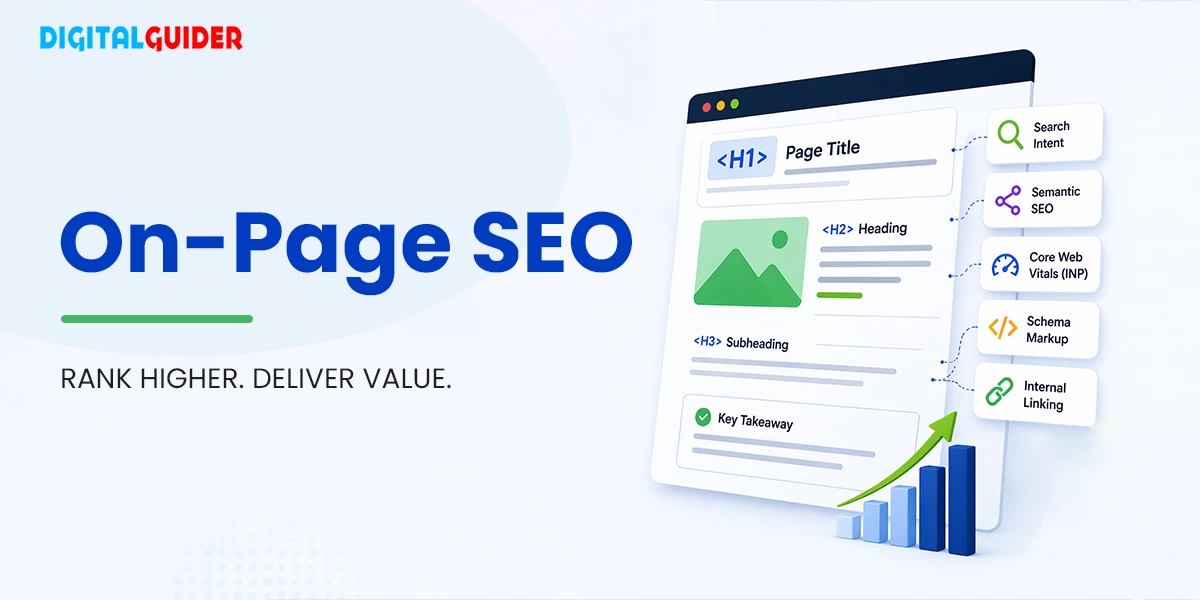
Synopsis On-page SEO is how you tell Google and your readers, exactly what your page is about. Get it right and your content ranks. Get it wrong and even your best work stays invisible. Here's everything you need to know.
In this blog, you will learn:
- What is on-page SEO?
- Why on-page SEO matters
- The three elements of on-page SEO
- Content elements
- HTML elements
- Site architecture elements
- The 80/20 rule of SEO
- On-page SEO vs. off-page SEO
- Frequently asked questions
What is on-page SEO?
On-page SEO is the practice of optimizing individual web pages so they rank higher on Google’s search engine results page (SERP) and attract the right visitors. It covers everything you directly control on the page itself – the quality and structure of your content, the HTML signals you send to search engines, and the technical experience you deliver to users.
Think of it in three layers: what you say (content), how you label it (HTML elements like title tags, meta descriptions, and heading structure), and how it’s built (site architecture, page speed, mobile responsiveness).
Unlike off-page SEO which depends on third parties linking to you, on-page SEO is entirely within your control. That makes it the logical starting point for any SEO strategy.
Search intent comes first
Before optimizing any element on your page, establish what type of search intent you’re serving – informational, navigational, commercial, or transactional. Every on-page decision flows from that.
Why on-page SEO matters
Imagine writing your best book ever – but leaving the cover completely blank. The story inside is outstanding, but no one picks it up because there’s nothing to tell them what it’s about. That’s your website without on-page SEO.
For a Web Page, on-page SEO primarily decides the title (H1), summary (meta description), and index (table of contents). This helps to cover the gap between your website and search engines.
If your on-page SEO is done correctly, then it will help search engines to understand what you want to show the users when they visit your webpage. In this way, the Google search engine will be able to decide whether your webpage matches the search intent of a user or not.
What are the elements of On-Page SEO?
There are three main categories under which we can group On Page SEO elements:
- Content Elements
- HTML Elements
- Site Architecture Elements
| ✍️ Content Elements | 🏷️HTML Elements | 🏗️ Site Architecture Elements |
| The quality, relevance, and structure of what you actually write is the core of any page Google will rank. | The tags and labels that tell search engines what your page is about title tags, meta descriptions, headings, alt text. | URL structure, internal linking, page speed, Core Web Vitals, and mobile-friendliness the foundation your content sits on. |
Content elements
Content is the soul of your website page. Without great content, no amount of On Page optimization will engage users on the website. Engagement of the users and the quality of the content decides its ranking on website pages.
Quality and genuine information gain
Your content needs to be accurate, clear, and genuinely useful but in 2026, “useful” has a higher bar. Google rewards content that adds information gain: original insights, specific examples, unique data, or a perspective that isn’t already covered by the top-ranking pages. Rehashing what’s already there is no longer enough.
Keyword Optimisation
Your target keywords or phrases are needed to be placed naturally. Placement of keywords should be such that it is “contextual” and “not forced”. Users should be tempted to click on the keyword to learn about the subject in detail. “Stuffing of keywords” must be avoided.
Stuffing vs. placement
Keyword stuffing means forcing your target term into every third sentence regardless of context. Natural placement means using the keyword where a reader would expect to find it — and using semantically related terms everywhere else.
Topical authority and semantic SEO
Modern Google doesn’t just look at individual pages it evaluates whether your site demonstrates topical authority across a subject. That means covering related subtopics, using semantically connected terms, and building a content cluster that signals depth of expertise. Semantic SEO means structuring your content around real concepts and entities not just exact-match keywords and that’s how competitive rankings are actually won today.
Search Intent should be specific
Your content needs to align perfectly with the requirements of the users. The content needs to focus on a particular intent so that it can cater to that audience. There are primarily four types of intent, that you need to focus upon:
- Analysing Competitors(Commercial Intent)
- Learning Concepts(Informational Intent)
- Finding Specific Websites(Navigational Intent)
- Buying A New Product(Transactional Intent)
The framework of the content for all of these intents will be different based upon the content that they are covering.
EEAT signals in content
Demonstrate Experience (first-hand knowledge), Expertise (depth and accuracy), Authoritativeness (citations, credentials), and Trustworthiness (transparency, accuracy). These signals increasingly influence how Google evaluates and ranks content.
HTML elements
Elements that tell search engines what your page is about are called HTML elements. These are quite useful to give a complete picture of the subject that you are covering in the web page.
Following are the HTML elements that you can easily optimise in your website page:
Title tags
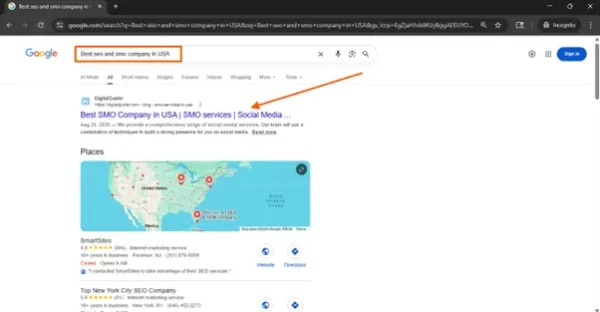
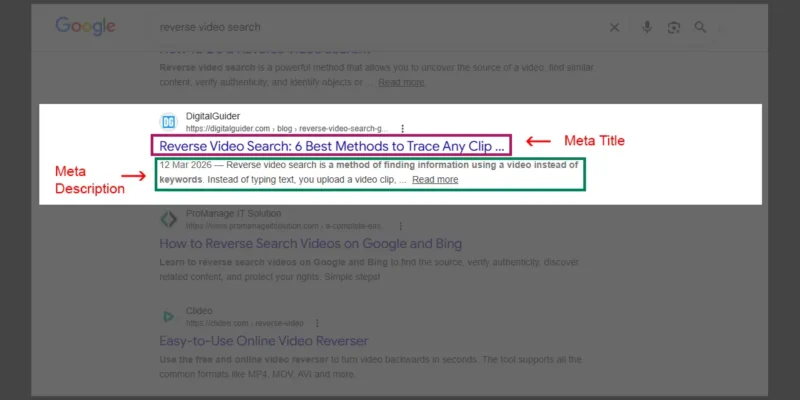
Blue headlines that appear on Google’s Search Engine Results page are the Meta title. Meta titles need to be catchy, precise and consist of your main keyword.
Meta Description
Short summary text that appears below title tags is known as meta description. Meta description has to be precise and encouraging just like an advertisement, to make users click on your page.
Heading tags (H1, H2, H3)
Headings break your content into digestible chunks for the readers. There are three heading tags that you need to be aware of:
-H1 Tag: Main title of your page. There is only one H1 tag on a webpage.
-H2 & H3 Tags: These are the subheadings that organize your ideas and make it easy for both humans and search engines to understand your intent.
-Image Optimisation(Alt Text): Search engines do not have the capacity to analyse an image just like humans. Alt text(alternative text), provides text description of the image. Through alt text, Google understands the image and also helps visually impaired individuals to understand the context of the image.
Schema markup
Schema markup is structured data you add to your HTML to give Google explicit, machine-readable information about your page. FAQ schema can earn accordion-style rich results. Article schema helps Google classify your content type.
LocalBusiness schema (for eligible businesses) supports map pack appearances. Schema doesn’t guarantee rich results, but it meaningfully increases your eligibility for them.
Structural Elements
Let us now dive into some of the elements that decide the structure of your page. These elements are also responsible for connecting your page with the rest of your website.
URL Structure
URL(Uniform Resource Locator) is the web address of your page. URLs should be simple and to the point. In this way, they will serve their purpose for users and search engines.
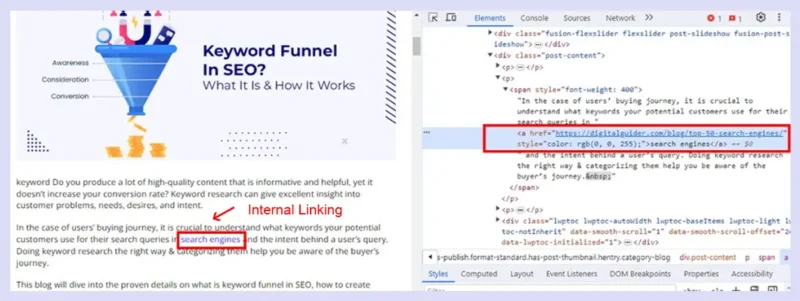
Internal Linking
Internal linking within your website page plays a prominent role as it helps Google to find your content faster. It also guides readers to go through other helpful articles.
Mobile responsiveness
Nowadays, websites are mostly accessed through smartphones. Google also promotes those websites which are easy to access on small screens.
Core Web Vitals
Core Web Vitals are Google’s three page experience metrics:
- Largest Contentful Paint (LCP – how fast your main content loads)
- Interaction to Next Paint (INP – responsiveness to user input)
- Cumulative Layout Shift (CLS – visual stability)
Poor scores here create a measurable drag on rankings, particularly in competitive markets. Use Google’s PageSpeed Insights to audit and address each one.
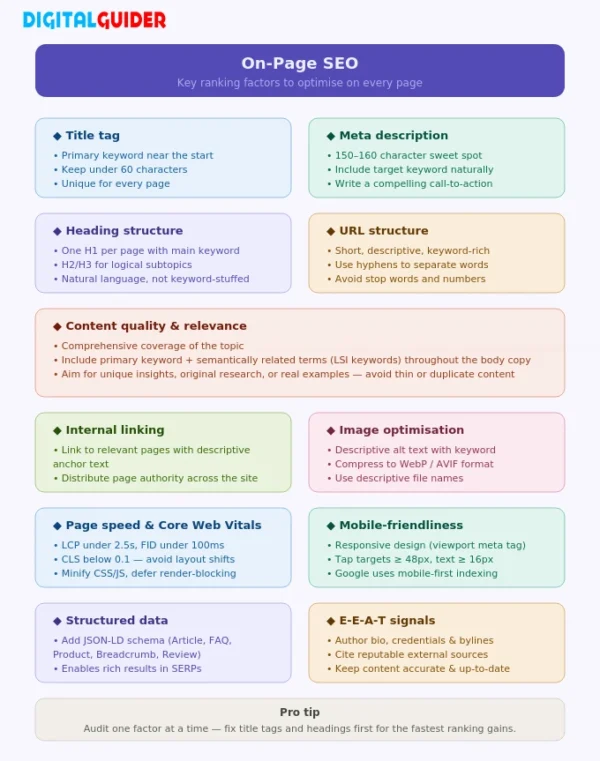
This is the image showing factors of On-page SEO
What is the 80-20 rule of SEO?
The 80/20 rule in SEO means that 20% of your focused efforts on “vital factors” will translate into generating 80% of your organic traffic. You do not need to optimise every single page of your website. You need to focus upon following factors:
- Identifying top performing pages and high intent keywords.
- Focus on keeping content up to date.
- Technical fixes and internal linking strategies.
By focusing on these few points your SEO results can be maximised and you can attain sustainable growth in online business.
What is the difference between On Page SEO and Off Page SEO?
Before diving into the difference between On Page SEO and Off Page SEO, let us try to understand the difference by the example of a physical store:
On Page SEO is every change that you make inside your store like organizing shelves, offering quality products and putting up clear signs.
Off Page SEO are the things that happen outside your store like people recommending your shop to friends, building strong reputation in the neighborhood and getting listed in local directory.
Here is a clear breakdown of the main differences:
| Feature | On-Page SEO | Off-Page SEO |
|---|---|---|
| Definition | Actions taken directly on your website to improve SERP visibility | Actions taken outside your website to build authority and trust |
| Primary focus | High-quality, intent-matched content and correct technical elements | Earning quality backlinks and building brand authority |
| Key tactics | Title tags, meta descriptions, heading structure, keyword optimization, schema markup, Core Web Vitals | Link building, guest posting, Google Business Profile optimization, community engagement, brand mentions |
| Control level | High – you control 100% of what’s on your own site | Low to medium – depends on third parties linking to or mentioning you |
| Best used for | Foundation of every SEO campaign; required before off-page work pays off | Ranking for competitive terms where content quality alone isn’t enough |
Frequently asked questions
1. What are the 3 C’s of SEO?
Content, Code, and Credibility – the three foundational pillars of SEO. Content covers relevance, depth, and quality. Code covers technical correctness, structured data (schema markup), and page performance. Credibility covers trust signals like backlinks, EEAT indicators, and brand authority. Strong SEO requires all three working together.
2. What is the 3-3-3 rule in SEO?
The 3-3-3 rule is a content focus framework: concentrate on 3 core messages, 3 primary platforms, and 3 target audience segments. The principle recognizes that in an era of shrinking attention spans, clarity and focus outperform saying things to everyone. Applied to on-page SEO, it reinforces the value of focus on content over broad, shallow coverage.
3. What are the four types of SEO?
The four main types are On-Page SEO, Off-Page SEO, Technical SEO, and Local SEO. On-page covers content quality, keyword optimization, heading structure, and HTML elements. Off-page covers link building and brand authority. Technical SEO addresses site performance, schema markup, and crawlability. Local SEO focuses on Google Business Profile optimization, map pack rankings, and location-based search visibility.
4. Do meta descriptions impact ranking?
Meta descriptions don’t directly influence rankings – Google has confirmed this. However, they significantly affect click-through rate. A compelling meta description that matches the user’s search intent draws more clicks, which can indirectly support rankings over time by signaling relevance and engagement. Write them for humans first, algorithms second.
5. Is on-page SEO more important than off-page SEO?
Neither should be prioritized to over other, as they work in sync. On-page SEO ensures your content is high quality and matches search intent on the other hand, Off-page SEO builds the authority and trust that help you compete for high-volume keywords. Think of on-page SEO as the prerequisite, it needs to be solid before off-page efforts deliver their full return.
Share This Article
About the Author: Lucia Ferrer

Related Articles
 October 12th, 2026 | 6 minutes read
Imagine someone needs a lawyer today. What do they do? They pull out their phone, search Google, compare a few
 October 5th, 2026 | 7 minutes read
“Why isn’t my law firm showing up when potential clients search for an attorney?” Imagine, as a law firm owner,
- October 1st, 2026 | 8 minutes read
Growing your business online sounds simple until you see how many marketing options there are. SEO? Social media? Paid ads?
- September 28th, 2026 | 9 minutes read
Chicago businesses don’t all compete in the same way. A local restaurant in River North, a growing company in Fulton