Synopsis SEO competitor analysis is crucial for staying ahead in the digital landscape. In this blog, we discuss various SEO competitor analysis tools that help businesses track and learn from their rivals to refine their strategies. The importance of competitor analysis is illustrated through the downfall of Blackberry, which failed to adapt to market changes.Tools like SEMrush, Ahrefs, Moz Pro, SparkToro, BuzzSumo, and others offer insights into keyword rankings, backlink profiles, audience behavior, and content performance. Investing in these tools allows businesses to identify opportunities, benchmark performance, and make data-driven decisions to boost organic traffic and revenue.
In one of our previous blog, we extensively discussed SEO competitor analysis and how to conduct it.
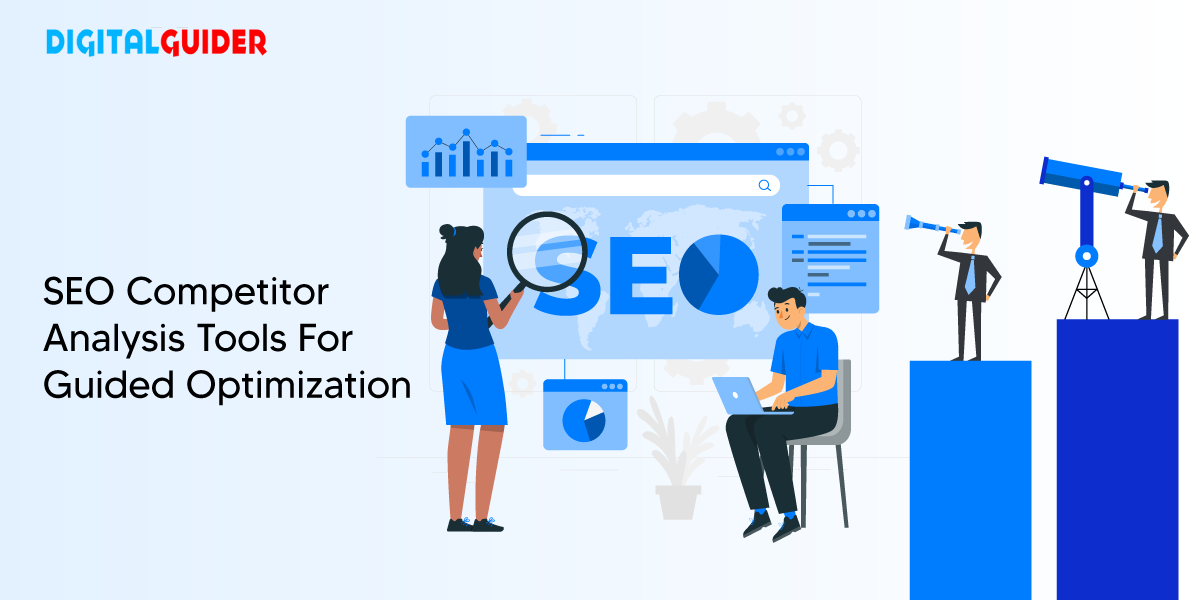
Today, we will discuss SEO competitor analysis tools the world uses to drive inspiration from their competitors to stay relevant in this competitive online world. Before that, let me give you a quick feeler for a deeper connection to this blog.
When was the last time you exchanged a BBM PIN with somebody? Yes, that Blackberry messenger PIN. If you’ve ever been a Blackberry mobile phone user, you know the pain of not being able to use it anymore. Well, because its competitors overpowered it in the world of cellular phones.
So what happened? Sadly, Blackberry didn’t want to upgrade to touchscreen mobiles; the rest is history! Once, an insane brand to show off waned, and Apple Inc. changed everybody’s ‘taste.’
Had BB mended its ways, it might have been the ruling company today. So this, our dear readers, is enough to learn: never underestimate your competitors and always learn from them by watching their activities. It’s okay to imitate to create!

Having said that, knowing the complexities of conducting R&D on your competitors, you can rely upon tools. Competitor analysis tools for SEO are there for your rescue. More than half of your competitive research will be executed by the tools we will now discuss.
Comparision of Best Competitor Analysis Tools for SEO
| SEO Competitor Analysis Tools — Full Comparison 2026 | |||||
| # | Tool | From (per mo) | Free? | Best for | Rating |
| 1 | Semrush All-in-one | $117 Pro plan | 7-day trial | Full competitor analysis + AI search visibility | ⭐⭐⭐⭐⭐ 9.5/10 Best Overall |
| 2 | Ahrefs Backlinks | $129Lite plan | Webmaster Tools | Backlink + content gap competitor research | ⭐⭐⭐⭐⭐ 9.2/10 Best for Backlinks |
| 3 | Moz Pro All-in-one | $99Starter plan | 30-day trial | Small businesses & beginners | ⭐⭐⭐⭐ 7.8/10 Best for Beginners |
| 4 | SparkToro Audience | $38Basic plan | 5 searches/mo | Audience & PR competitive intelligence | ⭐⭐⭐⭐ 7.5/10 Best for Audience Intel |
| 5 | BuzzSumo Content | $199Content Creation | 30-day trial | Content marketing & PR teams | ⭐⭐⭐ 7.0/10 Best for Content Teams |
| 6 | SpyFu PPC + SEO | $39Basic plan | Limited searches | PPC competitor analysis on a budget | ⭐⭐⭐⭐ 7.8/10 Best Value PPC+SEO |
| 7 | SE Ranking All-in-one | $129Essential plan | 14-day trial | Budget GEO tracking & all-in-one SEO | ⭐⭐⭐⭐ 8.2/10 Best Budget All-in-one |
| 8 | Similarweb Traffic | Contact sales~$125+ est. | Basic snapshots | Traffic intelligence & market sizing | ⭐⭐⭐⭐ 8.0/10 Best for Traffic Intel |
| 9 | Surfer SEO Content | $99Essential plan | No free plan | Content optimisation to outrank competitors | ⭐⭐⭐⭐ 8.3/10 Best for Content Optimisation |
| 10 | Majestic Backlinks | $49.99Lite plan | No free plan | Budget backlink & link quality analysis | ⭐⭐⭐ 7.2/10 Best Budget Backlinks |
Best SEO Competitor Analysis Tools
Choosing the right tool for your business can be tricky. Hence, reviewing the features of many available tools and selecting one or two per your requirements is crucial.
You might want all in one SEO tools with competitor analysis. However, we can also go for tools that have specific, unique features. Let’s dive in.
1 – SEMRUSH
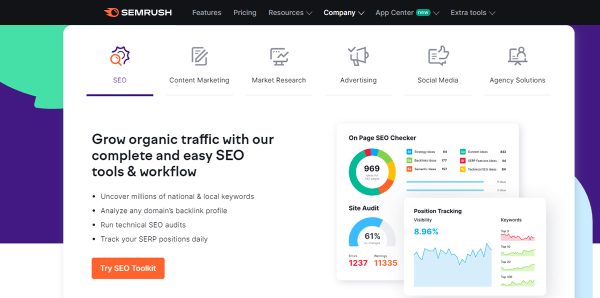
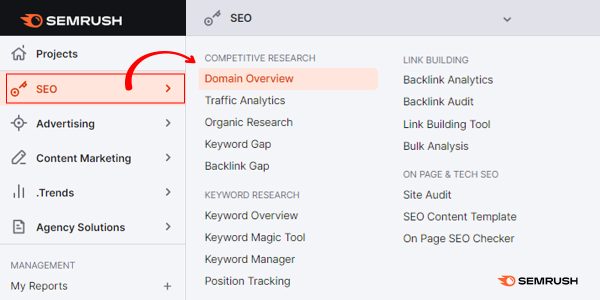
Often considered the industry leader, Semrush offers a wide range of tools for SEO, PPC, and competitor analysis. Its unique features include:
- Domain analytics: Track competitor’s website traffic, organic keywords, backlinks, keyword gap and more.
- Keyword research: Find high-volume keywords that your competitors are ranking for.
- Competitive intelligence: Track your competitors’ advertising campaigns and social media activity.
- Content marketing tools: Create and optimize content that will rank higher than your competitors.
Also read, Content Amplification Strategy
Pricing: Starts at $139.95 per month.
Pros: The most complete SEO platform in 2026 with AI Copilot, GEO tracking (ChatGPT, Gemini, Perplexity), and the best keyword and backlink gap tools on the market.
Cons: Most expensive at $208/mo, steep learning curve, and key AI features are locked behind the pricier Guru plan.
Stats and facts: Over 8 million users, trusted by Forbes, Bosch, and HP.
2 – Ahrefs
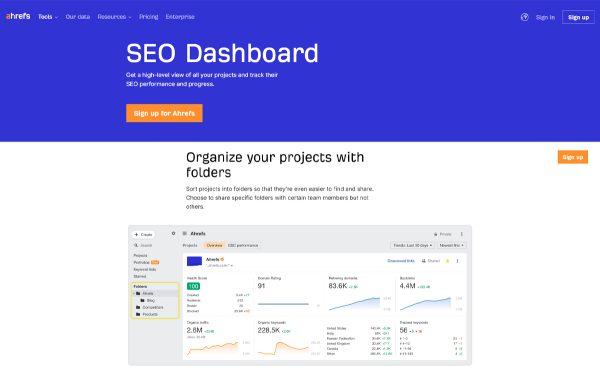
A close competitor to Semrush, Ahrefs is known for its powerful backlink analysis tools. Its unique features include:
- Backlink analysis: See which websites link to your competitors and how valuable those links are.
- Rank tracking: Track your competitor’s keyword rankings over time.
- Content Explorer: Find popular content that your competitors are linking to.
- Site audit: Identify technical SEO issues on your competitor’s website.
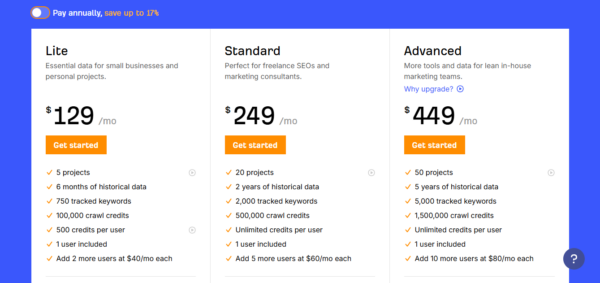
Pricing: Starts at $129 per month.
Stats and facts: Over 2 million users, trusted by Netflix, Spotify, and Deloitte.
Pros: The most accurate backlink index in the industry, excellent content gap analysis, and a built-in AI Content Helper — trusted by Netflix, Spotify, and 2M+ users.
Cons: No GEO or AI search visibility tracking yet, weak PPC data, and the interface can feel overwhelming for beginners.
Check out the video below to learn how to use Ahrefs for SEO and competitor research.
[yotuwp type=”videos” id=”_oU8lclN114″ ]3 – Moz Pro
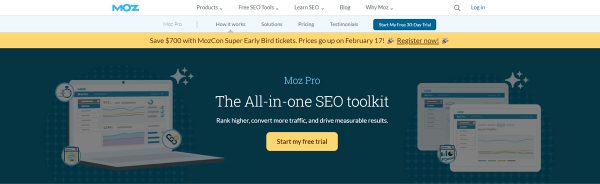
A preferred choice for beginners & small businesses, Moz Pro provides a good balance of features and affordability. Its unique features include:
- Domain authority scoring: See how authoritative your competitors’ websites are.
- Keyword research: Find high-quality keywords with low competition.
- Backlink analysis: Check out the sources of the backlinks that your competitors are using.
- On-page optimization: Get suggestions for improving your website’s on-page SEO.
Pricing: Starts at $49 per month.
Pros: The most beginner-friendly SEO tool with industry-standard Domain Authority scoring and solid backlink analysis starting at $99/mo.
Cons: Smaller database than competitors, no AI or GEO features, and slower data refresh rates across the board.
Stats and facts: Over 500,000 users, trusted by Mailchimp, Hootsuite, and SEMrush.
Read more about getting quality backlinks: How to Get Quality Backlinks?
4 – SparkToro
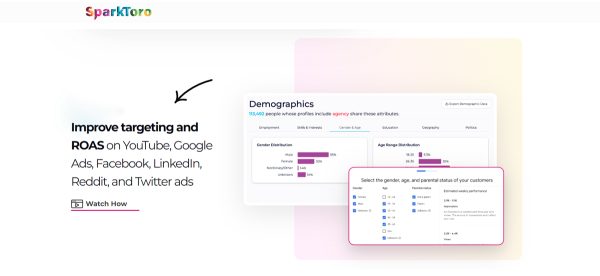
This tool focuses on competitor analysis through audience intelligence. Its unique features include:
- Competitor audience analysis: See where your competitors’ website traffic comes from.
- Influencer identification: Find influencers who are discussing your competitors.
- Content insights: See what topics and formats are performing well for your competitors.
Pricing: Starts at $50 per month.
Pros: Reveals where your competitors’ audiences hang out online — podcasts, YouTube, subreddits, and social — intelligence no traditional SEO tool provides.
Cons: No keyword, backlink, or traffic data. Works best as a supplement to a full SEO platform, not a standalone tool.
Stats and facts: Over 5,000 users, trusted by Unbounce, HubSpot, and CoSchedule.
Read more to know, 10 Ways Social Media Influencers Make Most Money
5 – BuzzSumo
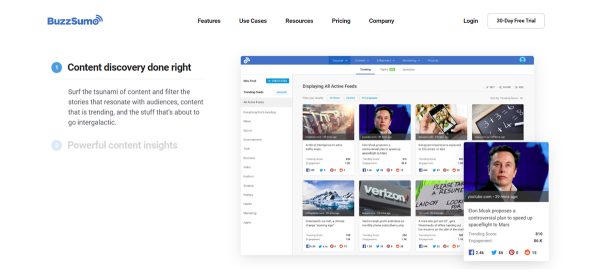
If you want to see what content is performing well for your competitors on social media, BuzzSumo is a great option. Its unique features include:
- Content discovery: Find popular content that your competitors are sharing.
- Influencer identification: Find influencers who are sharing your competitors’ content.
- Analytics: See how well your competitors’ content is performing on social media.
Pricing: Starts at $199 per month.
Pros: Best tool for finding competitor top-shared content and viral trends in real time, with influencer amplifier analysis built in.
Cons: Expensive at $199/mo for a content-only tool, no SEO or backlink data, and Twitter/X share data has become unreliable since the API changes.
Stats and facts: Over 100,000 users, trusted by BuzzFeed, National Geographic, and The Guardian.
‘Bonus tip: Competitor analysis is just one piece of the SEO puzzle. Use the insights to inform your overall strategy, not mindlessly copy your competitors.’
6 – SpyFu
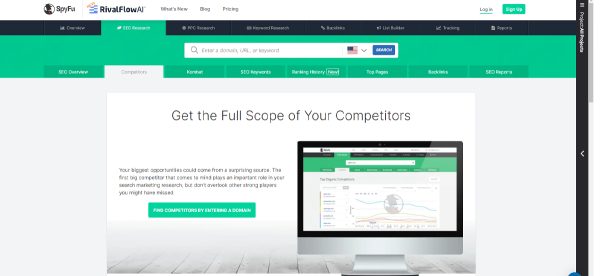
This tool is a good option for budget-conscious businesses, as it offers a limited but affordable set of features. Its unique features include:
- Historical keyword tracking: See how your competitors’ keyword rankings have changed.
- Paid keyword research: See which keywords your competitors are bidding on for PPC ads.
- Domain history: See how your competitors’ websites have changed over time.
Pricing: Starts at $39 per month.
Pros: Best value PPC + SEO combination starting at $39/mo, with SpyFu GPT for AI-powered insights and unlimited keyword downloads with no hard caps.
Cons: Smaller database than Ahrefs or Semrush, a dated interface, and no GEO or AI search visibility features.
Stats and facts: Over 100,000 users, trusted by Wix, Hootsuite, and SEMrush.
7 – SE Ranking
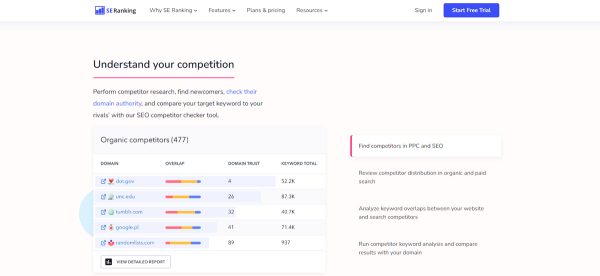
This tool offers a good value for the price, with a wide range of features for SEO and competitor analysis. Its special features include:
- Rank tracking: Track your competitor’s keyword rankings for multiple search engines.
- Website audit: Identify technical SEO issues on your competitor’s website.
- Backlink analysis: Check out the sources of the backlinks that your competitors are using.
Pricing: Starts at $129/month, scales with features. Free trial available.
Pros: The only affordable all-in-one tool with built-in GEO tracking across ChatGPT, Gemini, and Perplexity — all from just $44/mo with a clean, easy-to-use interface.
Cons: Smaller keyword database, fewer third-party integrations, and backlink data not as deep as Ahrefs.
Stats: Over 800,000 users, trusted by HP, PayPal, and Philips.
Wondering how to start a website audit, read this blog, How to Audit Your Website for SEO?
8 – Similarweb
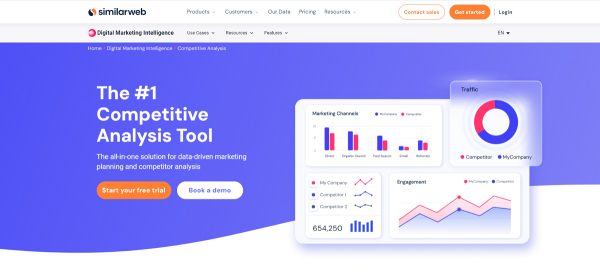
This tool analyzes website traffic, offering deep insights into your competitors’ audience and market share. Its unique features include:
- Website traffic analysis: See how much traffic your competitors get, where it comes from, and what devices they use.
- Market share analysis: See how your competitors rank in market share for your industry.
- App analytics: Analyze the performance of your competitors’ mobile apps.
Pricing: Freemium plan available, paid plans start at $249 per month.
Pros: Traffic intelligence across 1 billion+ websites with AI chatbot traffic analysis and the best market share benchmarking data available.
Cons: No public pricing, estimated data that can be inaccurate for smaller sites, and no keyword or backlink tools included.
Stats and facts: Over 2 million users, trusted by Uber, Amazon, and eBay.
9 – Surfer SEO
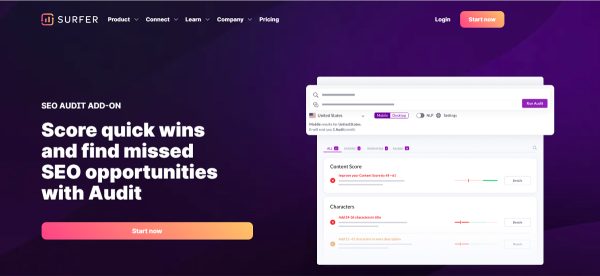
This tool focuses on on-page optimization, helping you create optimized content for search engines & users. Its unique features include:
- Content audit: Analyze your existing content and identify areas for improvement.
- Topic cluster builder: Create content clusters that target related keywords.
- Serp analysis: See how your content compares to the top-ranking pages for your target keywords.
Pricing: Starts at $119 per month.
Pros: Real-time content scoring against top SERP competitors, AI-assisted writing with live SEO feedback, and AI Overview tracking built in.
Cons: Content-only tool with no backlink or traffic data, article limits on lower plans, and AI drafts still need human editing.
Stats and facts: Over 100,000 users, trusted by Ahrefs, SEMrush, and Moz.
Read more, How To Do Keyword Research for SEO
10 – Majestic
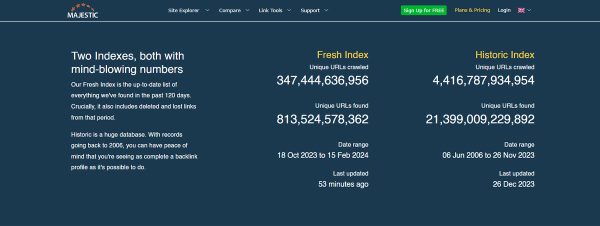
This tool is known for its strong backlink analysis capabilities, offering a unique perspective on your competitor’s link profiles. Its special features include:
- Backlink Explorer: See all the websites that link to your competitors.
- Citation flow: Analyze the quality and authority of your competitor’s backlinks.
- Historical backlink analysis: See how your competitors’ backlink profile has changed.
Pricing: Freemium plan available; paid plans start at $49.99 per month.
Pros: Most affordable dedicated backlink tool at $49.99/mo with a trillion-link index and unique Trust Flow and Citation Flow metrics for link quality analysis.
Cons: No keyword research, rank tracking, or content tools — backlink-only focus means it must be paired with a broader SEO platform.
Stats and facts: Over 2 million users, trusted by Backlinko, HubSpot, and Neil Patel.
“Tip: Remember, the best tool for you will depend on your specific needs and budget. Consider the most important features and compare pricing plans before deciding.”
Other Types of Competitor Analysis Tools
In 2026, brands use a wider range of specialised tools to monitor what competitors are doing across every digital channel — from social media and email to video content and AI-generated search results.
Social Media Management Tools: These tools track how competitors schedule, publish, and engage with their audience across platforms like Instagram, LinkedIn, and X. They reveal posting frequency, content formats, and audience response patterns that inform your own social strategy.
Social Listening & Competitor Monitoring Tools: Social listening tools monitor brand mentions, hashtags, and conversations about your competitors in real time. They help you spot emerging trends, reputation shifts, and customer sentiment before your competitors can react.
Web Analytics & Traffic Analysis Tools: Analytics tools estimate competitor website traffic, traffic sources, bounce rates, and top-performing pages. Platforms like Similarweb give you a data-driven view of how competitors attract and retain visitors without access to their private data.
AI-Powered Competitor Analysis Tools: AI tools now automate the most time-consuming parts of competitive research — clustering keyword gaps, summarising competitor content strategies, and flagging ranking shifts. In 2026, tools like Semrush Copilot and SpyFu GPT can surface actionable insights in seconds.
Content & Blog Analysis Tools: Content analysis tools identify which competitor blog posts, guides, and landing pages generate the most traffic, backlinks, and social shares. BuzzSumo and Ahrefs Content Explorer are the leading tools in this category.
Video Competitor Monitoring Tools: These tools track competitor activity on YouTube and other video platforms — including publishing frequency, view counts, top-performing topics, and audience engagement — helping you identify content gaps in video search.
Email & Ad Competitor Analysis Tools: Email intelligence tools like Mailcharts and ad monitoring platforms like AdBeat or SimilarWeb’s ad intelligence feature let you track competitor email campaigns, ad creatives, messaging strategies, and promotional timing across Google, Meta, and display networks.
GEO & AI Search Visibility Tools: A critical new category in 2026 — GEO (Generative Engine Optimisation) tools track where competitors appear in AI-generated answers on ChatGPT, Gemini, Perplexity, and Google AI Overviews. SE Ranking and Semrush’s AI Visibility Toolkit are currently the leading platforms for this type of analysis.
Why Should You Invest in SEO Competitor Analysis Tools?
SEO competitor analysis tools help US businesses understand exactly what competitors are doing to rank higher, attract more traffic, and win customers online so you can do it better.
Stay Ahead & Find New Opportunities
- Identify rising keywords and content formats early so your brand captures traffic before the competition catches on.
- Discover high-volume search terms your competitors are ignoring and dominate those gaps before they do.
- See how top-ranking competitors adapt when Google updates hit, and adjust your strategy faster than the rest of your industry.
Improve Your SEO & Get Better Results
Benchmark your performance. Compare your rankings, backlinks, and traffic against competitors to pinpoint exactly where you’re falling behind.
Set realistic, data-backed goals. Stop guessing. Use real competitor data to set SEO targets grounded in what businesses in your niche are actually achieving.
Focus on what moves the needle. Prioritise the optimisation tasks with the highest impact — based on what’s already working for your top competitors.
Investing in SEO competitor analysis tools gives US businesses a clear, data-driven path to:
- Higher Google rankings — by doing what top competitors do, better
- More qualified organic traffic — by targeting the right keywords at the right time
- Increased revenue — by converting the visitors your competitors are missing
Over To You
Numerous beneficial SEO competitive analysis tools are accessible today. While they do not execute SEO tasks on your behalf, they streamline the process, enabling you to achieve improved results more efficiently. Additionally, these tools offer efficient access to extensive data, a task that would typically require days to compile. The common thread among these SEO tools is their emphasis on time-saving, increased productivity, and providing data for well-informed decision-making. An SEO marketing company can help you with all the hassles of using SEO tools. Contact us if you want to focus on your business, and let us do all this for you!
FAQs – SEO Competitor Analysis Tools
Q1: What is the best SEO competitor analysis tool in 2026?
A: Semrush is widely considered the most comprehensive, especially with its new AI Visibility Toolkit. Ahrefs leads for backlink and content gap analysis. For budget-conscious users, SE Ranking offers the best value with built-in AI search (GEO) tracking.
Q2: Are there free SEO competitor analysis tools?
A: Yes. Google Search Console (keyword gap analysis), Google Alerts (competitor content monitoring), Ahrefs Webmaster Tools (limited), Similarweb free plan (traffic snapshots), and Visualping’s free plan (5 competitor page monitors) are all solid free starting points.
Q3: How do AI tools improve SEO competitor analysis?
A: AI tools can process hundreds of competitor pages and data exports simultaneously, cutting manual analysis time by up to 45%. They automatically cluster keyword gaps by intent, identify content themes, and surface strategic opportunities that would take weeks to find manually.
Q4: What is GEO, and why does it matter for competitor analysis in 2026?
A: GEO (Generative Engine Optimisation) is the practice of optimising your content to appear in AI-generated answers on platforms like ChatGPT, Perplexity, Google AI Overviews, and Gemini. Competitor analysis tools like Semrush and SE Ranking now include GEO tracking, showing you where competitors appear in AI answers versus where you do.
Q5: How often should I run an SEO competitor analysis?
A: For keyword rankings and content gaps, run a full analysis quarterly. For real-time competitor changes (pricing page updates, new product launches, messaging shifts), use an automated monitoring tool like Visualping to check pages hourly or daily.
Q6: What is the difference between Semrush and Ahrefs for competitor analysis?
A: Semrush offers a broader suite, including PPC, social media, and AI search visibility, making it better for full-funnel competitive intelligence. Ahrefs has the most accurate backlink database and excels at content gap and keyword analysis. Many teams use both.
Share This Article
About the Author: Ryan Clark

Related Articles
 October 12th, 2026 | 6 minutes read
Imagine someone needs a lawyer today. What do they do? They pull out their phone, search Google, compare a few
 October 5th, 2026 | 7 minutes read
“Why isn’t my law firm showing up when potential clients search for an attorney?” Imagine, as a law firm owner,
- October 1st, 2026 | 8 minutes read
Growing your business online sounds simple until you see how many marketing options there are. SEO? Social media? Paid ads?
- September 28th, 2026 | 9 minutes read
Chicago businesses don’t all compete in the same way. A local restaurant in River North, a growing company in Fulton