Last Updated: 12-03-2026
In this guide to Semantic Content Optimization, you will learn:
✅ The Evolution of Search Intent
✅ What is Intent Satisfaction?
✅ Why it is critical: Why a dedicated Law Firm SEO strategy is the most effective way to grow your practice in 2026.
✅ Local SEO for Attorneys: How to optimize your presence for geographically relevant searches.
“Search engines no longer rank strings of text; they rank clusters of meaning. To win in 2026, you must stop ‘keyword targeting’ and start ‘concept mapping’.”
| Quick Summary Search engines no longer rank strings of text; they rank clusters of meaning. To win in 2026, you must stop ‘keyword targeting’ and start ‘concept mapping‘. |
From Keywords to Entities: The Evolution of Search Intent
The era of matching ‘strings’ is dead; we are now in the era of matching ‘things.’ Modern SEO isn’t about repeating a primary phrase until a crawler notices; it’s about Semantic Content Optimization—building a comprehensive web of meaning that satisfies user intent. By moving past outdated ‘LSI’ concepts and embracing Entity-Based Search, we don’t just help Google find your page; we help Google understand your expertise. This is how you transform thin content into a high-authority resource that survives every algorithm update.
Think of your primary keyword as the Sun. In the old days, SEOs just stared at the Sun. Today, Google looks at the entire Solar System. LSI keywords are the planets, moons, and gravity that prove your Sun is actually at the center of a real topic.
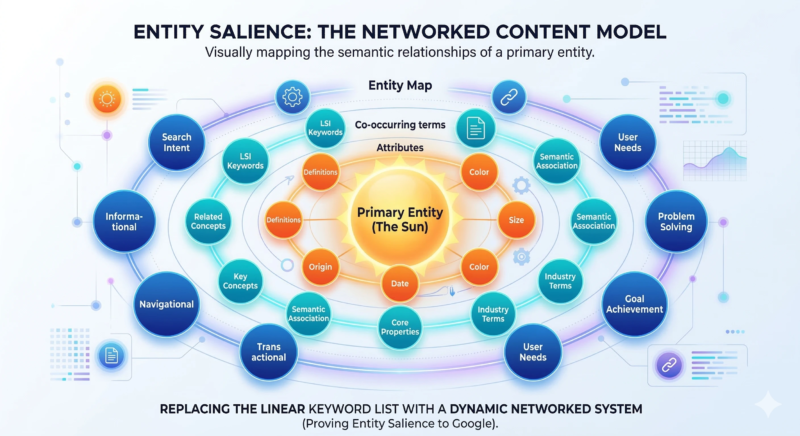
Figure 1: This “Entity Map” illustrates the shift from linear keyword targeting to a networked content model. By anchoring the Primary Entity at the center and surrounding it with relevant Attributes, Co-occurring Terms, and User Intent, creators can demonstrate high Entity Salience to search engines, ensuring the content is recognized as a topical authority rather than just a collection of strings.
| Old Concept | 2026 “Soulful” Equivalent | Why it Matters |
| LSI Keywords | Entity Salience | Tells Google exactly which “Bank” you mean (River vs. Finance) by the surrounding vocabulary. |
| Keyword Density | Topical Breadth | It’s not about how often you say a word, but how completely you cover the sub-topics. |
| Keyword Stuffing | Semantic Redundancy | Google now penalizes “semantic fluff.” If a sentence doesn’t add new information, it’s dead weight. |
The Three Pillars of Intent Satisfaction
To truly “put a soul” into this, you need to show the reader (and Google) that you understand the human behind the search:
- Informational Intent: “Explain the ‘Why’ behind the ‘What’.” Use Schema.org to define your entities.
- Navigational Context: Use Internal Semantic Linking. Don’t just link to a page; link to a concept that completes the user’s journey.
- Transactional Trust: Ensure your LSI terms include “Actionable Entities” (e.g., “Implementation guide,” “Optimization workflow,” “Audit checklist”).
Mapping the Meaning: A Framework for Semantic Content Optimization
Step 1: Beyond the Seed (Entity Discovery)
In the old SEO playbook, you started with a “seed” like “Organic Coffee” and looked for high-volume variations. In Semantic Content Optimization, the seed is just the center of a web. Google doesn’t just want to see the word “coffee”; it looks for the Attributes and Related Entities that prove you actually know the subject.
Example: If the topic is “Coffee,” the entities aren’t just “buy coffee,” but “Arabica beans,” “roasting profiles,” “caffeine extraction,” and “brewing temperature.”
What are Entities vs. Keywords?
The Keyword: “Best Espresso Machine.”
The Entities: Pressure bars (9 bars), thermoblock heating, porta-filter, crema, extraction time, and grind consistency.
If you write about an espresso machine but never mention “extraction time” or “pressure,” Google’s Neural Matching algorithm flags your content as “thin” or “low-authority.” It assumes you are a generalist, not an expert.
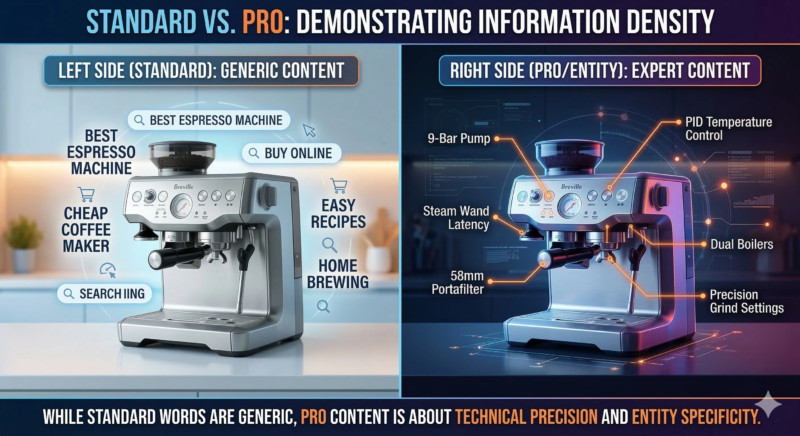
Figure 2: This comparison highlights the difference between surface-level keyword targeting and high Information Density. While the “Standard” approach relies on high-volume, generic strings, the “Pro” approach utilizes Entity-specific technical callouts. By shifting focus to granular details like pump pressure and thermal stability, creators provide the “Information Gain” that search engines now prioritize for expert-level ranking.
How to Discover Your Entities
To move beyond the seed, you must map out the contextual neighborhood of your topic:
Define the “Class”: What category does your topic belong to? (e.g., “SaaS” or “Home Improvement”)
Identify Attributes: What are the physical or technical characteristics? (e.g., “Battery life,” “API integration,” “Stainless steel”)
Find “Co-occurring” Terms: What words always show up in high-ranking papers on this topic? These aren’t synonyms; they are the “logic” of the conversation.
The Expert Take: Stop asking “What is the volume for this keyword?” and start asking “What are the essential concepts I must cover to satisfy a researcher’s curiosity?”
Step 2: Satisfying the Knowledge Graph
Google’s Knowledge Graph is essentially a giant brain that understands how different concepts (Entities) relate to one another. When you write about a topic, Google’s AI performs a “Gap Analysis.” It looks at your content and asks: “If this person is an expert on X, why haven’t they mentioned Y or Z?”
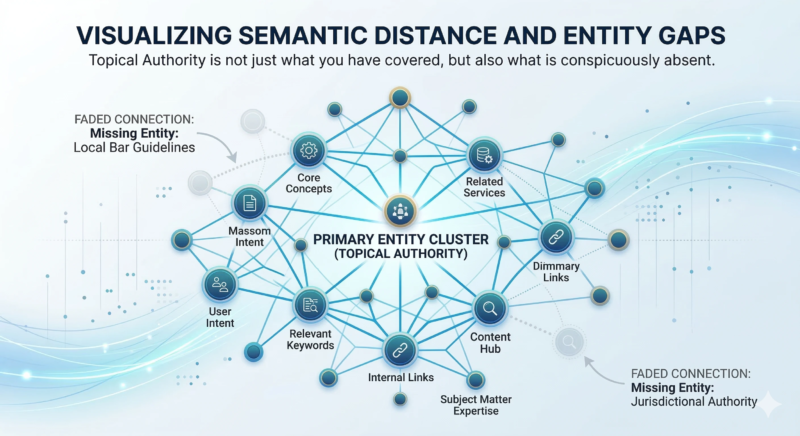
Figure 3: This diagram illustrates the concept of Semantic Distance and Entity Gaps. When Google evaluates a domain for expert-level authority on a complex topic (e.g., legal or compliance issues), it looks for a complete semantic web. By showing a fully connected cluster but highlighting critical, faded nodes—specifically “Missing Entity: Local Bar Guidelines” and “Missing Entity: Jurisdictional Authority“—we can visualize why an otherwise strong content hub may still fail to achieve primary ranking: the topical authority is incomplete until those gaps are bridged.
To satisfy the Knowledge Graph, you must move beyond a single article and build Contextual Clusters:
- The Pillar & Spokes Model: Your main “Pillar” page should cover the broad concept, while “Spoke” articles dive deep into specific sub-entities.
- The “Must-Have” Entities: If you are writing about Law Firm SEO, the Knowledge Graph expects to see related entities like Bar Association guidelines, Local Pack rankings, Legal Service Ads (LSAs), and Client Confidentiality. Missing these tells Google your content is incomplete.
- Semantic Breadcrumbs: Use internal links to connect these clusters. This creates a “Meaning Map” that Google can crawl, proving you have covered the topic exhaustively from every angle.
The Expert Take: You aren’t just writing a blog post; you are building a database of expertise. If Google can’t find the “logical neighbors” of your topic on your site, it won’t trust you as an authority.
Step 3: Natural Language Integration (NLP)
This is the “Anti-Crap” rule of modern SEO. In the past, we wrote for crawlers. In 2026, we write for LLMs (Large Language Models) that can detect “robotic” patterns. If your writing feels forced, Google’s NLP algorithms (like BERT and Gemini) will flag it as low-quality “SEO-first” content.
The Rule: “If a keyword makes the sentence sound robotic, delete it. If the context is strong, Google will find you anyway.”
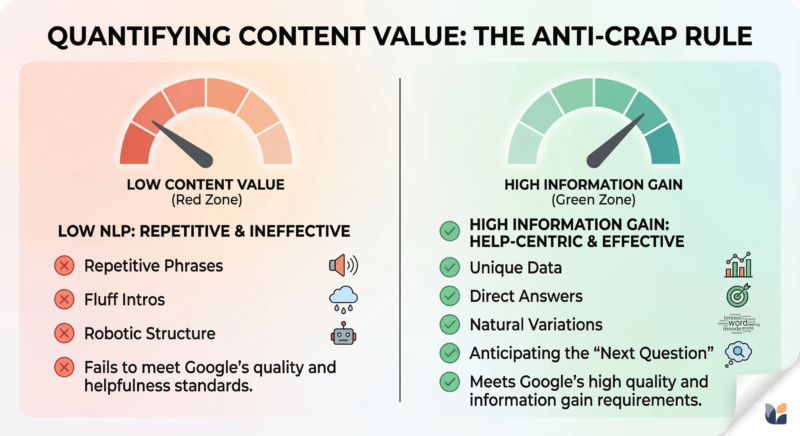
Figure 4: This “Value Meter” visualizes the Anti-Crap Rule in modern SEO. To rank in a post-Helpful Content Update (HCU) landscape, pages must move away from the “Red Zone”—characterized by robotic structures and fluff—and toward the “Green Zone.” High-performing content is defined by Information Gain: providing unique data and a natural narrative flow that anticipates and answers the user’s next logical question before they even have to ask it.
How to integrate keywords naturally:
- Prioritize Reader Flow: Use the “Read Aloud” Test. If you wouldn’t say the sentence to a client in person, don’t put it on your website.
- Use Latent Logic, Not Exact Matches: Instead of forcing the phrase “Best Divorce Lawyer in Chicago” five times, use variations like “Chicago-based family law practitioners” or “navigating the Cook County court system.”
- Optimize for “Information Density”: NLP favors sentences that provide high value quickly. Avoid “fluff” phrases like “In today’s fast-paced world…” or “It is important to note that…“
- Answer the “Next Question”: Semantic SEO is about anticipating the user’s journey. If a user reads about “SEO for Lawyers,” their next thought is “How much does it cost?” Answer that naturally within the flow.
The Expert Take: Google is smart enough to know that “Car Insurance” and “Auto Policy” are the same thing. Stop worrying about exact percentages and start worrying about Information Gain—the new, unique value you are adding to the internet.
What is the role of LSI in Ranking, Keyword Density & Content?
LSI Keywords for Better Ranking
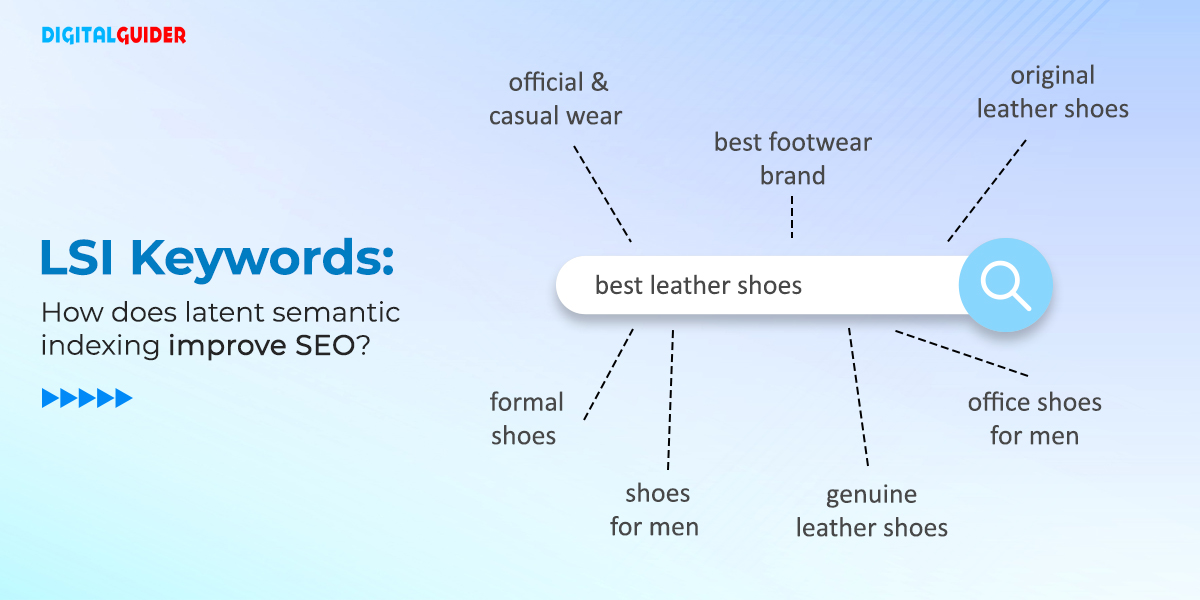
People search for common problems on Google in various ways, so LSI keywords matter for Google’s rankings. Using LSI keywords in your content is good for SEO. It helps make your content more relevant and improves how easily people can find it in searches.
Contextual Relevance:
- With LSI keywords, search engines understand the context of your content. Instead of repetitively using the same keyword, you can incorporate LSI keywords that are naturally associated with your main topic.
- If your target keyword is “digital marketing,” LSI keywords could include “content marketing,” “social media strategy,” or “online advertising.”
Improved Readability:
- LSI keywords contribute to the overall coherence and natural flow of your content. They can seamlessly integrate into your writing, making it more reader-friendly than awkwardly stuffing the same keyword multiple times.
- This approach helps maintain a natural and engaging tone in your content, which readers and search engines appreciate.
Also read: How Scannable Content Rules the Internet? [A Beginners Guide]
Diverse Vocabulary:
- Using LSI keywords into your content helps diversify your vocabulary, reducing redundancy and enhancing the user experience. If you’re wondering how to find LSI keywords, consider using tools like Google Autocomplete or related searches.
- Understanding the LSI keywords meaning can also help you create more relevant and engaging content.
- Instead of repeating the exact phrases, you can introduce synonyms and related terms that convey similar meanings, making your content more informative and engaging.
Semantic SEO:
- Search engines increasingly rely on semantic analysis to understand the intent behind user queries. LSI keywords align with this trend by emphasizing the semantic relationships between words.
- By incorporating LSI keywords, you tell search engines that your content is comprehensive & relevant to a broader topic, potentially improving your content’s ranking.
Avoiding Penalties:
- Keyword stuffing, or overloading your content with the same keyword, can lead to penalties from search engines. LSI keywords provide a more natural and user-centric approach, reducing the risk of being penalized for keyword manipulation.
Thematic Clusters:
- Instead of focusing on a single keyword, LSI keywords allow you to create thematic clusters around your main topic. This holistic approach helps search engines better understand the depth and breadth of your content.
Hence, Google and other search engines pay attention to the words on your page that aren’t just keywords and use them to evaluate and rank your page. So, for better SEO, it’s a good idea to include related terms on the web page you want to rank.
Impact of LSI Keywords on Density
As LSI allows a better understanding of context and intent, search engines can effectively cater to uncommon search queries by online users. Content creators now prioritize natural language and a comprehensive scope of topics, enabling a user-centric approach. LSI keywords have, therefore, influenced a more holistic content strategy, emphasizing relevance, diversity, and semantic depth over the simplistic metric of keyword density in SEO practices.
See the example shown below:-
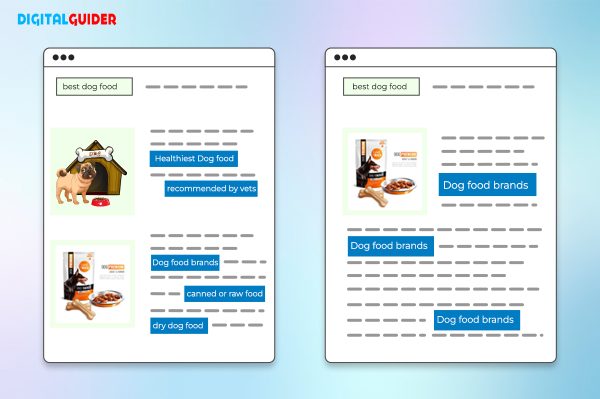
LSI keywords to improve SEO and Content
Earlier, Google’s spiders would find and check websites by moving from one link to another on connected pages. They looked at keywords in title, content, images, and headings. After the LSI update:
- Google understands web pages better – It scans for related keywords, going beyond the main one. It uses latent semantic indexing to grasp content deeply.
- Scans pages contextually – The algorithm reads pages like humans, categorizing keywords based on context. It distinguishes between literal and figurative expressions.
- Generates more relevant results – Identifies words that often occur together for accurate categorization and more relevant results.
- Considers the overall picture – It weighs your business name, website, and industry to understand each page connected with your business.
LSI keywords are crucial for Google’s goal of providing the most relevant results, even for new search terms. This quality standard is achieved with latent semantic indexing.
Google has always agreed on three things:
– It’s crucial to understand and take hold of what people want when they search and use the right words.
– Making helpful content that matches what users are looking for is vital.
– Creating a well-connected silo, clusters, and relevant groups of topics is essential for information retrieval.
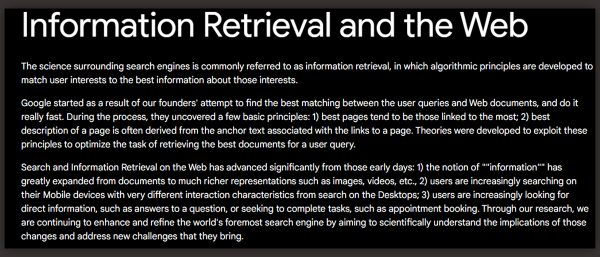
Source: Google
What are LSI keyword generator tools?
LSI keyword tool is a handy helper in search engine optimization (SEO). It assists you in finding LSI (Latent Semantic Indexing) keywords, which are terms semantically related to your primary keyword but not necessarily synonyms. Think of it as a way to expand and enrich your topic, providing more context and depth for search engines and readers alike.
Here’s how LSI keyword generator tools work:
- You feed them a seed keyword: This could be the main topic of your content, a product you’re writing about, or anything else you want to explore further.
- The tool analyzes the search landscape: It digs into search results, related searches, and other sources to understand how your seed keyword relates to additional terms.
- It spits out a list of LSI keywords: These are related keywords that naturally pop up alongside your seed keyword, indicating relevant subtopics, concepts, and angles you can explore in your content.
Benefits of using LSI keyword generator tools:
- Improved SEO: Incorporating LSI keywords makes your content more relevant and comprehensive, potentially boosting your ranking in search results.
- Enhanced content quality: LSI keywords help you cover your topic more thoroughly, creating informative and engaging content for readers.
- Broader reach: You can tap into related searches and attract a wider audience interested in different aspects of your main topic.
Here are some popular LSI keyword generator tools:
Free options
- Keysearch: Offers a dedicated LSI keyword generator tool with limited free use.
- Ahrefs: Provides a free keyword generator with LSI suggestions included.
- Twinword Ideas: It has a simple LSI keyword generator with limited output in the free version.
Paid options
- LSI Graph: Offers in-depth LSI keyword research with location targeting and bulk analysis features.
- KWFinder: Includes LSI suggestions alongside its main keyword research functions.
- Serpstat: Provides LSI keywords along with other SEO metrics and competitor analysis.
- Semrush: Semrush analyzes your page against top-ranking competitors and identifies missing semantic keywords they use. Semrush offers both free and paid plans. Explore the free features before considering paid options.
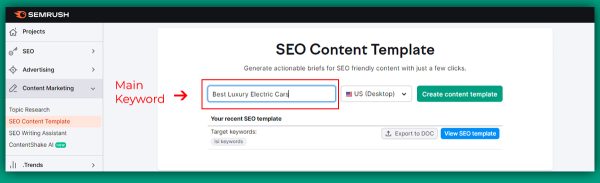
SEO Recommendations from Semrush are shown in the example below:
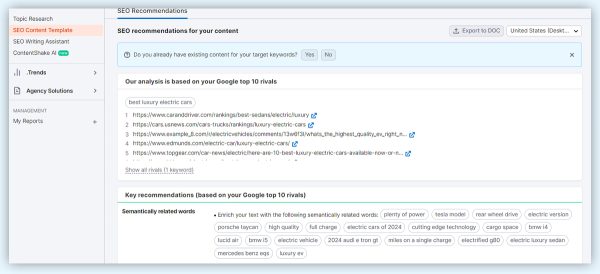
Remember, LSI keyword generator tools are just a starting point. It’s crucial to analyze the suggested keywords, choose those relevant to your content and target audience, and integrate them naturally to avoid keyword stuffing.
How to create LSI keywords-rich content for your website?
To create content that has a lot of related keywords, we need to create a list of keywords with our research and with the help some tools (which will be discussed in the next section).
In this section, we will discuss how to find and create a list of keywords related to your specific keyword or primary keyword.
Explore Search Engines’ Autocomplete Results –
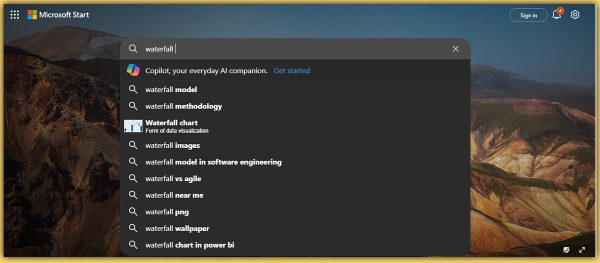
Also known as autocomplete suggestions or predictions, these are the dynamically generated suggestions that appear in a drop-down menu when a user begins typing a query into a search engine or other online platform. These suggestions assist users by predicting what they might be looking for based on the initial characters entered, as shown in the image below.
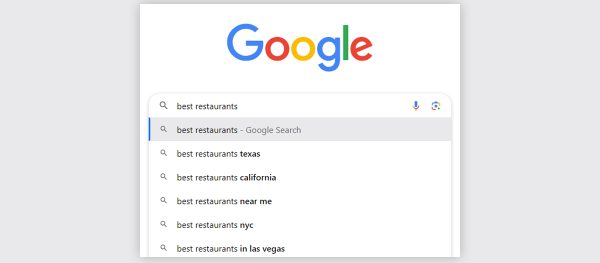
Autocomplete is a feature implemented by search engines like Google, Bing, and others, as well as various websites and applications. The suggestions are derived from popular and relevant search queries made by other users, and they aim to save time for users by offering possible completions or alternatives to their search. Autocomplete results are part of the search engine’s effort to enhance user experience and provide quicker access to information.
These autocomplete predictions can help us see what types of search queries people are searching online.
Utilize Related Searches
Related searches, often displayed on search engine result pages (SERPs), are suggestions for additional queries (closely) related to the original search term. These intimations help users refine their search and explore related topics or aspects of the initial query.
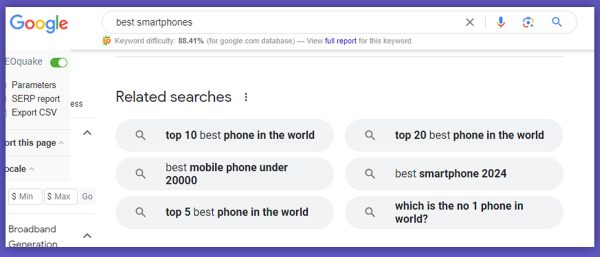
For example, if someone searches for “best smartphones,” the related searches might include terms like “top-rated Android phones,” “latest iPhone models,” or “budget-friendly smartphones.” These suggestions are generated by the search engine’s algorithms, taking into account users’ search history and patterns to provide relevant and helpful options.
Users can click on these related searches to explore different facets of the topic or find more specific information tailored to their interests. It’s a feature designed to enhance the search experience and assist users in discovering content that aligns with their information needs.
Check People also ask (PAA) – questions related to the same topic
“People Also Ask” (PAA) is a feature in search engine result pages (SERPs) that provides related questions based on the user’s original query. These questions are typically displayed in an expandable box, and when clicked, they reveal brief answers or snippets taken from various sources.
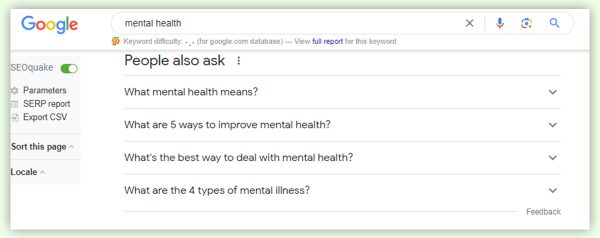
The “People Also Ask” feature aims to anticipate and address additional questions users might have related to their initial search. Search engines like Google help users explore different facets of a topic or gather more comprehensive information by offering a range of related questions. This feature is part of search engines’ efforts to enhance UX by providing a more interactive and informative search environment. Users can click on the questions to get concise answers or click through to relevant sources for more in-depth information.
Use People Also Search For (PASF) – different related topics
(Not to be confused with PAA)
‘People Also Search For’ is a list of additional search queries often found on search engine result pages (SERPs), particularly on Google. These suggestions help users discover and explore related topics or refine their search to find more relevant information.
For example, if we search for “best hiking boots,” the “People Also Search For” section might display additional queries such as “waterproof hiking shoes,” “top-rated hiking gear,” or “hiking boot reviews.” These searches are generated based on the collective search behavior of users who have conducted similar queries. One more example given below.
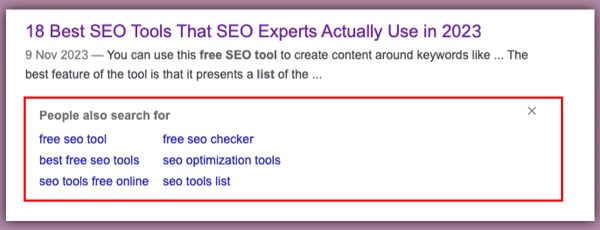
Users can click on any of these related search suggestions to see new search results related to that particular query, allowing for a more dynamic and exploratory search experience. The goal is to help users find a broader range of information related to their interests.
More Tips:
Improve title tags, meta descriptions, and headers by using LSI keywords.
Connect related pages with internal links using LSI anchor text.
Keep an eye on your keyword rankings and tweak your plan as needed.
When did LSI Keywords start serving the Search Intent of the users?
It all began in 2004 when Latent Semantic Indexing (phrase-based indexing) was applied in Google’s search engine algorithms Its aim was to help the search engine offer users results that are more relevant and fitting to their search queries.
The search engine no longer focused solely on exact-match keywords within the content of web pages. The algorithm evolved to comprehend context and synonyms, enabling Google to analyze the entire content of a page rather than relying on a single target keyword and its keyword density (frequency) to determine the web page’s subject.
Wrapping Up
In conclusion, understanding and strategically implementing Latent Semantic Indexing LSI keywords encompassing semantically related words, phrases, and entities can significantly enhance website rankings. It is essential to judiciously incorporate LSI keywords within the content, ensuring relevance and coherence.
By doing so, websites can benefit from enhanced SEO performance as search engines increasingly prioritize semantic understanding and context. The careful integration of LSI words contributes to a more comprehensive and fine representation of content, aligning with search engines’ evolving algorithms and standards for delivering relevant and valuable information to users.
FAQs – LSI Keywords
Q1. How do LSI keywords differ from traditional keywords in SEO?
A1. LSI keywords improve context & relevance, while traditional keywords focus on exact matches.
Q2. How reliable are LSI keyword tools for finding relevant keywords?
A2. LSI keyword tools like LSI Graph typically provide 70-90% relevance.
Q3. Are there specific industries where LSI keywords are more effective?
A3. Industries like healthcare & technology benefit from LSI keywords.
Q4. Do LSI keywords benefit my E-Commerce product pages?
A4. Yes, LSI keywords add context to your product descriptions, which can help your products appear in top search results.
Q5. Can LSI Keywords lower the cost of content marketing?
A5. LSI keywords improve organic traffic, reducing the need for paid ads & lowering content marketing costs.
Q6. Can LSI keywords improve local SEO strategies?
A6. Yes, by using location-based LSI keywords.
Q7. Do LSI keywords work differently for voice search optimization?
A7. LSI Keywords align your content with natural language and user intent.
Q8. Can LSI Keywords Reduce My CPC?
A8. Yes, using LSI keywords can lower your CPC by increasing CTR.
Q9. How can I measure the results of LSI keywords in my ad campaigns?
A9. You can track results from Google Ads or SEO tools like Semrush.
Q10. Do LSI keywords affect the way featured snippets are selected?
A10. Yes, LSI keywords increase the chances of matching user intents of appearing in snippets.