Updated: Mar 03, 2026
In this blog, we will discuss:
- What is AI SEO
- How AI improves your SEO performance
- How to implement AI optimization
- Traditional SEO vs AI SEO
- SEO vs AEO vs GEO vs AIO
- The Best AI SEO Tools to Get Started in 2026
What is AI Optimization?
AI Optimization (AI SEO) is the strategic process of structuring and validating your content so it is discoverable, extractable, and citable by Generative AI engines. Unlike traditional SEO — which chased rankings — AI SEO ensures your brand becomes the preferred source that models like Gemini, ChatGPT, and Perplexity trust to generate their answers.
And the shift is already here.
By late 2025, daily AI tool usage had doubled to 29.2% (Jan–Jun 2025). Commercial searches via AI rose to 18%, transactional searches to 14% by November. Users aren’t just Googling anymore — they’re querying, conversing, and expecting direct answers. (Semrush, 2025)
To meet that demand, AI SEO leverages machine learning (ML), natural language processing (NLP), and large language models (LLMs) to go beyond keyword matching. It decodes:
- The real intent behind a search — not just the words, but the why
- Content and keyword gaps your competitors haven’t filled yet
- How topical authority and content structure influence what AI engines cite
- Why certain pages consistently outrank (and out-cite) others
This makes AI SEO the engine powering two emerging disciplines:
| Model | Full Name | Optimizes For |
|---|---|---|
| GEO | Generative Engine Optimization | AI Summaries & Gemini Overviews |
| AEO | Answer Engine Optimization | Direct Answers & Voice Search (Siri) |
In the age of generative search, your goal has shifted. It’s no longer about earning a click — it’s about earning a citation.
How AI Actually Improves Your SEO Performance:
AI hasn’t just improved SEO — it’s rebuilt it from the ground up. What was once a manual, intuition-driven process is now a precision science, operating across four critical pillars.
1. Content & Semantic Intelligence
Keyword research alone no longer cuts it. AI replaces guesswork with Semantic Mapping — a deeper understanding of what users mean, not just what they type.
- Beyond Keywords: AI identifies entities and latent intent — the “why” behind a search — so your content answers the questions users didn’t even know to ask.
- Information Gain: AI audits top-ranking pages to pinpoint exactly what’s missing, ensuring your content adds new value rather than recycling what already exists.
- Machine Readability: It fine-tunes your syntax and structure, so LLMs like GPT-4o and Gemini can cleanly extract and cite your content in their generated answers.
2. Technical Precision & UX
AI-driven audits don’t just flag errors — they surface opportunities hiding in plain sight.
- Predictive UX: AI simulates real user behavior to forecast where visitors drop off, letting you fix friction points before they drag down your rankings.
- Self-Healing SEO: Tools now auto-generate Schema Markup and llms.txt files, making your site “pre-digested” for AI crawlers — no manual configuration needed.
- Competitive Gap Analysis: AI benchmarks your entire site against the SERP, isolating the specific technical gaps keeping you off the top spot.
3. Radical Efficiency — The 10x Workflow
The biggest time sink in SEO used to be the groundwork. AI eliminates it.
- Automated Research: Keyword clustering, backlink auditing, GBP monitoring — tasks that once consumed 20+ hours now run in seconds.
- On-Page Scale: Meta-tags, internal link suggestions, and content optimizations that would take weeks to implement manually can now be deployed across thousands of pages simultaneously.
The result? Your team stops executing and starts strategizing.
4. Predictive Strategy & Trend Forecasting
This is where AI’s advantage becomes unfair — in the best way.
- Demand Forecasting: AI analyzes massive datasets to identify trending topics before they peak, giving you a first-mover advantage your competitors can’t replicate manually.
- Strategic Decision Intelligence: Instead of reacting to last quarter’s data, you’re operating on foresight — knowing which content investments will drive the highest ROI next quarter.
Putting It Together
| Use Case | How AI Delivers |
|---|---|
| Data Analysis | Scans thousands of “People Also Ask” queries to surface content gaps in seconds |
| Intent Mapping | Identifies whether a user wants a quick fact or a deep dive — before you write a word |
| Technical Health | Auto-generates Schema markup and llms.txt files so bots crawl you cleanly |
| Content Precision | Scores your drafts against LLM readability standards to maximize citation potential |
How to Implement AI Optimization: A Step-by-Step Framework
Knowing why AI SEO works is only half the battle. The other half is execution. Here’s a practical, four-step framework to make your content discoverable, extractable, and citable — starting today.
Step 1: Map Intent, Not Just Keywords
Before you write a single word, ask a better question — not “what are people searching for?” but “why are they searching for it?”
AI tools like ChatGPT, Semrush, or Surfer SEO can analyze search patterns to uncover:
- Informational intent: users researching a topic (“what is AI SEO”)
- Commercial intent: users comparing options (“best AI SEO tools 2026”)
- Transactional intent: users ready to act (“hire AI SEO agency”)
Once you know the why, structure your content to answer it — directly, confidently, and completely. Generative engines cite sources that eliminate follow-up questions, not ones that create them.
Action Item: Use AI to surface the “unasked questions” in your niche — the gaps your competitors haven’t filled yet. That whitespace is your citation opportunity.
Step 2: Structure for Extraction, Not Just Readability
AI engines don’t read your content the way humans do — they scan, parse, and extract. If your structure isn’t clean, you won’t get cited, no matter how good your writing is.
Follow these structural rules:
- Use question-based H2/H3 headers that mirror how users actually phrase queries (“How does AI SEO work?” not “Overview”)
- Lead each section with a direct answer — then expand. AI models favor the inverted pyramid: conclusion first, context second.
- Use short paragraphs, tables, and numbered lists — these are the formats LLMs extract most reliably
- Bold your key claims — it signals semantic weight to both human readers and machine parsers
Think of your content architecture as an API. The cleaner the structure, the easier it is for AI to pull exactly what it needs.
Step 3: Make Your Site AI-Crawler Ready
Even perfectly written content gets ignored if AI bots can’t access or interpret it. This is the technical layer most brands skip — and where the biggest citation gaps live.
Two non-negotiables for 2026:
- Schema Markup: Add structured data (FAQ, HowTo, Article schemas) so search engines and AI models understand your content’s context, not just its text.
- llms.txt File: The emerging standard for AI-readable site maps. Think of it as robots.txt — but built specifically to tell LLMs what to crawl, trust, and prioritize on your site.
Modern AI SEO tools like Screaming Frog, Semrush, and Ahrefs can auto-generate both. There’s no reason to leave this undone.
Action Item: Audit your site’s Schema coverage today. If you have zero structured data, start with FAQ schema on your top 10 pages — it’s the fastest win for AI extractability.
Step 4: Validate with Authority Signals
Generative AI engines don’t just look at what you say — they evaluate whether you can be trusted to say it. This is where E-E-A-T (Experience, Expertise, Authoritativeness, Trustworthiness) stops being an SEO buzzword and starts being your citation scorecard.
To earn trust signals:
- Cross-reference your facts with authoritative external sources (think: government sites, peer-reviewed studies, established industry reports)
- Cite your data explicitly — vague claims get skipped; sourced claims get cited
- Build author credibility — bylines, author bios, and LinkedIn profiles tied to your content signal real human expertise to LLMs
- Earn mentions, not just backlinks — AI models are trained on the web. The more reputable sources mention your brand, the more your authority compounds over time
Action Item: Audit your top 5 pages. For every stat or claim, ask: “Can an AI verify this from an external source?” If not, add the citation. This single habit separates cited content from ignored content.
The Framework at a Glance
| Step | Focus | Key Action |
|---|---|---|
| Step 1 | Intent Mapping | Uncover the why behind queries, not just the what |
| Step 2 | Content Structure | Use question-based headers and lead with direct answers |
| Step 3 | Technical Readiness | Deploy Schema Markup and an llms.txt file |
| Step 4 | Authority Validation | Source every claim and build verifiable E-E-A-T signals |
Implementation isn’t a one-time project — it’s an ongoing practice. The brands that treat AI Optimization as a continuous discipline, not a checklist, are the ones that will dominate citations in 2026 and beyond.
Traditional SEO vs AI SEO
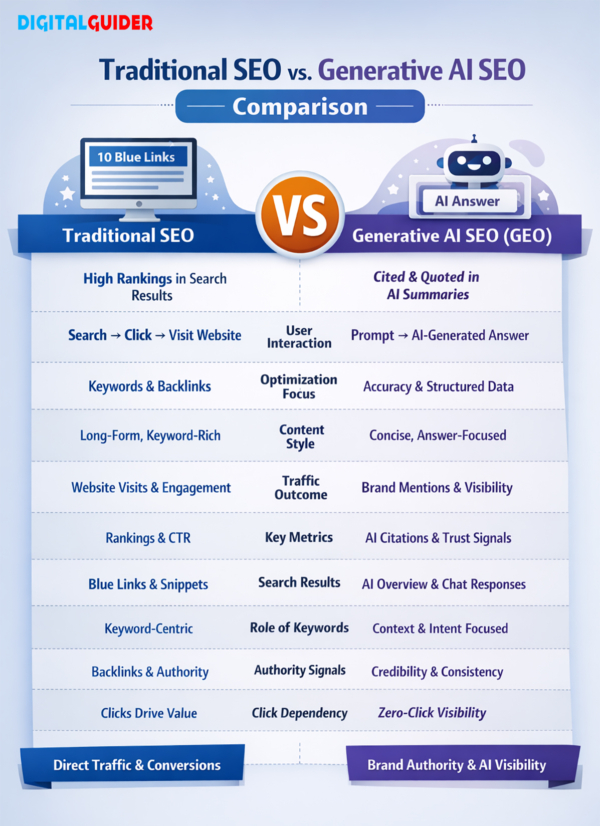
Traditional SEO vs AI SEO
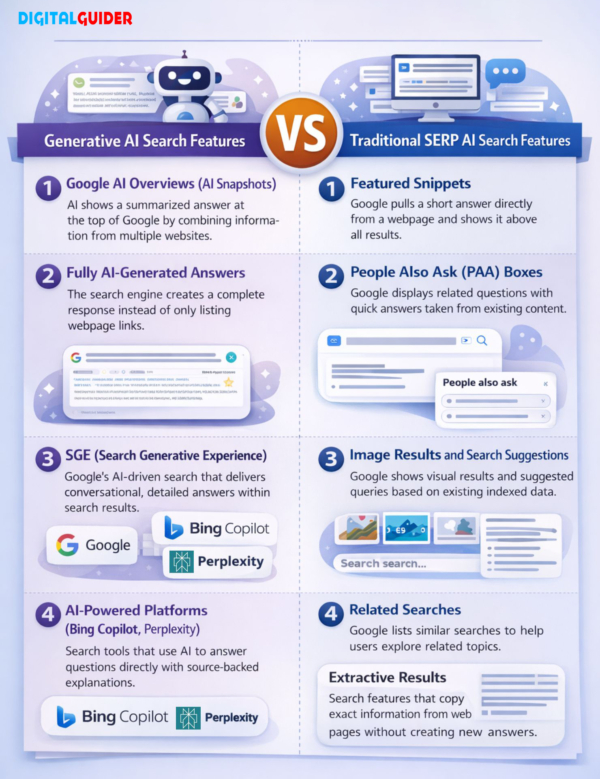
Generative AI Search Features vs Traditional SERP AI Search Features
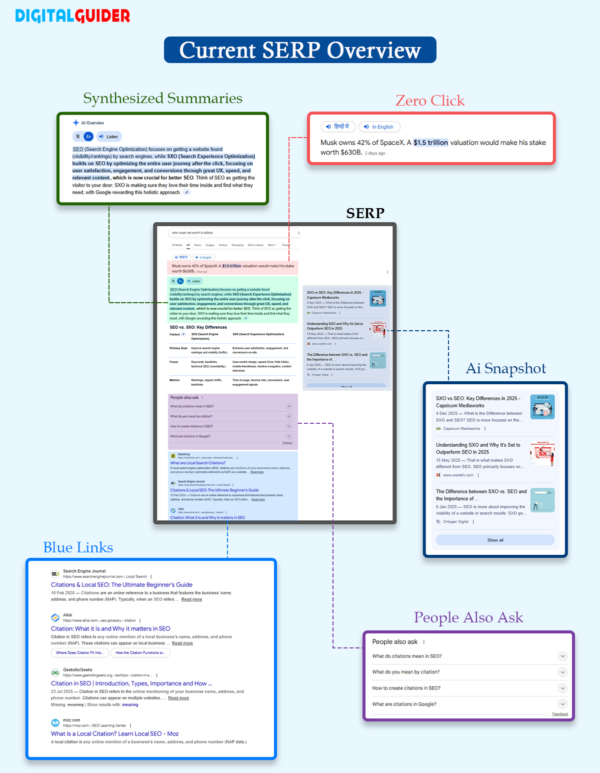
SERP AI Results
SEO vs AEO vs GEO vs AIO:
➨ SEO: Focuses on keywords, links, and website quality and helps your website appear higher on Google when people search for something.
➨ AEO: Is about clear questions and simple answers, which enables your content to be easy to read for Google, users, and voice assistants to pick as a direct answer.
➨ GEO: Focuses on authority and useful information, and helps AI tools like ChatGPT, Gemini, Grok, and Perplexity understand and mention your brand as a trusted source.
➨ AIO: Uses AI tools to speed up SEO work like content writing, analysis, and optimization.
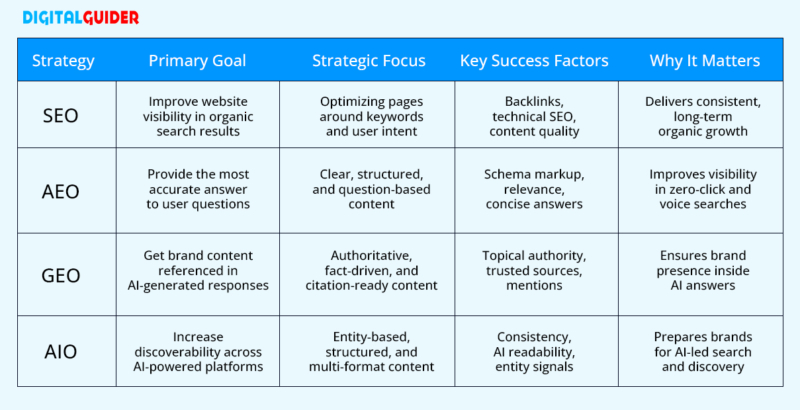
SEO, AEO, GEO, & AIO
The Best AI SEO Tools to Get Started in 2026
The framework is only as powerful as the tools executing it. The good news: the AI SEO tool ecosystem has matured rapidly — there’s now a purpose-built solution for every step of the process. Here’s what’s actually worth your time.
For Intent Mapping & Keyword Intelligence
Semrush (AI-Powered)
The gold standard for search intelligence, now supercharged with AI. Semrush’s Keyword Magic Tool and Topic Research features identify semantic clusters, intent categories, and content gaps at scale — in seconds.
- Best for: Commercial and transactional intent mapping
- Standout feature: AI-generated content briefs that pre-map your entire article structure
Surfer SEO
Where Semrush finds the opportunity, Surfer tells you exactly how to execute it. It scores your content in real time against top-ranking pages, flagging semantic gaps and LLM readability issues as you write.
- Best for: On-page optimization and Information Gain scoring
- Standout feature: Live content editor with NLP-based recommendations
ChatGPT / Gemini (Prompt-Driven Research)
Don’t underestimate conversational AI for early-stage research. Using the right prompts, both tools surface “unasked questions,” related entities, and audience pain points faster than any traditional keyword tool.
- Best for: Brainstorming content angles and identifying latent intent
- Standout feature: Conversational depth that keyword tools simply can’t replicate
For Technical SEO & Crawler Readiness
Screaming Frog SEO Spider
The industry benchmark for technical audits — now with AI-assisted analysis. It crawls your entire site to identify Schema gaps, broken structures, and crawlability issues that block AI bots from indexing your content correctly.
- Best for: Large-scale technical audits and Schema Markup implementation
- Standout feature: Auto-generates structured data and flags llms.txt readiness
Ahrefs
Beyond backlinks, Ahrefs has evolved into a full competitive intelligence platform. Its Site Audit tool identifies technical gaps, while Content Explorer maps the entire citation landscape in your niche.
- Best for: Competitive gap analysis and authority benchmarking
- Standout feature: Content gap tool that shows exactly what cited competitors cover that you don’t
For Content Creation & LLM Readability
Jasper AI
Built specifically for marketers, Jasper generates long-form content that’s pre-optimized for both human readers and AI extractability. It integrates directly with Surfer SEO for real-time optimization scoring.
- Best for: Scaling content production without sacrificing quality
- Standout feature: Brand voice training — ensures every piece of content sounds like you, not a bot
Frase.io
Frase sits at the intersection of research and writing. It pulls the top 20 SERP results for any query, extracts their key topics, and builds you an AI-assisted brief — all before you write a word.
- Best for: Content briefs and answer-engine optimization
- Standout feature: Auto-generates FAQ sections structured for AEO and voice search
For Predictive Strategy & Trend Forecasting
Google Trends + AI Layering
Still one of the most underrated tools in SEO. Pair Google Trends data with an AI model (ChatGPT or Gemini) to extrapolate where demand is heading — not just where it’s been.
- Best for: First-mover content strategy and seasonal planning
- Standout feature: Free, real-time, and integrates with any AI workflow
BrightEdge
Enterprise-grade AI SEO platform built for large teams. BrightEdge’s Data Cube analyzes billions of data points to forecast content performance, predict ranking shifts, and surface emerging opportunities before your competitors see them.
- Best for: Enterprise brands managing large content portfolios
- Standout feature: Predictive ROI scoring for content investments
Tools at a Glance
| Tool | Best For | Framework Step |
|---|---|---|
| Semrush | Intent mapping & content gaps | Step 1 |
| Surfer SEO | On-page optimization & LLM scoring | Step 2 |
| ChatGPT / Gemini | Research & latent intent discovery | Step 1 |
| Screaming Frog | Technical audits & Schema generation | Step 3 |
| Ahrefs | Competitive benchmarking & authority gaps | Step 3 & 4 |
| Jasper AI | Scalable content creation | Step 2 |
| Frase.io | Content briefs & AEO optimization | Step 1 & 2 |
| Google Trends | Demand forecasting & trend mapping | Step 4 |
| BrightEdge | Enterprise strategy & ROI forecasting | Step 4 |
No tool replaces strategy — but the right stack makes your strategy unstoppable. Start with one tool per framework step, master it, then layer. The brands winning citations in 2026 aren’t using more tools — they’re using the right ones, deliberately.
The Future of Search: From Ranking to Recognition
As we move deeper into 2026, the definition of “winning” at SEO has fundamentally changed. We are no longer just optimizing for a search engine’s crawler; we are optimizing for a Generative Ecosystem.
Traditional search rewarded the loudest voice with the most backlinks. AI Optimization rewards the clearest voice with the most verified authority. Whether it’s a direct answer from a voice assistant (AEO) or a detailed citation in a Gemini overview (GEO), your visibility now depends on how easily an AI can trust, extract, and summarize your expertise.
The “Blue Link” era hasn’t ended, but it has evolved. To stay visible, you must stop treating your website as a destination and start treating it as a structured data source for the world’s most powerful LLMs.
Your 2026 AI SEO Checklist: 3 Immediate Actions
If you do nothing else today, take these three steps to future-proof your traffic:
- Audit for Extraction: Check your top 5 pages. Do they lead with a clear, 50-word answer that an AI could “lift” and cite instantly?
- Deploy Your llms.txt: Create a simple text-based roadmap of your site’s best content to guide AI bots directly to your “source of truth.”
- Validate Your E-E-A-T: Ensure every claim is backed by a credible source. In 2026, if an AI can’t verify your facts, it won’t risk citing you.
Ready to Claim Your Spot in the Age of Generative Search?
The shift to AI search is happening in real-time. Don’t wait for your traditional organic traffic to dip before you start optimizing for the new era.
Is your site ready for the AI Shift? Book a Free AI-Readiness Audit with our team today, and we’ll show you exactly where your citation gaps are.
FAQ
Q1. Should I prioritize traditional or generative AI SEO?
A1. Start with traditional (immediate wins), then layer in generative (future-proofing).
Q2. How do I know if AI Overviews are using my content?
A2. Manual testing – ask AI questions in your niche and see if you’re cited.
Q3. Will AI Overviews kill traditional SEO?
A3. No, they’ll coexist. Different intents trigger different result types.
Q4. Can AI do SEO?
A4. Not complete SEO, the best SEO combines AI with human insight and experience. AI can automate some parts of SEO. It can help you with keyword research, content suggestions, and analyze some technical issues. Think of AI as a powerful SEO assistant, not a replacement.
Q5. Can ChatGPT do SEO?
A5. No, ChatGPT cannot do SEO optimization on its own. However, it may be a powerful SEO assistant for tasks like keyword research, content ideas, meta tags ideas, GEO/AEO strategies, and other optimization techniques to boost visibility in AI responses. It has to be combined with human intelligence first.
Q6. What is the 30% rule in AI?
A6. The 30% rule in AI means AI can handle around 30% of the work, depending on what you want from it. While humans manage the remaining 70% including strategy decision-making, etc. This ensures quality & trust in SEO marketing.
Q7. Is SEO worth it anymore?
A7. Absolutely! SEO is evolving, not dying. With AI overviews and answer engines, visibility is more valuable than ever. SEO means your brand, product, service, and content are visible to everyone, whether it is traditional SEO or AI SEO. Without it, you’re invisible in the digital world. Totally worth it!
Q8. Does AI SEO mean auto-generated content?
A8. No, AI SEO does not mean only auto-generated content. It is a broader practice that uses AI tools for keyword research, technical optimization, and content strategy, while high-quality content remains human-guided.
Q9. Does Google penalize AI SEO?
A9. No, Google does not penalize AI SEO or AI-generated content itself. Google’s policy focuses on content quality and user value, not how it’s created. The penalty is for the low quality, not the AI origin.
Q10. Can AI replace SEO experts?
A10. No, AI cannot replace SEO experts. AI automates SEO tasks, while SEO experts provide a strategic vision that requires human experience. It works in collaboration, not replacement.