What is AI SEO
AI SEO is about aligning your website with how AI-powered search engines such as Google AI search overviews, Bing-Copilot, Perplexity, ChatGPT, etc., think and rank content today. AI SEO is the use of artificial intelligence technologies to improve how websites are seen and ranked by AI-powered search engines. It focuses on how AI systems analyze search behavior, content meaning, and user intent. Unlike traditional SEO, which relies heavily on manual research, AI SEO uses machine learning (ML), natural language processing (NLP), and large language models (LLMs) to understand:
- What users are actually searching for
- How search engines interpret content
- Why certain pages rank better than others
AI SEO is the foundation for newer search models such as GEO (Generative Engine Optimization) and AEO (Answer Engine Optimization), where AI-driven systems cite your website as a credible source or generate direct answers.
What is AI SEO Optimization?
AI SEO optimization is the process of using AI (artificial intelligence or smart technology) and ML (machine learning) to help your website show up better on Google and other AI-powered search engines. AI SEO helps understand what people are really searching for and then helps improve your website content so it matches their needs. AI provides insights that guide better content creation, smarter keyword use, and more effective optimization. AI SEO optimization includes:
- Analyzing real search intent behind keywords
- Improving content structure and topical authority
- Optimizing keywords, headings, and internal links intelligently
- Identifying keyword/content gaps
For this, AI uses NLP (natural language processing) and LLMs (large language models), and AI SEO aligns content with real search intent. Instead of guesswork, it supports smarter SEO, GEO (Generative Engine Optimization), and AEO (Answer Engine Optimization) to drive stable rankings, relevant traffic, and better conversions in today’s AI-driven search environment. The final goal remains the same: stable rankings, more traffic, more leads, and more conversions.
How is AI useful for SEO?
As of late 2025, data from Semrush reports confirm a significant shift in search behavior and the rise of AI searches. By late 2025, commercial searches rose to 18%, and transactional searches up to 14% by November. Daily AI tool usage doubled to 29.2% between January and June 2025. Users are increasingly starting searches in dedicated AI tools or using conversational, long-tail queries. Here is how AI assists SEO strategy:
Content & Keywords:
From keywords, AI tools can discover what people really ask, the hidden intent, or unasked questions. Helps tailor suggestions or information to different visitors. It can easily group related ideas so you can create complete, helpful content. AI can also suggest many ways to make your writing clearer and reading easier.
Technical & User Experience:
It can quickly find broken links, slow pages, thin content pages, duplicate pages, low-quality pages, and other technical glitches that hurt your ranking. AI can also quickly browse through other websites that are doing better in terms of technical & user experience, and suggest the improvement areas, so you can do better.
Increases SEO Efficiency
AI can automate many minor to major research-based SEO tasks, such as keyword research, competitor research, content research, on-page SEO audits, technical SEO checks, backlink research, GBP audits, and more, saving a lot of SEO time. This reduces manual research time and improves SEO decision-making efficiency.
Assists in SEO Strategy
AI can predict trends and analyze data to guess what topics or searches will be trending next. AI assists in SEO strategy by analyzing large search datasets to identify keywords, intent, content gaps, and ranking patterns faster than humans. It also guides data-driven decisions by predicting trends, optimizing content structure, and automating audits.
How is AI SEO Optimization Done?
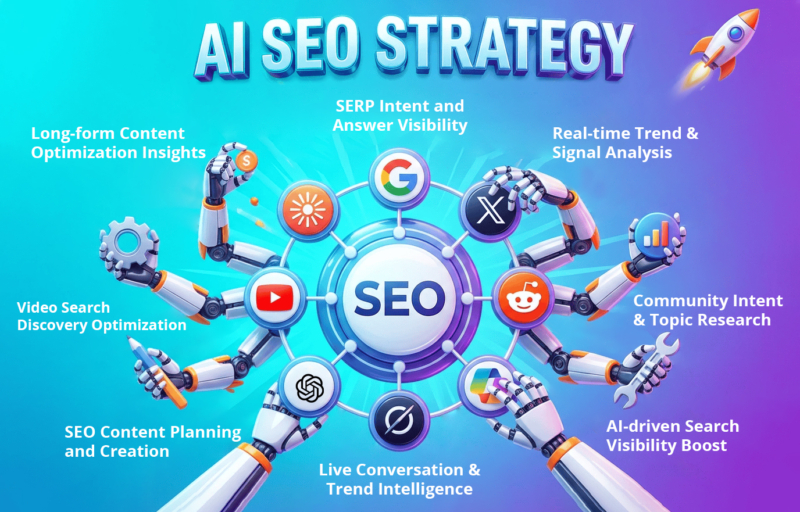
Understand real search intent:
AI reads like a person, focusing on the true meaning of your search, not keywords. AI tries to understand real search intent beyond your keywords, i.e., informational vs commercial vs transactional. Are you looking for an answer, researching a product, or want to buy something? AI can see through the purpose of the search and do predictive keyword & trend analysis, and spot rising queries.
Smart content planning:
AI can quickly cluster the topics around search queries than humans, as it has vast access to the database. These topics further assist in mapping question-based content for the PAA box or mention in the FAQs. It can also check your content for the EEAT guidelines.
Expert-like content evaluation (EEAT):
Using AI, you can easily evaluate, without any tool, whether the content demonstrates first-hand experience, subject-matter expertise, and accurate, in-depth topical coverage, and users find the content helpful & clear. Whether it fully satisfies user intent from start to finish using relevant, real-world examples. Assess trust signals such as author credibility, brand authority, and site reliability.
Testing & Optimization:
AI helps by quickly testing different versions of content, headlines, and pages to see what works best. Instead of waiting weeks, it analyzes results in real time and suggests improvements. This saves time, reduces guesswork, and helps websites improve performance and user experience much faster.
What is Generative AI Overview or GEO?
Generative AI Overview is when search engines like Google, Bing, Perplexity, and other AI-powered search platforms use artificial intelligence to read information from multiple websites and generate a short, helpful answer for users, rather than just listing websites. GEO (Generative Engine Optimization) means making your website content easy for AI to understand and trust, so it can use your content while creating these answers. In short, GEO helps your content get picked by AI-powered search results and not just rank as a link.
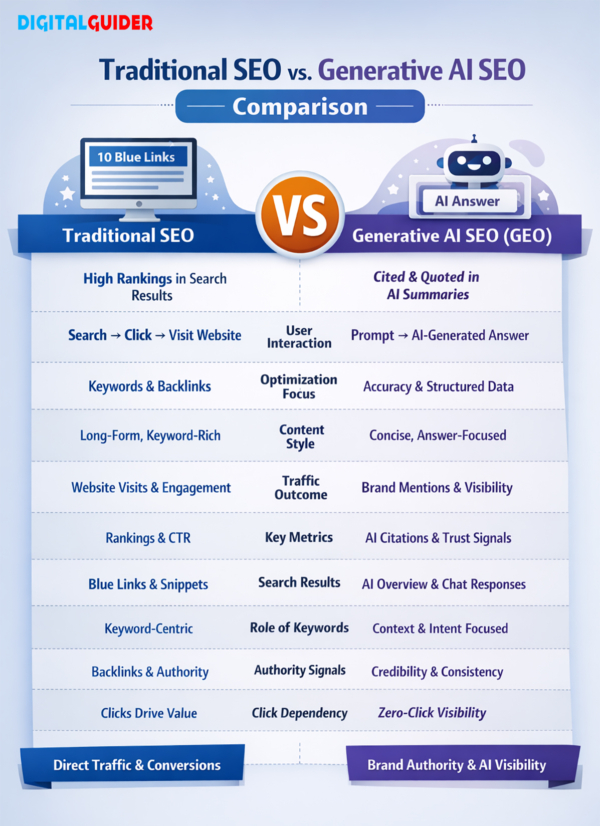
Unlike traditional SEO—where ranking a webpage is the main goal—GEO focuses on making your content understandable, trustworthy, and quotable for AI systems, so it can be referenced or summarized within AI-generated answers.
How does Generative AI Work?
- Understands the user’s question and intent
- Reads and analyzes information from many trusted sources
- Uses large language models (LLMs) to process language naturally
- Combines and summarizes relevant information
- Generates a clear, human-like answer
- Shows direct answers instead of only listing website links
- Users may get answers without clicking multiple websites
- Learns from patterns and improves results over time
Why GEO matters for SEO?
- Search engines now show AI-generated answers, not just website links
- Your content needs to be AI-readable and trustworthy to get featured
- Visibility is shifting from rankings to being cited in AI answers
- GEO helps capture high-intent users even if clicks reduce
- Drives high-intent traffic
- Well-structured content improves the chances of AI selection
- Supports modern search trends like AEO and voice search
- Future-proof SEO for AI-driven search experiences
Generative AI Search vs Traditional SERP AI
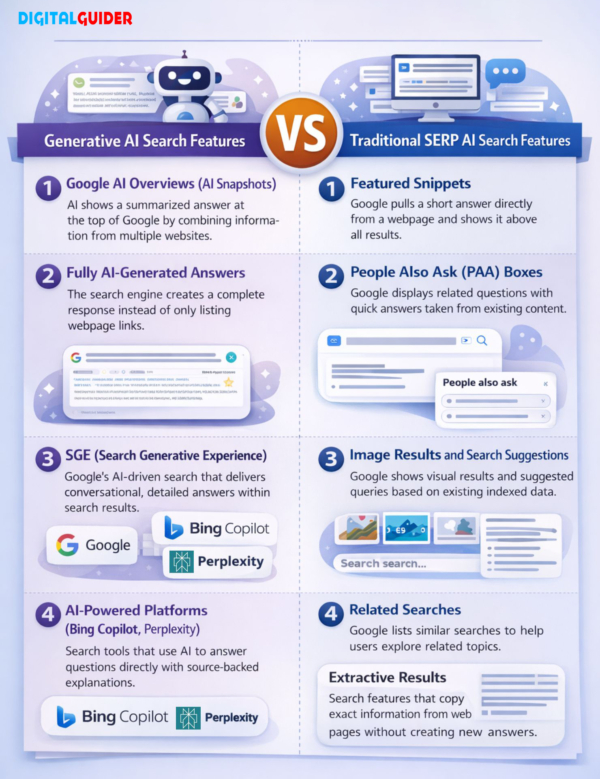
Generative AI Search Features vs Traditional SERP AI Search Features
Generative AI Search Features
- Google AI Overviews (AI Snapshots): AI shows a summarized answer at the top of Google by combining information from multiple websites.
- Fully AI-generated answers: The search engine creates a complete response instead of only listing webpage links.
- SGE (Search Generative Experience): Google’s AI-driven search that delivers conversational, detailed answers within search results.
- AI-powered platforms (Bing Copilot, Perplexity): Search tools that use AI to answer questions directly with source-backed explanations.
Traditional SERP AI Search Features
- Featured Snippets: Google pulls a short answer directly from a webpage and shows it above all results.
- People Also Ask (PAA) boxes: Google displays related questions with quick answers taken from existing content.
- Image results and search suggestions: Google shows visual results and suggested queries based on existing indexed data.
- Related searches: Google lists similar searches to help users explore related topics.
- Extractive results: Search features that copy exact information from web pages without creating new answers.
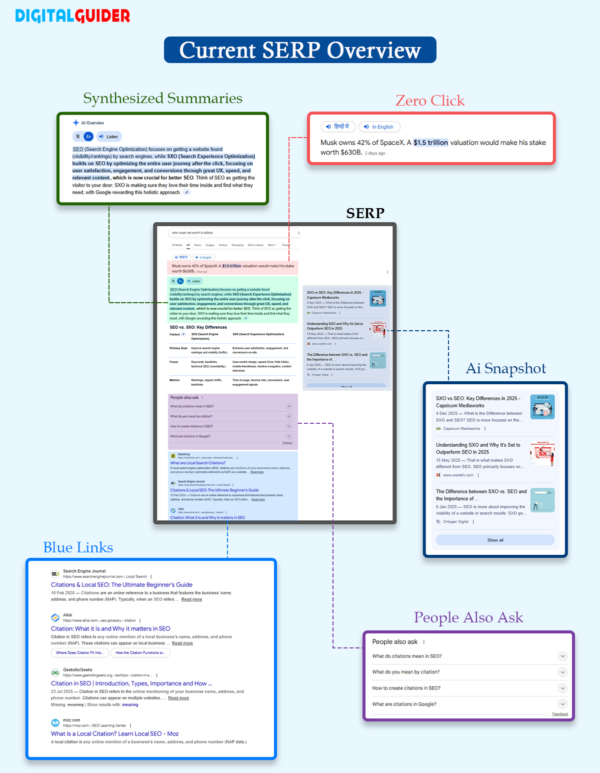
SERP AI Results
GEO Optimization Strategies
- Source optimization: Structure content so AI systems can easily recognize and cite it as a trusted source.
- Factual clarity: Use clear, accurate, and authoritative statements that AI can confidently summarize.
- Multi-perspective coverage: Cover a topic from different angles to help AI build complete answers.
- Freshness & regular updates: Keep content updated so AI considers it relevant and reliable.
- Topical authority: Build depth across related content clusters to signal expertise and trustworthiness.
SEO Optimization Strategies
- Structured data (Schema.org): Helps search engines better understand and display your content in SERP features.
- Clear Q&A formatting: Improves chances of winning featured snippets and People Also Ask boxes.
- Authority, trust, and E-E-A-T signals: Builds credibility through expertise, experience, and reliable sources.
- PageSpeed and Core Web Vitals: Ensures fast-loading, smooth user experiences that support rankings.
- Clean content hierarchy: Uses clear H1–H3 headings, lists, and tables to improve readability and extraction.
SEO vs AEO vs GEO vs AIO:
➨ SEO: Focuses on keywords, links, and website quality and helps your website appear higher on Google when people search for something.
➨ AEO: Is about clear questions and simple answers, which enables your content to be easy to read for Google, users, and voice assistants to pick as a direct answer.
➨ GEO: Focuses on authority and useful information, and helps AI tools like ChatGPT, Gemini, Grok, and Perplexity understand and mention your brand as a trusted source.
➨ AIO: Uses AI tools to speed up SEO work like content writing, analysis, and optimization.
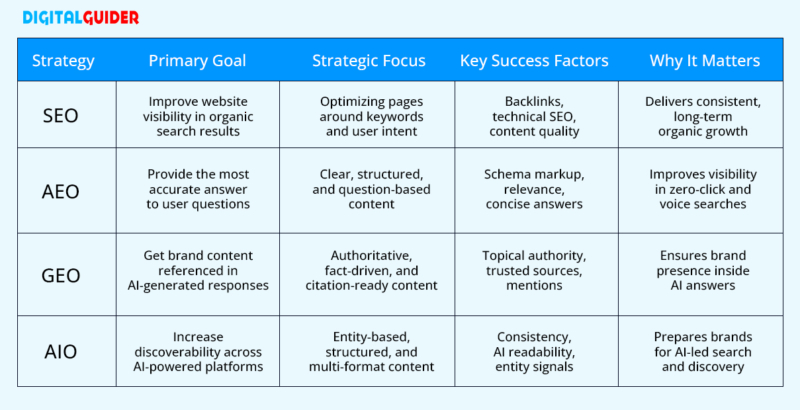
SEO, AEO, GEO, & AIO
How to start with AI SEO?
AI works best when your site already has strong technical SEO, clear content, and a good user experience. Automation without a proper audit often adds to the existing problems. AI SEO is no longer just about rankings—it’s about visibility across traditional results, AI Overviews, and answer-based search. A structured approach helps you adapt without over-optimizing. Use AI insights, but validate them with human review first. Here are some steps to start with AI automation:
- Integrate AI tools into your SEO workflow and audit your website for technical SEO. Optimize your top 10 pages for clarity and factual accuracy.
- Audit existing content for both extractive and generative AI. Create and optimize content for GEO (AI Overviews).
- Focus on search intent, trust, and real user experience. Content must be optimized for clarity, authority, and AI understanding, not just keywords.
- Test how AI summarizes your content using prompts. Monitor rankings, PAA, snippets, and AI citations together.
- Implement structured data to improve content interpretation.
- Optimize for voice and conversational queries.
- Use multimodal content (text, images, and video).
- Strengthen author and brand authority signals.
AI Tools for AI SEO Optimization:
1. Keyword research:
Helps find keywords people are actively searching for and shows how hard it is to rank for them. It also reveals competitors’ keywords and search trends to guide smarter content planning.
Focuses on discovering high-value keywords by analyzing search demand and ranking difficulty. It’s especially strong for finding keyword gaps and understanding why competitors rank higher.
AI Features (in SEO tools)
AI analyzes large keyword datasets to group similar terms by search intent automatically. It also predicts content opportunities and suggests keywords humans may overlook.
Uses AI to cluster keywords into meaningful topic groups based on intent. This helps create well-structured content that covers a topic fully, not just individual keywords.
2. Content creation:
Analyzes top-ranking pages and gives data-backed guidelines on word count, headings, and keywords. It helps optimize content structure to match what already ranks on Google.
Researches SERPs and automatically builds content briefs with questions, topics, and FAQs. It helps writers answer user intent more completely and faster.
It improves speed and consistency, but works best when guided by SEO data and human editing.
Assists in drafting, rewriting, and expanding content quickly using AI.
3. On-page optimization:
Analyzes top-ranking content to suggest relevant terms and topics to include. It helps improve topical relevance and content depth without keyword stuffing.
Uses AI to score content based on SEO best practices and ranking potential. It highlights on-page gaps like missing entities, weak headings, and optimization issues for improvement.
4. Technical audits:
Crawls websites like a search engine to identify technical SEO issues such as broken links, duplicate content, missing meta tags, and crawl errors. It helps SEO teams quickly diagnose and fix site-level problems that impact indexing and rankings.
FAQ
Q1. Should I prioritize traditional or generative AI SEO?
A1. Start with traditional (immediate wins), then layer in generative (future-proofing).
Q2. How do I know if AI Overviews are using my content?
A2. Manual testing – ask AI questions in your niche and see if you’re cited.
Q3. Will AI Overviews kill traditional SEO?
A3. No, they’ll coexist. Different intents trigger different result types.
Q4. Can AI do SEO?
A4. Not complete SEO, the best SEO combines AI with human insight and experience. AI can automate some parts of SEO. It can help you with keyword research, content suggestions, and analyze some technical issues. Think of AI as a powerful SEO assistant, not a replacement.
Q5. Can ChatGPT do SEO?
A5. No, ChatGPT cannot do SEO optimization on its own. However, it may be a powerful SEO assistant for tasks like keyword research, content ideas, meta tags ideas, GEO/AEO strategies, and other optimization techniques to boost visibility in AI responses. It has to be combined with human intelligence first.
Q6. What is the 30% rule in AI?
A6. The 30% rule in AI means AI can handle around 30% of the work, depending on what you want from it. While humans manage the remaining 70% including strategy decision-making, etc. This ensures quality & trust in SEO marketing.
Q7. Is SEO worth it anymore?
A7. Absolutely! SEO is evolving, not dying. With AI overviews and answer engines, visibility is more valuable than ever. SEO means your brand, product, service, and content are visible to everyone, whether it is traditional SEO or AI SEO. Without it, you’re invisible in the digital world. Totally worth it!
Q8. Does AI SEO mean auto-generated content?
A8. No, AI SEO does not mean only auto-generated content. It is a broader practice that uses AI tools for keyword research, technical optimization, and content strategy, while high-quality content remains human-guided.
Q9. Does Google penalize AI SEO?
A9. No, Google does not penalize AI SEO or AI-generated content itself. Google’s policy focuses on content quality and user value, not how it’s created. The penalty is for the low quality, not the AI origin.
Q10. Can AI replace SEO experts?
A10. No, AI cannot replace SEO experts. AI automates SEO tasks, while SEO experts provide a strategic vision that requires human experience. It works in collaboration, not replacement.