In this blog, we discuss:
- What is Black Hat SEO?
- Black hat techniques to avoid
- Risks and Penalties of using black hat seo
- How Google detects black hat seo techniques
- Real-world black hat seo examples
- How to recover from black hat seo penalties
- How to avoid black hat seo practices
What Is Black Hat SEO?
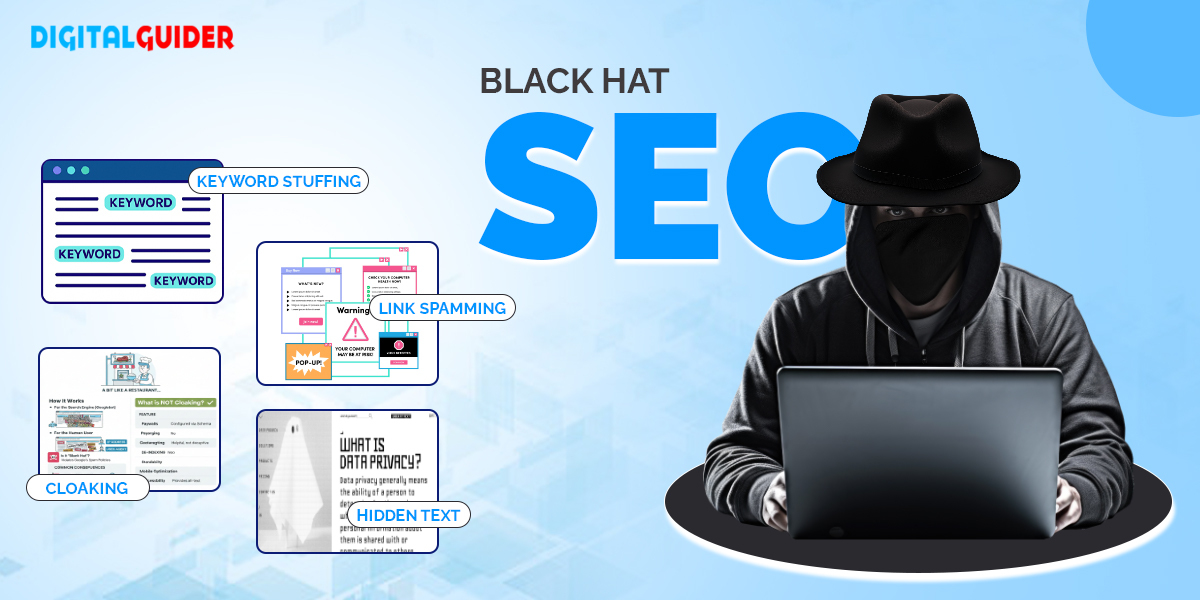
Black hat seo is the use of unethical, manipulative techniques to increase a website’s ranking in search engine result pages (SERPs), violating guidelines set by platforms like Google. These practices target search algorithms rather than providing real value to users. This may seem like an easy way to gain organic traffic and visibility, but it carries many risks, like algorithmic penalties, manual actions, ranking drops, de-indexing, and long-term damage to a website’s authority and credibility.
Why Marketers Use Black Hat SEO
Black hat seo in digital marketing has become an easier way to rank faster, earn revenue, and has many other reasons for its use for marketers:
| Promise of Fast Rankings The biggest reason marketers use black hat seo is speed. They want their website to rank higher in a very short time. Google uses algorithms to detect your site, and website owners usually fool it here with tactics like keyword stuffing, cloaking, private link networks, and automated backlinks. This makes it easy for ranking, but has consequences. Short-Term Profit Strategy Many marketers do not bother about long-term consequences; they just focus on short-term profit, which is the best part of black hat seo. Marketers use these unethical practices to increase their ranking, generate revenue and then disappear before any penalties. Competitive Pressure When it becomes difficult to rank/gain traffic, marketers usually notice their competitors’ practice of ranking and follow the same. They start using the same techniques to reach the position above their competitors. This comes as pressure and becomes a race to manipulate the algorithm of Google. Lower Upfront Investments Black hat seo gives you results quickly and lowers the upfront investments of link building, high-quality content, technical optimization, and brand building. Unlike white hat seo, marketers find the benefit in using these tactics for lowering their investments. Lack of Knowledge Not all black hat seo is intentional; some use the techniques due to a lack of knowledge of Google guidelines, and hence they may purchase low-quality backlinks, over-optimized anchor text, duplicate content, keyword stuffing, and more. |
Black Hat SEO Techniques to Avoid
Black hat seo techniques are the unethical practices used to manipulate search engine rankings that violate search engine guidelines. Here are the techniques that people use, but should avoid:
Keyword Stuffing
Keyword stuffing is a black hat tactic in which you use your primary keyword multiple times in a paragraph, resulting in poor readability, a bad user experience, and search engine penalties. This is a very common, unintentional (sometimes) practice in black hat seo.
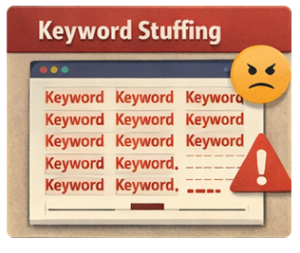
Keyword stuffing
Hidden Text and Links
Hidden texts and links are used to manipulate rankings without improving user experience. It involves placing links on a webpage that are invisible to the users but can be read by search engines. The keywords/links are hidden by matching the colour to the background, using CSS to hide text, placing texts off-screen, or using extremely small font sizes.
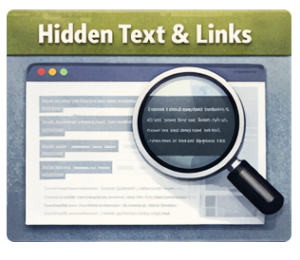
Hidden Text & Link
Cloaking
Cloaking is the practice of showing two different contents to search engines and users. This is a practice of manipulating the search engines with well-optimised content and misleading the users with unusual and unrelated content. This may lead to penalties, de-ranking, and more such consequences.
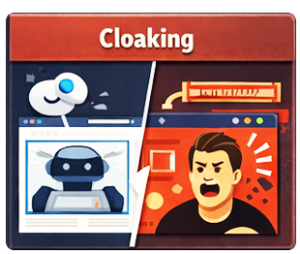
Cloaking
Doorway Pages
Doorway pages are low-quality web pages that are created to rank a specific keyword and manipulate search engines. The sole purpose of these pages is to funnel the users to a totally different, often unrelated landing page.

Doorway Pages
Link Farms
Link farms is a tactic in which many websites are created to give backlink support to a single website. These websites contain very thin and unrelated content, which is merely written to deceive the search engine algorithms.

Link farming
Private Blog Networks (PBNs)
Private blog networks are a group of websites owned by a single person/company that is used to create multiple backlinks for their main/big webpage (especially a ‘money website’). They use websites whose domain has expired but has authority. PBNs usually hide their identity as if owned by one person, but Google and other search engines may detect the same and can cause you high penalties.

Private Blog Network
Paid Links
Paid links are links that the website owner buys from high authority sites in order to rank their webpage. This black hat seo technique is used to increase the ranking of a page by passing the link equity. This is considered unethical by Google.
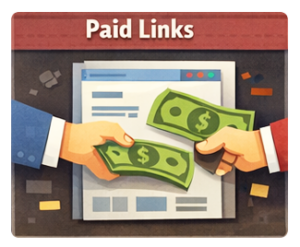
Paid links
Content Scraping
Content scraping is a way in which you copy/extract some content from search bots or some websites without the owner’s permission. This constitutes copyright infringement and can lead to legal consequences. It is considered unethical and can lead to severe penalties.

Content scraping
Article Spinning
Article spinning is a black hat tactic in which you create multiple copies of a single piece of content and spin it by using synonyms, changing headings, structure, and more. This is done to post multiple pieces of content on a single topic in different ways to bypass duplicate content filters by SEO. This may result in low-quality, unreadable content, which can frustrate the user and cause you Google penalties.

Article Spinning
Negative SEO
Negative SEO aims to destroy the competitor’s website ranking. This includes building spammy, low-quality backlinks, copying content, or hacking. It may also include spreading fake/negative reviews. This is unethical and can cause you legal penalties.
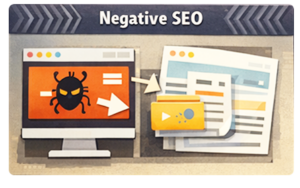
Negative SEO
Structured Data Manipulation
Structured data manipulation involves adding misleading or fake schema markup. It includes adding fake reviews, incorrect ratings, or deceptive product information. If this gets detected by search engines, it may remove rich result eligibility, cause you penalties, or de-rank your website.
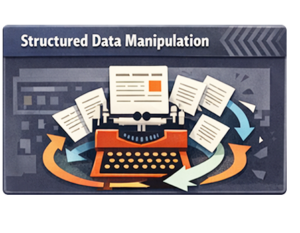
Structured Data Manipulation
How Google Detects Black Hat SEO
The detection of spam has changed significantly over time, especially with Google ranking algorithms:
1. Core Algorithms
- Google Penguin algorithm has transitioned from operating as an independent algorithm to working within Google’s core algorithm, which catches spam through backlink pattern recognition, discovering link farms, and identifying excessive anchor text optimization.
- Google Panda has transitioned from an independent algorithm that was focused on evaluating low-quality content to now being integrated into the Google core update that uses the same methodology for checking overall content quality.
- Google Hummingbird allows Google to understand the intent behind search queries by searching for relevant terms rather than exact matching terms.
- Google RankBrain is allowing Google to utilise machine learning to create algorithms that help identify search queries that have never been attempted and develop an understanding of how individuals are using search results.
- Helpful Content System: Google’s helpful content will vary in relation to the overall rank assigned to a website based on the content being produced for users.
2. User Signals
Google is always watching user behaviour when they’re reading your content. Google uses indirect engagement signals to determine if users are engaging with your content. These include:
- High bounce rates.
- Very short dwell time.
- Low click-through rates.
- Pogo-sticking.
3. Manual Review Team
Google employs a human review team to investigate spam reports, apply manual penalties and demote sites from the SERP, or de-index them if the infraction is severe enough.
Site owners will receive notification of action taken against them, including Google Search Console. The Console will notify you of any manual penalties or demotions against your content for infringement or use of spammy techniques. It will also notify you of security issues and any spam warnings.
Risks and Penalties of Black Hat SEO
Black hat seo is not a growth strategy; it is a risk strategy. While you may see a sudden rise in your ranking and traffic, there are many risks and penalties associated with using these techniques:
- Algorithm Penalty: If you continue running your site with black hat techniques, Google’s algorithm will automatically detect the spam/low-quality content. It is a serious issue, as with all the warnings and detection, it affects your page, or sometimes may affect the whole website.
- Manual Action: It means your website is detected and analysed by a human reviewer. This action will put your website at a high risk and result in affecting your high-ranking page/deranking your entire website.
- Deindexing: It happens when there are repeated violations of Google’s rules and algorithm. The seriousness is extreme because your whole website will be removed from the SERPs. This triggers the entire revenue generation medium and has the most drastic SEO consequences.
- Long-Term Brand Damage: This is the result of the continuous use of black hat tactics and many warnings. The seriousness is high as it will demolish the credibility of your brand, and you may lose the trust of your users.
- Legal Penalties: It is related to the use of someone else’s content, copyright infringement, trademark violation, or more. The seriousness is extreme, with financial fines, lawsuits, and may result in the closing of your business.
| Risk Type | What Triggers It | Seriousness | Who/What It Affects |
| ⚠️ Algorithmic Penalty | Google automatically detects spammy content or low-quality pages | Medium–High | Affects pages or sometimes the whole site |
| ⚠️ Manual Action | A human reviewer finds violations of Google’s rules | High | Specific pages or your entire website |
| ⚠️ De-indexing | Severe or repeated rule-breaking | Extreme | Your whole website can disappear from search results |
| ⚠️ Long-Term Brand Damage | Losing user trust, a bad reputation, and repeated penalties | High | Your brand’s credibility and authority in the market |
| ⚠️ Legal Penalty | Copyright infringement, using someone else’s content, and trademark violations | Extreme | Financial fines, lawsuits, or even the risk of closing your business |
Real World Examples of Black Hat SEO
Let us understand the real risks and black hat seo examples that have led to destroying the whole website/business in one go:
1. J.C. Penney’s Paid Link Scheme (2011)
In 2011, J.C. Penny was using an excessive paid link scheme to rank #1 for highly competitive keywords like “dresses”, “bedding”, and “area rugs”. This was exposed by the New York Times, and it revealed that thousands of unrelated websites linked to J.C. Penny were using exact anchor text. This was clearly a tactic used to manipulate rankings.
What Happened?
- Google put manual penalties on the site.
- What was ranking on the 1st page of SERP, was plummeted overnight.
- This was a huge loss for J.C. Penny.
Lesson: Using paid and manipulative backlinks can trigger manual penalties and will destroy your whole site.
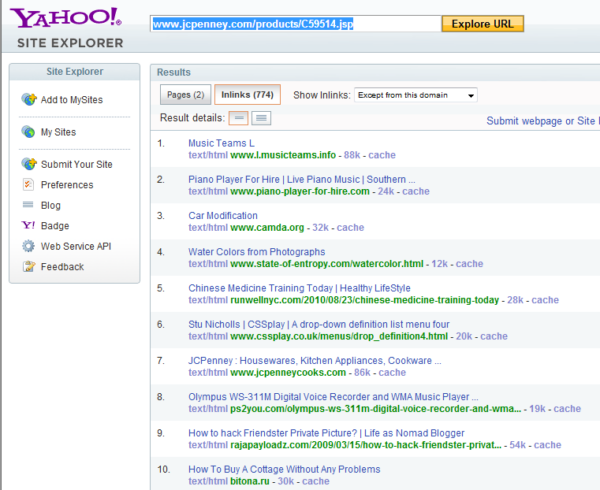
Source: Search Engine Land
2. Sea Wall / “A Life” Domain Manipulation (2019)
The company behind the film ‘A Life’ (referred as ‘sea wall’) purchased a high authority domain and redirected it to their project site. This was a case of domain manipulation and was done to increase its rankings and build high authority. This is a common black hat tactics that resulted in major consequences.
What Happened?
- Google detected the unnatural redirect
- It resulted in dropping their rankings drastically
- Unethical SEO benefits turned out to be a sign of disappearing from the search pages
Lesson: Google algorithms are designed to detect such irrelevant redirects and thus be extra careful while manipulating the domain for a temporary boost.
3. DoNotPay’s Sudden Traffic Decline Case
DoNotPay was a site that had a major organic traffic of 2 million+, but it dropped heavily after search algorithm updates. This happened because they relied on aggressively optimised programmatic pages, large-scale keyword targets, and thin or templated content.
What Happened?
- Sudden traffic loss.
- Many pages were de-ranked
- Huge loss to the authority built
Lesson: Scaling content without maintaining quality can lead to algorithm penalties.
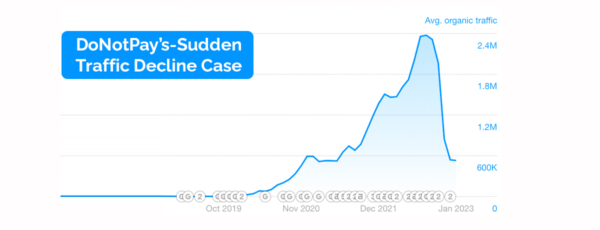
DoNotPay’s-Sudden Traffic Decline Case
4. BMW & Doorway Pages (2006)
In 2006, BMW was penalised for using doorway pages that were stuffed with keywords designed to rank high, but redirect users to another page. This black hat tactic was used to trick the search engines into sending users to web pages that are not directly related to the search intent. Initially, BMW denied using these techniques, but after a strict warning and penalties, they agreed and were ready to accept the consequences.
What Happened?
- Google removed BMW.de from its indexing.
- The site almost lost its authority on Google.
- The brand temporarily disappeared from search results.
Result: After public acknowledgement and removal of the deceptive pages, the site was regained and reinstated.
Lesson: No matter how big the brand is, Google penalties are unbiased for everyone.
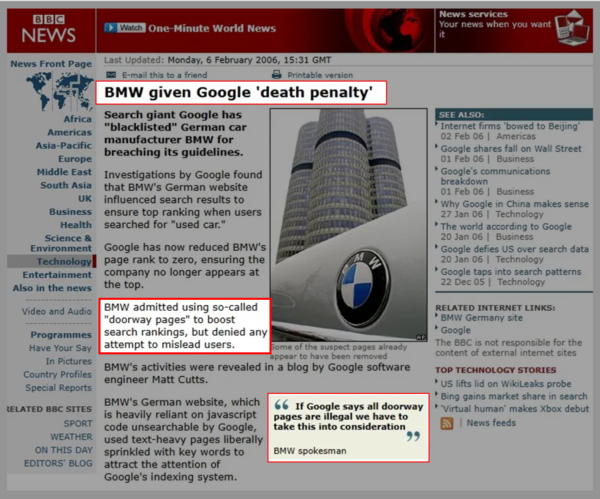
BMW-doorway page case
5. Overstock.com- Paid Links (2011)
Overstock.com offered discounts to universities in exchange for backlinks from .edu domains. This was done to earn rankings from the links that carry strong authority signals. This is a very common black hat tactic, which results in de-ranking, visibility dropped, and more.
What Happened?
- Violation of Google’s link scheme guidelines.
- The site was de-ranked.
- Organic visibility dropped significantly.
Lesson: Incentivised or exchanged links can be classified as manipulative tactics and trigger consequences and penalties.
Black Hat, White Hat & Gray Hat SEO
Search engine optimisation can make or break your online visibility. While some businesses focus on working under the guidelines set by Google search engines, others opt for some tactics to ease their business ranking and later on face severe consequences. Understanding the difference between white hat and black hat seo is important to get real and authentic results. Before that, let us understand what is white hat seo.
What Is White Hat SEO?
- White Hat SEO is an ethical method of achieving a good ranking for a website in the search engines. The process adheres to the guidelines set by search engines and tries to provide users with value rather than just attempting to manipulate the system.
- The goal is to create a website that deserves a high ranking in the search engine results rather than to try to use any type of deceitful technique or scheme to get there.
- The net result of using White Hat SEO will be a sustained increase in traffic to your site, long-term search engine rankings, and a better overall perception of your brand among consumers.
Key Differences Between Black Hat and White Hat SEO
| Aspect | White Hat SEO | Black Hat SEO |
| Definition | Follows search engine guidelines and focuses on user experience | Violates search engine rules to manipulate rankings |
| Techniques | Quality content, proper keyword use, ethical link building, and technical optimization | Keyword stuffing, cloaking, hidden links, spammy backlinks, PBNs |
| Goal | Sustainable, long-term growth and authority | Quick ranking gains, often short-lived |
| Risk Level | Low risk; safe from penalties | High risk; can lead to penalties or deindexing |
| Content Strategy | User-focused, original, valuable content | Search engine-focused, often manipulative, or low-quality |
| Link Building | Earned organically from credible sources | Purchased, spammy, or manipulative links |
| User Experience | Prioritized; optimized navigation and readability | Often neglected, manipulative techniques degrade the experience |
| Results | Steady, reliable growth over time | Temporary spikes; high chance of ranking loss |
What Is Gray Hat SEO?
Gray hat SEO lies between the two tactics- white hat and black hat seo. It is a technique that is less harmful than black hat, but still has some penalties and consequences. Some common gray hat seo techniques are buying expired domains, excessive keyword stuffing, and unnecessary link building.
How to Recover From Black Hat Penalties
1. Identify the Penalty
Check Google Search Console:
- Go to security & manual actions
- Click on manual actions
- You will either see ‘no issue detected’ or ‘a list of penalty’
- If you notice a sudden traffic drop, it may not be a manual warning; rather its the algorithm update
2. Find the Root Problem
- Bad links? Remove spammy backlinks
- Thin/duplicate content? Improve, merge, or delete low-quality pages
- Cloaking/hidden text? Remove immediately
3. Submit Reconsideration (Manual Only)
- Submit your request in Google Search Console
- Admit the issue
- Explain how it happened
- Show all the valid proof
- Commit to following the guidelines
4. Gain the Trust
- Publish high-quality & informative content
- Earn natural backlinks
- Improve the UX of your website
- Be mindful and natural with your website
How to Avoid Black Hat SEO Practices
Follow Search Engine Policies
| As a website developer, it’s required that you comply with Google & Bing’s webmaster guidelines when creating your site. Tactics used to manipulate the search engines are not allowed. |
Create Quality Content
| Your website should contain original and valuable information for your visitors. Avoid duplicating content, stuffing keywords into your text or spinning content. Concentrate on addressing the needs of your visitors. |
Do not Buy Backlinks
| Never purchase backlinks or become involved in link-building schemes. Backlinks to your website should come from creating high-quality materials and developing good relationships. |
Do Not Cloak Or Hide Text
| Both your visitors and the search engines should be able to view the same information on your website. Failure to do so through the use of hidden text, doorway pages, or sneaky redirection will lead to penalties. |
Regularly Monitor/Check The Performance Of Your Website
| Utilise tools such as Google’s Search Console to monitor your site’s performance. This provides a quick method to track all aspects of your website’s performance. |
Look Long-Term
| Using a white-hat SEO policy will allow for an even-paced, long-term growth of your website while minimising the chances of you experiencing any penalties; make sure you do not take any shortcuts to enhance the experience of your website visitors. |
FAQs About Black Hat SEO
Ques: Is black hat seo illegal?
Ans: No, not usually, but it violates search engine guidelines. However, some tactics, like content theft and copyright infringement, will lead to legal consequences along with Google’s penalties
Ques: Does black hat seo still work in 2026?
Ans: Yes, black hat seo still works in 2026, but it is riskier with the advancement of AI-driven spam detection and frequent Google algorithm updates.
Ques: How long does it take Google to detect black hat seo?
Ans: Detection may happen within hours or days if it is obvious. But sometimes a few websites go unnoticed before algorithm updates.
Ques: Are AI-generated articles considered black hat seo?
Ans: No, not directly. AI-generated articles do not count as a black hat seo tactic, until it contains thin, spammy content or are created solely to manipulate search engines.
Ques: Can a website get permanently banned for using black hat seo?
Ans: Yes, with continuous use of black hat seo despite all the warnings and consequences, your website can be removed permanently from the search results.