Synopsis Bluesky vs Twitter (X) is one of the most searched social media comparisons as users look for alternatives to traditional platforms. Twitter (X) remains the largest real-time conversation network, while Bluesky is gaining attention for its decentralized design, cleaner feeds, and creator-friendly engagement. This guide compares Bluesky and Twitter (X) based on users, growth, features, engagement, and use cases—so you can decide which platform fits your goals in 2026.
Bluesky is a decentralized, microblogging social media service often seen as an alternative to X (formerly Twitter). However, it is totally based on different technology and philosophy. It runs on an open-source framework called the Authenticated Transfer Protocol (AT Protocol). This means other developers can build their own social apps or networks that can communicate and operate with Bluesky. You could even move your account and followers to another app built on the AT Protocol without starting over. Although it is far smaller than X, it still appeals to users looking for a fresh start in social microblogging, with a focus on user control and transparency.
How It Differs From Twitter/X:
Bluesky looks and feels a lot like Twitter/X. But on Bluesky, your profile and data are portable; you can choose or change your feed algorithm, and if it shuts down, you can take your posts and followers with you. Bluesky focuses more on privacy, transparency, user control, and gives power to users. Twitter/X focuses on engagement, growth and gives power to the platform.
Bluesky vs Twitter (X): Quick Comparison
| Feature | Bluesky | Twitter (X) |
| User Base | Smaller but growing fast | Hundreds of millions |
| Platform Type | Decentralized | Centralized |
| Ads | Minimal / none | Ad-heavy |
| Algorithm Control | More transparent | Algorithm-driven |
| Best For | Creators, artists, niche communities | News, brands, mass reach |
| Engagement | Higher per post in niches | Higher total engagement |
| Monetization | Still evolving | Subscriptions & ads |
What is the AT Protocol in Bluesky?
AT Protocol is a network of many servers working together (a decentralized framework) that powers Bluesky Social Media. It is an open-source toolbox that gives Bluesky users and developers more control over their data and interactions. This framework lets you move your account, choose algorithms, and customize moderation. The AT Protocol is like owning your phone number; you can change providers while remaining connected. It gives you control over your digital identity.
How AT Protocol Really Works – Step-by-Step
1. DID + Handle:
When you join AT Protocol, you get a secure Decentralized Identifier (DID). This is your permanent & unique digital ID. You also have a human-readable handle (for example, @yourname.bsky.social), which links to the DID. This gives you a portable account that stays yours even if you change servers.
2. Personal Data Server (PDS):
PDS is your own social storage for social content; you own & control it. Every user gets a Personal Data Server (PDS) that stores their posts, reactions and likes, follows and blocks, and any other activity.
3. Apps Read & Write from Your PDS:
When you use an app (like the official client or a third-party client), the app doesn’t store your data, it fetches from and writes to your PDS. Your content stays decentralized; apps just act as access tools.
4. Your Data & Account Are Portable:
Because data is stored securely and linked by your DID, you can migrate your entire account and content to a different server without losing any posts or followers.
5. Decentralized Network:
Posts are discoverable worldwide because they use a network of many servers working together. Even if you are on one PDS and another user is on a different one, you can still see each other’s posts, follow, and interact.
6. Control Over Privacy & Data Ownership:
The protocol supports privacy settings, account portability, and gives you control over how and where your data is stored. Since your PDS holds your data and you control your DID, you own your data.
Why AT Protocol Matters for Users:
Users get full ownership of their content and identity. Your data is portable; you can switch servers or clients without losing anything. Decentralization means less censorship risk and more freedom to choose how you show yourself online. It means broader reach & more control over assets. Moreover, it is very easy to migrate – a big advantage for long-term social presence and branding.
Bluesky vs Twitter/X: Key Features Compared
| Feature | Bluesky | Twitter/X |
| Network Type | Decentralized social network | Centralized platform |
| Data Ownership | Users own their data | Data is controlled by Twitter/X |
| Algorithms | Choose or build custom feed algorithms | One main algorithm controlled by platform |
| Freedom & Control | Users control what they see and where their data goes | Limited control, reliance on platform rules |
| Account Portability | Can move profile, followers, and content | Locked to Twitter/X ecosystem |
| Privacy Focus | Designed for stronger privacy | Often criticized for privacy concerns |
| User Experience | Clean, simple interface; fewer ads and clutter | Ads, recommendations, and promotional content visible |
| Developer Ecosystem | Open source and open for developers to build apps | Controlled and closed ecosystem |
| Vision | Long-term idea of a user-first, open social web | Corporate and revenue-driven platform |
1. Decentralized Ownership:
Bluesky runs on a decentralized protocol, which means your data is not owned by one company or platform.
Bluesky: If you ever move to another app built on AT Protocol, your account, posts, and followers come with you.
Twitter/X: You cannot move to another app with your data, as everything is locked inside the platform.
2. Personalized Algorithms:
You decide what you want to see in your feed – not the platform. Instead of a single default feed, Bluesky lets you choose or create the type of content you want to see.
Bluesky: You can install a feed like “Tech Only,” “No Politics,” or “Friends First.”
Twitter/X: On X, the algorithm decides what appears.
3. Portable Profile and Followers:
Your profile, handle, connections, and data travel with you. Your identity and followers stay with you, even if you switch apps.
Bluesky: You start on the Bluesky app → move to another AT Protocol app later → your username, followers, and posts come along.
Twitter/X: Twitter/X does not give this option.
4. Interoperability Across Platforms:
It is not an isolated platform; Bluesky is built to connect with other apps.
Bluesky: A user on another AT Protocol app can reply or follow you just like on Bluesky, like WhatsApp and Telegram talking to each other.
Twitter/X: X is a closed platform and does not support external access.
5. Strong Focus on Privacy:
Users get more control over how their information is shared. Gives you more control over who sees your content and data.
Bluesky: You decide what content is public or private.
Twitter/X: On Twitter/X, data is used mainly for advertising and recommendations.
6. Simple & Clean Interface:
Bluesky keeps the UI simple and easy to navigate. A minimal interface with fewer confusing menus and monetization features.
Bluesky: No clutter. Just posts, replies, and feeds.
Twitter/X: Easier for beginners than Twitter/X.
7. Community-Centered Development:
Bluesky includes users and developers in shaping the platform’s future. Users participate in decisions and platform rules.
Bluesky: Bluesky allows community-made moderation tools and feed rules.
Twitter/X: On X, rules often change suddenly and centrally.
8. Open-Source Platform:
The platform is transparent and open for developers and brands. Everyone can see how it’s built and contribute.
Bluesky: Developers can build new feeds, features, and apps on top of Bluesky.
Twitter/X: Twitter does not allow this level of access.
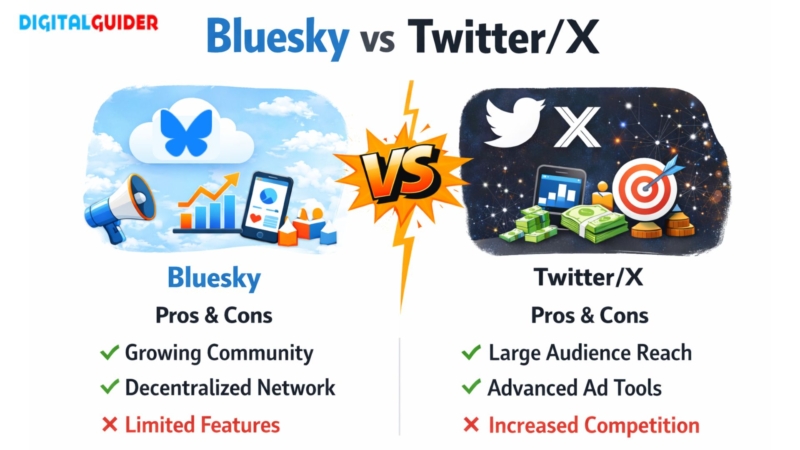
Bluesky vs Twitter/X: Pros and Cons
Pros of Bluesky:
- Users own their profile and data
- Fewer ads and less algorithm control
- Built for privacy and decentralization
- You can customize your feed experience
- Cleaner interface and less clutter
- Better long-term future for creators
- Supports social selling opportunities
Cons of Bluesky:
- Still a newer platform with fewer users
- Features and tools are still being built
- Smaller audience for brands and marketing
- Not as many third-party tools and analytics yet
Pros of Twitter/X:
- Massive global user base
- Great for news, trends, and real-time updates
- Wide reach for brands and creators
- Mature ecosystem with ads, analytics, and monetization
Cons of Twitter/X:
- Data and identity are platform-controlled
- Heavy moderation, ads, and algorithm control
- Privacy and security concerns
- Changes and rules depend on a single company
Bluesky: If your goal is long-term brand control, privacy, community building, and experimenting with new social media formats, Bluesky has a strong future. Its decentralized system gives creators more control over their audience, and brands can build niche communities without worrying about platform rules changing overnight. Best for Future Growth!
Twitter/X: If your goal is fast reach, trending content, and a large audience, Twitter (X) is still the stronger marketing platform. It has more users, better advertising tools, and widespread brand presence. Businesses can run ads, promote posts, use analytics, and instantly reach large audiences. Best for Marketing Today!
bluesky vs X
Why Bluesky is Gaining Popularity?
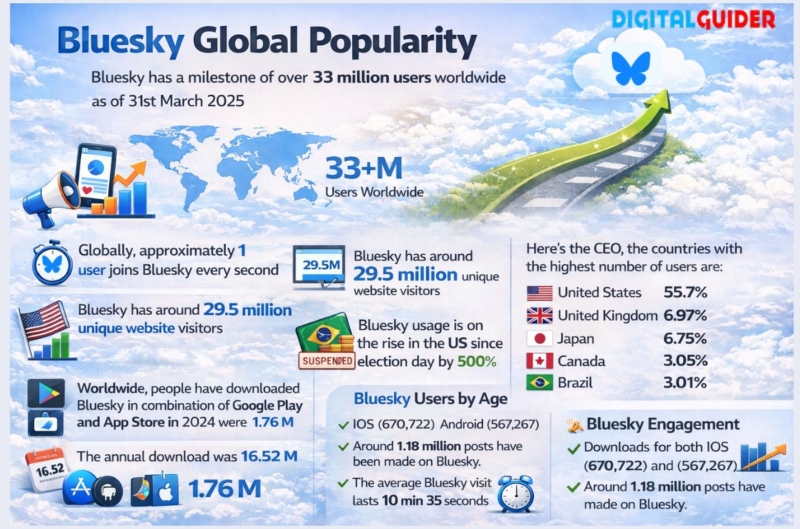
Because of engagement. It increases visibility, builds connections, and extends reach. The change from Twitter to X under Musk changed the social media scene, leading users to move to different platforms like Meta, Threads, and Bluesky social. Though the latter one is much smaller (23M users) as compared to Threads (275M) & X (535M), it shows higher engagement:
- Bluesky has downloads for both iOS (670,722) and Android (567,267) operating systems.
- Around 1.18 million posts have been made on Bluesky.
- The average Bluesky visit lasts 10 minutes and 35 seconds
- Engagement per follower on Bluesky is 10x higher than on X/Twitter.
Some more Bluesky facts:
- Bluesky has over 33 million users worldwide as of March 31, 2025
- Approximately one new user joins every second globally
- Around 29.5 million unique website visitors
- 500% growth in U.S. usage since Election Day
- 3 million new users gained after X/Twitter was suspended in Brazil
- 1.76 million downloads globally in 2024 across Google Play and the App Store
- 16.52 million total downloads worldwide recorded in 2024
As per Bluesky’s CEO:
Bluesky users by country:
| United States | 55.7% |
| United Kingdom | 6.97% |
| Japan | 6.75% |
| Canada | 3.05% |
| Brazil | 3.01% |
Bluesky users by age:
| 18 to 24 | 35.02% |
| 25 to 34 | 27.67% |
| 35 to 44 | 14.67% |
| 45 to 54 | 10.03% |
| 55 to 64 | 7.74% |
| 65+ | 4.92% |
Sources: Statista, Exploding Topics, Semrush, Jaz Statistics, Adam Connell, Backlinko, Wikipedia
Bluesky social became popular in a short period among other versatile social media sites because it is independent, giving users more freedom and control. The open protocol allows developers, publishers, and businesses to build custom tools and apps on top of the platform. It provides flexibility to tailor social media strategy.
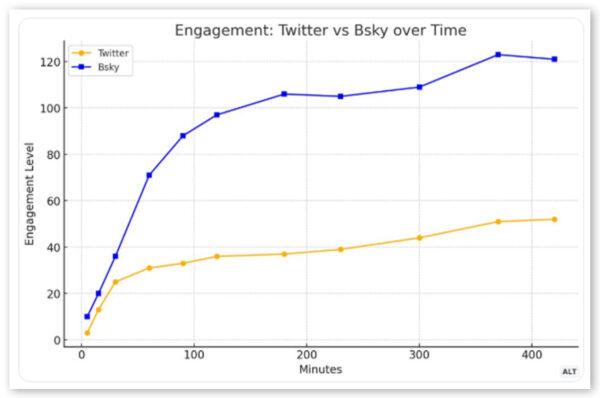
source: Bluesky
Conclusion
Bluesky and Twitter/X both have their pros & cons. Bluesky offers a more user-controlled, decentralized ecosystem, while Twitter/X continues to lead in scale, visibility, and established features. Ultimately, the right platform depends on what matters most to you—privacy and ownership, or reach and speed. As both platforms evolve, the best choice will vary for users & businesses.
Frequently Asked Questions: Bluesky vs Twitter (X)
Q1. How many users are on Bluesky vs Twitter (X)?
Ans. Twitter (X) still has a significantly larger global user base, with hundreds of millions of active users. However, Bluesky is growing rapidly, especially among early adopters, developers, journalists, and creators looking for a decentralized social experience.
Q2. Are Bluesky users increasing?
Ans. Yes, Bluesky users are increasing steadily. The platform has seen strong growth during periods of major policy changes on Twitter (X), with many users joining to explore its open and decentralized social networking model.
Q3. Are people leaving Twitter for Bluesky?
Ans. Many users are experimenting with Bluesky as an alternative to Twitter (X), particularly creators, artists, and tech communities. While most users haven’t fully left Twitter, there is a clear trend of cross-posting and gradual migration.
Q4. How does Bluesky compare to Twitter (X) in terms of users and engagement?
Ans. Twitter (X) currently offers a broader reach and higher overall engagement due to its size. Bluesky, on the other hand, delivers more focused conversations, fewer ads, and stronger community-driven interactions.
Q5. Bluesky vs Twitter vs Threads – which is better?
Ans. Twitter (X) is best for real-time news and mass reach. Threads focuses on Instagram-linked social sharing, while Bluesky appeals to users who prefer decentralized platforms and algorithm transparency. The “better” option depends on user goals.
Q6. Bluesky vs Twitter vs Mastodon – what’s the difference?
Ans. Bluesky and Mastodon both emphasize decentralization, but Bluesky offers a simpler onboarding experience. Twitter (X) remains centralized with broader visibility but less user control over algorithms.
Q7. Is Bluesky better than Twitter for artists?
Ans. Many artists prefer Bluesky due to better content visibility, fewer ads, and stronger community engagement compared to Twitter (X), where algorithm changes can limit organic reach.
Q8. What do Bluesky vs Twitter stats show?
Ans. Recent stats highlight Twitter’s dominance in total users, while Bluesky shows faster percentage growth and higher engagement per post within niche communities.
Q9. Should businesses use Bluesky or Twitter (X)?
Ans. Most businesses still get better results from Twitter (X) because of its large audience and strong real-time reach. However, Bluesky works well for early-stage brands that want to build niche communities and engage with highly focused audiences.
Q10. Is Bluesky replacing Twitter (X)?
Ans. No, Bluesky is not replacing Twitter (X). Instead, it’s becoming a popular alternative for users who prefer decentralized platforms, fewer ads, and less algorithm-controlled feeds.
Q11. Which platform is better for creators: Bluesky or Twitter (X)?
Ans. Bluesky is often better for creators who want organic visibility and stronger community interaction. Twitter (X) remains more effective for creators looking for viral reach and large-scale exposure.
Q12. Can you use Bluesky and Twitter (X) together?
Ans. Yes, many users and brands actively use both platforms. Cross-posting on Bluesky and Twitter (X) helps maintain reach while testing engagement on newer, decentralized networks.
Share This Article
About the Author: Stella Quinn

Related Articles
 October 5th, 2026 | 7 minutes read
“Why isn’t my law firm showing up when potential clients search for an attorney?” Imagine, as a law firm owner,
- October 1st, 2026 | 8 minutes read
Growing your business online sounds simple until you see how many marketing options there are. SEO? Social media? Paid ads?
- September 28th, 2026 | 9 minutes read
Chicago businesses don’t all compete in the same way. A local restaurant in River North, a growing company in Fulton
- September 21st, 2026 | 8 minutes read
Someone nearby is searching for a cannabis dispensary right now. They may want a specific strain, need to check store