Last Updated: 16-12-2025
What is SEO for Lawyers?
SEO for lawyers—also known as lawyer SEO or legal SEO—is all about helping people find your law firm online when people are actively searching for legal help services. It focuses on improving your website, Google Maps presence, and overall visibility and it makes your website and Google Maps listing easier to find when someone is looking for legal services. The goal is simple: attract more genuine, high-intent visitors who are already looking for the legal services you offer.
SEO for Lawyers vs General SEO
☑️ Purpose
While general SEO applies to all industries, legal SEO considers specific factors that affect how law firms rank and get found online. For example local search, strict YMYL (Your Money Your Life) content guidelines, compliance with bar association rules, alignment with search engine algorithms, legal marketing ethics etc.
☑️ Focus
| Aspect | SEO for Lawyers | General SEO |
|---|---|---|
| Goal | Get potential clients searching for legal services | Increase traffic, leads, or sales for any type of business |
| Target audience | People looking for legal help (clients, cases) | Anyone searching online for products, services, or information |
| Search intent | Mostly local & transactional (e.g., “best criminal lawyer near me”) | Can be informational, commercial, or transactional depending on business |
☑️ Keywords
Lawyer SEO focuses on local legal keywords, service-based searches, and practice-area related keywords, e.g. “divorce lawyer in Dallas”. General SEO targets any industry or niche-specific keywords e.g. “best running shoes”.
☑️ Content Strategy
Lawyer SEO focuses on educational content about legal topics, FAQs and guides. Content must show (EEAT) experience, expertise, authority, trust. Law content needs to ensure that all content aligns with legal advertising guidelines in the area jurisdiction. General SEO content focuses on clicks, engagement, and conversions, and can be anything from entertainment, product reviews to tutorials, or blogs.
☑️ On-Page & Technical SEO
Lawyer SEO focuses on local SEO, Google Maps, structured data (lawyer schema), contact info, mobile friendly local searches etc. In general SEO speed & UX are important, on-page SEO varies based on niche and local SEO may be optional.
☑️ Off-Page SEO / Link Building
In lawyer SEO citations in legal directories, local business listings, reviews on Google My Business, backlinks from authoritative legal blogs or local media are important. General SEO backlinks can come from any relevant sites or industry blogs with high DA and good traffic.
☑️ Compliance & Trust
Law firms must approach SEO with integrity. That means avoiding misleading claims and respecting client confidentiality. Lawyer SEO must follow YMYL (Your Money Your Life) rules as it comes under regulated industry marketing. Credentials, and reviews must be very strong. General SEO has fewer strict rules.
Why SEO for Lawyers Matters?
- Most people search on Google first when they need legal help
- SEO helps your law firm appear on Google Maps and top search results
- Makes it easier for potential clients to find and contact your firm
- Builds trust and credibility through visibility, reviews, and helpful content
- Attracts high-intent clients who are already looking for a lawyer
- Reduces dependence on paid ads and referrals over time
- Delivers long-term, cost-effective leads for your practice
Understanding How Legal Clients Search Online
Before you can optimize your website, it helps to understand how your potential clients behave online.
Most legal clients aren’t casually browsing—they’re searching with urgency and purpose. Whether it’s “DUI lawyer near me,” “how to file for divorce in [state],” or “car accident lawyer free consultation,” people are typing questions or service-based queries into Google, expecting quick, local, and trustworthy answers.
Their search journey often includes:
- Typing a specific legal issue or need into Google.
- Checking out the top few results. (organic listings, Google Maps, or the “Local Pack”)
- Visiting 1–2 law firm websites before making a call or filling out a contact form.
The better your website matches what they’re searching for—both in language and location—the more likely they are to choose you over a competitor.
Does SEO for Lawyers Work?
Yes, SEO works for lawyers—but only when it’s done with a clear understanding of how legal consumers behave online.
Search Behavior of Legal Clients
Legal clients are often in a moment of stress or urgency. They’re not researching for fun—they’re looking for help. That’s why phrases like:
- “Best personal injury lawyer near me”
- “Immigration attorney in Houston”
- “How much does a DUI lawyer cost?”
…are so common. These searches are specific, local, and high intent.
The Role of Search Intent
Understanding search intent is key to effective legal SEO. For example:
| Search Phrase | Intent |
| “Best criminal lawyer near me” | Ready to hire |
| “What happens after a second DUI?” | Researching options |
| “Free consultation personal injury firm” | Cost-conscious, ready to call |
When your website content matches these different search intents, you improve your chances of attracting and converting the right clients.
Understanding SERP Types
Not all search results are the same. Legal clients often see different result types on Google, including:
- Local Pack: A box showing 3 local firms with map locations and reviews
- Organic Listings: Standard search results based on SEO performance
- Map Results: An expanded view of law firms nearby, often tied to your Google Business Profile
Strong SEO helps your law firm appear in all three areas—especially the Local Pack, which drives a high volume of calls and clicks.
Top SEO for Lawyer Strategies to Get More Clients
If you’ve ever wondered why some law firms show up at the top of Google while others barely make page two, it comes down to smart SEO strategy.
Strategic Law firm SEO campaign aligns your website with how real clients search—and how Google delivers results.
Several pieces need to work together to convert visitors into consultations to make that happen.
Let’s break those down.
Keyword Research for Law Firms
Successful keyword research begins by asking questions like –
What are your potential clients typing into Google?
Your job is to uncover those exact phrases—and show up when it counts.
Not all searches are the same, some have informational intent, some are of a commercial sense.
For example, “How does divorce work?” is someone doing research; “divorce lawyer near me” is someone looking to hire a lawyer.
High-intent keywords are the ones you want to prioritize. Look for clues like:
- Local intent: “in [city],” “near me,” or neighborhood-specific queries
- Legal urgency: “emergency custody,” “defend DUI,” “file now”
- Specificity: “probate lawyer for small estate,” not just “lawyer”
- ✅ “DUI lawyer in Fort Worth” = someone is ready to call.
- ❌ “What is a DUI” = still doing homework.
This distinction helps you attract people who are looking to hire, not just learn.
Note: Although commercial keywords are great for your legal firm’s ROI. But be mindful not to completely ignore informational ones. These keywords will help you establish yourself as a go-to expert in the law firm industry.
Google’s smarter than it used to be. It understands context.
So you don’t need to repeat the same phrase 10 times. Instead, add in related terms that support the topic.
For a page targeting “personal injury lawyer New Jersey,” you might also include:
- Car accident attorney.
- Slip and fall claim.
- Workers’ compensation law.
- NJ statute of limitations.
Not only does this make your content feel more natural, but it also helps you rank for more long-tail variations your clients might be searching for.
Helpful Read: LSI Keywords: How do related words improve SEO?
Building an SEO Optimized Law Firm Website
Finding the right keywords is half the battle.
The other half?
Creating a website that earns trust, answers questions, and nudges people to contact you.
Let’s walk through the core pages your law firm website needs—and how to build each one with SEO and conversion in mind.
Your homepage is your elevator pitch. In seconds, a visitor should know:
- What you do
- Who you help
- Where you’re located
- How to get in touch
Create Practice Area Pages
Each practice area you cover—family law, immigration, criminal defense—deserves its dedicated page.
Why?
Because Google (and your clients) want content that’s focused, not generic.
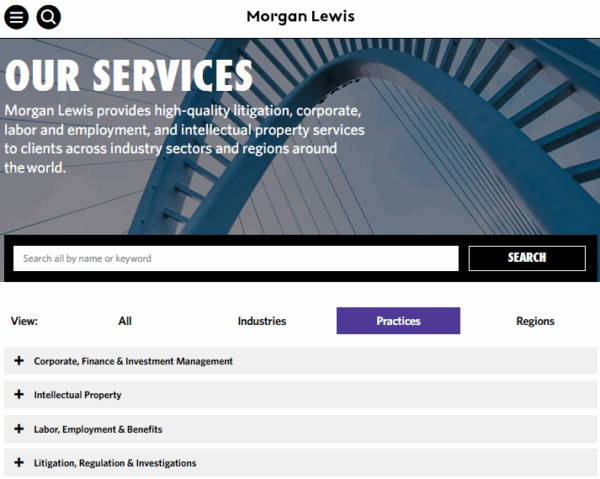
Here’s how to structure each page:
- Start with a client-focused intro. (not just “we’re experts”)
- Use H2s to break down services. (e.g., “Child Custody,” “Prenuptial Agreements”)
- Mention relevant laws or state-specific processes.
- Add testimonials or case wins if you can.
- Use internal links to the FAQs, contact page, and blog content.
Create Attorney Bio Pages
Believe it or not, your “About” page might be the most visited section after your homepage.
People want to know the person behind the legal advice.
Here’s an attorney page of the Latham & Watkins law firm.
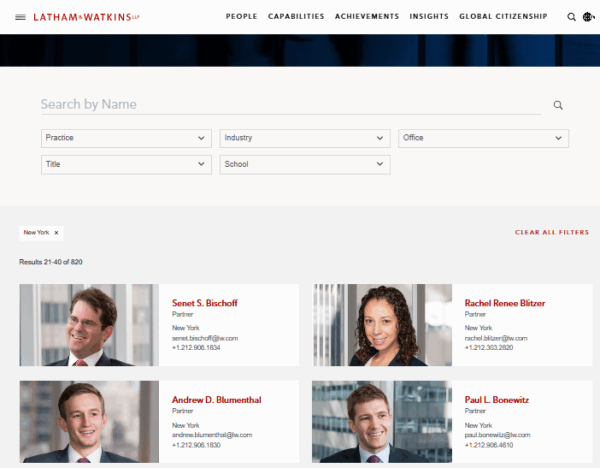
Here are some tips to make a great attorney bio page:
- A sharp headshot (smiling is good!)
- A short, engaging story about your background
- Credentials, specialties, bar memberships
- A quote or philosophy (e.g., “Every client deserves a fair shot”)
- A CTA
On-Page Optimization for Legal SEO
To attract clients, SEO for lawyers starts with strong on-page optimization. First, this makes your law firm’s website trustworthy and relevant for Google and potential clients.
To begin, optimize meta titles and descriptions for law firm SEO. For example:
Weak:
- Meta Title: “Home | Smith & Associates”
- Meta Description: “Smith & Associates is a law firm…”
Optimized:
- Meta Title: “Maryland Criminal Defense Lawyer | Free Case Review”
- Meta Description: “Facing charges in Maryland? Our experienced attorneys protect your rights. Call 24/7 for a free consultation.”
Importantly, the optimized version uses attorney SEO best practices, including location, practice area, and a clear call-to-action, boosting clicks.
Therefore, keep titles under 60 characters and descriptions under 160, incorporating SEO for law firm keywords naturally.
Next, clear headings should be used to guide readers and Google. For instance:
- H1: “Personal Injury Lawyer in Austin”
- H2s: “Why Choose Our Firm,” “What to Expect,” “Recent Settlements”
Additionally, place keywords in the H1, one H2, the first 100 words, the conclusion, and URL (e.g., /austin-personal-injury-lawyer/).
Furthermore, enhance local SEO for lawyers by linking service pages to blog posts (e.g., “Learn how Texas calculates personal injury damages [here]”) and blogs to service pages with CTAs like “Schedule a free consultation.”
As a result, this strengthens SEO for lawyers and law firms and improves user experience.
Finally, add schema markup for star ratings, reviews, FAQs, and contact info to boost local SEO for law firms in search results (e.g., ⭐ 4.9 | Personal Injury | 24/7).
Pro Tip: To ensure accuracy, use Google’s Rich Results Test to validate.
Local SEO for Lawyers
When someone searches “divorce lawyer near me” or “criminal attorney in Atlanta,” they’re not browsing for fun—they need legal help now, and they want someone local, credible, and easy to reach.
That’s where Local SEO for lawyers steps in. If your law firm isn’t showing up when it matters most, you’re handing potential clients to your competitors.
Let’s start with the most powerful tool in your law firm SEO toolbox: your Google Business Profile (GBP). This is the listing that appears in Google’s local map pack, right under the ads, when someone searches for legal services nearby.
Optimizing it is non-negotiable. Make sure you:
- Claim and verify your GBP.
- Use your actual business name. (No keyword stuffing!)
- Select precise categories like “Family Law Attorney” or “DUI Lawyer.”
- Add business hours, services, contact details, and location.
- Post updates like blogs, case results, and FAQs.
- Add high-quality photos of your office, team, and even thank-you notes from clients
Must Read: How to Generate Organic Visits for Google Business Profile + Free Tools
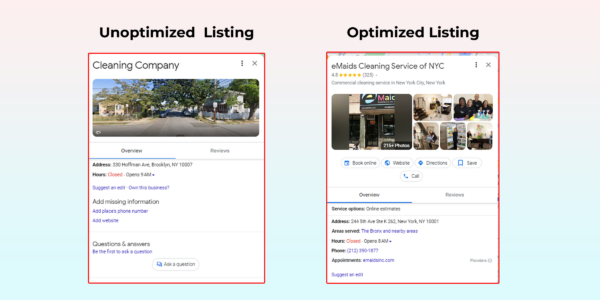
Next, focus on NAP consistency—your Name, Address, and Phone Number must match across your website, legal directories, social media, and local listings.
Even small mismatches confuse Google and hurt your attorney SEO rankings.
Want to expand your reach?
Get listed on legal directories like-
- Avvo
- Justia or,
- Martindale-Hubbell.
These local citations act as digital trust signals and also drive direct traffic from potential clients comparing firms.
And don’t overlook reviews. Nearly 90% of legal clients trust online reviews as much as personal recommendations. Proactively ask satisfied clients to leave feedback.
Then respond—professionally—to every review, good or bad.
Building trust here boosts both rankings and conversions.
Build Content Strategy for Law Firms
Content is your firm’s 24/7 advocate—it doesn’t just answer “What happens after a DUI in Florida?”; it shows you’ve handled cases like theirs.
By showing Experience, Expertise, Authoritativeness, and Trustworthiness (E-E-A-T), you build credibility and boost law firm SEO.
Building Your Law Firm Content Strategy
First, audit and plan:
- Identify topic gaps (e.g., “Estate Planning Attorney in Denver,” “Personal Injury Lawyer in Charlotte”).
- Assign priority keywords to each page or post.
- Develop a content calendar with weekly, monthly, and quarterly goals.
Creating E-E-A-T-Driven Content
Next, craft every piece with E-E-A-T authority:
- Experience: Share real client stories (“How we helped a client avoid eviction in California”).
- Expertise: Publish clear how-tos (“Step-by-Step Guide to Filing for Divorce in Texas”).
- Authoritativeness: Cite court rulings or reputable journals and earn backlinks from legal directories.
- Trustworthiness: Include attorney bios, client testimonials, and up-to-date disclaimers.\
Content Formats That Fuel SEO for Law Firms
- FAQ Blogs: Short posts answering real questions (“Do I need a lawyer after a minor accident?”).
- Cornerstone Guides: In-depth resources like “Ultimate Guide to DUI Defense in Florida.”
- Local Landing Pages: Target “DUI Lawyer in Austin” or “Estate Planning Attorney in Orange County” with consistent NAP data to dominate Local SEO for lawyers.
Finally, stick to your calendar:
- Weekly: One FAQ blog post
- Monthly: Local-page updates
- Quarterly: New cornerstone guide
- Seasonal: Timely posts (e.g., Q1 tax law changes)
By following this roadmap, your SEO marketing for law firms becomes not just visible, but genuinely valuable.
Grab Your Free SEO Checklist for Lawyers📝Make sure your law firm’s website ranks higher and attracts more clients. Get our comprehensive SEO checklist — it’s easy to follow and ready to use! |
Focus on Technical SEO
Even the smartest legal advice won’t matter if your website loads like it’s stuck in 2005. That’s why technical SEO is a crucial part of your SEO campaign.
First, speed and mobile-friendliness aren’t negotiable. Most potential clients search for legal help on their phones. They’re gone if your website takes more than 2.5 seconds to load.
Tools like WP Rocket and TinyPNG can speed things up without making your site look like it’s missing something.
Also, test your mobile version — not just desktop — using Google’s Mobile-Friendly Test.
Next, tackle Core Web Vitals — the signals Google uses to decide if your site offers a smooth experience. Want to rank higher? Keep your hero image light, your layout steady, and your code lean.
These tweaks are key for strong law firm SEO.
Then comes the basics: HTTPS, clean site structure, and indexable pages. No “Not Secure” warnings. No missing sitemaps. No weird URLs like /page?id=34. That stuff quietly hurts your rankings and trust.
Want extra points?
Use schema markup to highlight your reviews and FAQs in search. Redirect broken links properly. And unless you’re running a legal news site, you can skip AMP.
Pro tip:
Set up automated weekly performance audits using Google Looker Studio (formerly Data Studio) + Search Console. Create a dashboard that flags speed drops, crawl errors, or Core Web Vitals dips before they become ranking problems. It’s a smart way to monitor your SEO marketing for law firms without constantly logging into multiple tools.
Implement Link Building Strategies
Google sees backlinks (links from other sites to yours) as digital endorsements. But in the legal niche, getting quality backlinks is more important than just getting any backlinks.
Let’s break down what makes backlinks work—and how your law firm can earn them the right way.
Why Backlinks Matter in Law Firm SEO?
Backlinks tell search engines, “This site is trustworthy.”
The more high-quality, relevant sites that link to you, the better your chances of ranking for competitive terms in lawyer SEO.
But here’s the catch:
Bad links can hurt your SEO. Irrelevant or low-quality links (like one from a cat blog or spammy site) can do more harm than good.
Think of backlinks like referrals:
- A link from Avvo, FindLaw, Justia, or your state bar association = strong signal
- A link from an unrelated blog = weak or even toxic
Building backlinks for SEO for law firms is about earning mentions from authoritative, relevant sources.
Start with these:
Legal-Specific Sources:
Local SEO for Lawyers:
|
💡 Pro tip: Your offline activities—speaking gigs, pro bono work, events—often lead to natural backlinks when you’re mentioned online.
AI and Voice Search Optimization for Law Firms
As we approach 2025, two major changes are affecting how potential clients search for law firms online: voice search and AI-powered search.
If your firm isn’t getting ready for these changes, you might lose out on important website visitors and potential clients.
Let’s explain what this means and how you can stay ahead.
Consider how people ask questions nowadays.
They don’t just type “divorce lawyer Dallas.” Instead, they ask their phone:
- “How do I file for divorce in Texas?”
- “Can I sue for a dog bite in California?”
- “What should I do after a car accident near me?”
That’s voice search in action—and it’s growing fast.
Over 40% of U.S. adults use it daily. These searches are more conversational and specific, which means your website needs to reflect that.
How to adapt:
- Use long-tail, question-style keywords that match how people speak. Tools like AnswerThePublic or Google’s “People Also Ask” are goldmines for this.
- Add FAQs under each practice area on your site. Think of the real questions clients ask you and answer them.
- Put your answers in the first sentence—aim for 40–60 words—and use bullet points or lists where it makes sense.
Make Sure Your Website Can Keep Up
Voice searches often happen on phones, so your website needs to be:
- Fast
- Mobile-friendly
- Secure (HTTPS)
- Easy for Google to crawl and understand
Use free tools like Google PageSpeed Insights to see how your site performs—and what to fix.
AI Is Getting Smarter—So Should Your Content
Search engines aren’t just looking for keywords anymore. They’re trying to understand intent. That means content written just to check an SEO box won’t work. You need to show Google (and readers) that you’re legit.
What helps:
- Focus on building trust and authority—write like you’re explaining things to a real client
- Keep your advice helpful, accurate, and easy to understand
- Show your experience with real-world examples or clear explanations
Bottom line: These changes aren’t just trends—they’re the new standard. If you adjust your content and SEO strategy now, your law firm will be in a much stronger position to attract clients in 2025 and beyond.
Hire a law firm SEO expert
You’ve seen what it takes: building a trustworthy site, choosing the right keywords, and connecting with clients the moment they hit “search.” But here’s the truth—you don’t have to do it alone.
Legal SEO is more than just rankings. It’s about earning trust, generating leads, and being found by the people who need your help the most. A seasoned SEO expert can bridge that gap faster and with fewer missteps.
Let your law firm be the one they find—and the one they choose.
🔍 Book a free consultation today and discover how expert lawyer SEO services can turn search traffic into signed cases.
FAQs
Q1. Can I handle SEO for multiple legal specialties on one website?
A1. Yes—create separate, focused practice area pages (e.g., “Family Law,” “Personal Injury”) with unique keywords and content for each specialty.
Q2. What’s the biggest on-page SEO mistake lawyers make?
A2. Using generic titles like “Home” instead of keyword-rich titles (e.g., “Chicago DUI Defense Attorney | Free Case Review”).
Q3. Are client testimonials important for SEO?
A3. Yes—adding genuine testimonials with schema markup boosts trust signals and can appear as rich snippets in search results.
Q4. How do I track SEO success for my law firm?
A4. Monitor organic traffic, keyword rankings, local pack appearances, and contact form submissions via Google Analytics and Search Console dashboards.
Q5. Should my law firm blog about legal news?
A5. Yes—timely, accurate legal news articles can attract backlinks and demonstrate your firm’s expertise to both clients and search engines.
Q6. Can I use FAQs on my service pages?
A6. Absolutely—adding a concise FAQ section with schema markup on each service page improves user experience and can generate FAQ rich results.
Q7. What role do meta descriptions play in legal SEO?
A7. Meta descriptions don’t directly affect rankings but improve click-through rates by clearly summarizing your page’s value to searchers.
Q8. Is HTTPS mandatory for lawyer websites?
A8. Yes—HTTPS is a trust signal for both users and Google, and sites without it may be flagged as “Not Secure.”
Q9. How do I optimize images for my law firm site?
A9. Compress images for faster load times, use descriptive file names (e.g., “dallas-personal-injury-lawyer.jpg”), and add alt text with keywords.
Q10. What’s a quick SEO win for small law firms?
A10. Claiming and fully optimizing your Google Business Profile often yields immediate visibility boosts in local map packs.