Updated On 19-12-2025
What is Google Click Fraud (Fake Clicks)?
Google click fraud is a deceptive practice that occurs when a user or bot clicks on an advertisement, button, or hyperlink to deceive the platform into believing there is more engagement than there is. These clicks may come from bots, automated scripts, competitors, or click fraud networks, and they falsely increase your cost-per-click (CPC) while delivering zero return on ad spend (ROAS). These fraudulent clicks seem like a real user when they are not; they can bypass basic detection systems and corrupt key PPC KPI such as quality score, conversion rate, CPA, and impressions, which directly impact search engine marketing performance.
This will lead to budget wastage and reduced campaign profitability, especially when ads appear across multiple Google SERP features. In simple terms, click fraud sends low-quality or fake traffic to your ads to exhaust your daily ad budget and ruin your PPC strategy.
Why Does Click Fraud Happen?
- Simply saying, it happens because it is financially rewarding.
- Fraudsters, unethical publishers, and affiliate operators earn direct revenue from click fraud.
- As brands consistently increase their pay-per-click (PPC) budgets, fraudsters see greater financial opportunities, leading to more aggressive bot-driven attacks.
- Fraudulent clicks distort rivals’ campaign data, making ads appear more successful than they actually are.
- Advertisers make incorrect decisions around bidding, targeting, and budget allocation.
- Over time, this data pollution reduces return on ad spend (ROAS) and weakens the overall ad marketing, which also affects your site’s Google E-E-A-T.
How is Click Fraud Done?
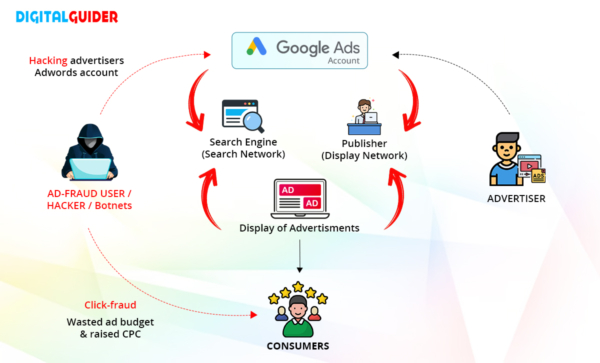
how is click fraud done
- Through automation & advanced bot technology: The fraudsters use residential proxy networks, and distributed botnets to generate fake clicks by mimicking human interactions using real devices & proxy networks, bypassing CAPTCHA.
- By competitors aimed to waste ad budgets: Competitors hire fraudsters to use fake clicks to drain the budget and raise cost-per-click (CPC).
- By publishers (website owners): Publishers earn revenue on a cost-per-click (CPC) basis. They may use bots or click farms to show false engagement. These fake clicks increase their earnings from the ad but deliver no real value to advertisers.
- By using headless browsers and rotating IP addresses
- By click farms where real people are paid to click ads repeatedly
How to Identify Fake Click
Click fraud often shows patterns like:
- Abnormally high CTR with zero conversions
- Repeated clicks from the same IP range, device ID, or geo-location
- Extremely short session durations and high bounce rates, which not only indicate fake clicks but can also harm key on-page SEO factors.
- Invalid traffic (IVT) flagged by Google Ads, but not always refunded
The Most Common Types of Click Fraud
Manual Click Fraud:
The act of a human repeatedly and intentionally clicking on pay-per-click ads without any interest. The goal is to drain the advertiser’s daily budget and remove their ads from competition.
Clickbot Fraud:
Clickbot Fraud involves automated bots programmed to simulate human clicks on ads. These bots can generate fraudulent clicks, draining ad budgets and distorting campaign metrics.
Competitor Click Fraud:
Competitor click fraud is a cutthroat tactic used by business rivals or hired bots to repeatedly click on your online ad, exhausting your ad budget. This artificial activity reduces your ad visibility, distorts campaign performance data, and gives competitors an unfair advantage in the market.
Click Farms:
Click farm is a type of fraud that involves a group of people or automated bots/scripts, sometimes referred to as advanced or “Silicon Valley,” that generate a high volume of fake clicks on ads. This activity creates the illusion of genuine user interest, but the clicks deliver little to no real value to advertisers.
Deepfake Clicks:
Deepfake clicks are new forms of click fraud where fraudsters use advanced AI and machine learning to get highly realistic human behaviour. From scrolling pages to mouse movement and time-on-page, creating fake profiles and making them harder to detect than traditional bot traffic.
Ad Stacking:
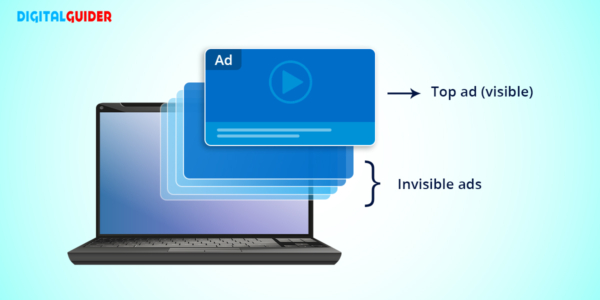
Ad stacking happens when multiple ads are layered on top of another ad in a single ad placement. Therefore, when a user clicks on the visible ad, they unintentionally click on the hidden or invisible ads as well, generating multiple fraudulent clicks.

Image explaining Ad Stacking
Ad Injection:
An ad injection fraud happens when we insert unauthorised ads into a user’s app, browser or website through a seemingly harmless browser extension or malware. These injected ads are often clicked by users unknowingly, leading to Click Fraud.
Mobile Emulator Fraud:
With the rise of mobile advertising, fraudsters employ mobile emulators to simulate clicks on ads. These emulators mimic mobile device behavior, making differentiate genuine clicks from fraudulent ones.
Pixel Stuffing:
In Pixel Stuffing, fraudsters hide tiny, invisible pixels within ads. When these ads are loaded on web pages, the pixels trigger fraudulent clicks without the user’s knowledge.
How to Detect & Prevent Fake Clicks?
Check IP Addresses:
IP addresses are one of the most common ways fraudsters use to generate fake clicks within an internet service provider (ISP) network. Luckily, advertisers can recognize these IP addresses and block them to stop fraudulent clicks. However, it is essential to investigate further if you feel something fishy about it.
- Look for the following points to detect click fraud through IP address
- Check for sudden spikes in clicks from the same ISP or IP range
- Multiple clicks originating from a single IP in a short period
Monitor Click Patterns
Regularly review your ad traffic that isn’t part of your regular Google advertising or marketing strategy. These unusual patterns could be a sign of fraudulent activity. Look for-
- Repeated clicks at consistent intervals may indicate bot activity
- Unusual geographic distribution of clicks (e.g., clicks from regions outside your target market)
- High click activity during odd hours or low-traffic periods
- A proper website audit checklist can help identify these red flags early.
Analyze Conversion Rates
Conversion metrics are key indicators of genuine engagement, which tell you the number of clicks your ad received that resulted in meaningful actions like purchases, sign-ups, or inquiries. To detect click fraud-
- Compare your current conversion rates with historical campaign performance
- Sudden drops in conversions despite high click volumes may signal fraud
- Extremely fast conversions or patterns that don’t reflect typical user behavior
Review Ad Targeting and Traffic Sources
When identifying Click Fraud, fine-tuning your ad targeting can be a game-changer. Here are some ways you can optimize your PPC ad for success:
- Use demographic, interest, and geographic targeting to focus on relevant audiences
- Monitor bounce rate, time on site, and conversion rate for each segment
- Geo-targeting lets you show your ads only in specific locations, so you avoid clicks from areas where your products or services aren’t available.
- Use negative keywords to prevent ads from appearing in irrelevant searches
- Keep an eye on suspicious referral sources or unusual traffic channels
Leverage Detection Tools
Modern tools are very important to detect the click fraud implemented through advanced AI and machine learning. These tools-
Flag patterns that deviate from normal engagement
- Identify bots, click farms, and emulator-driven traffic
- Provide automated recommendations for blocking or filtering fraudulent clicks
- Using specialized click fraud monitoring software complements manual detection methods and reduces losses.
- You can use tools like FraudBlocker, ClickGUARD, Appsflyer, Anura, CHEQ ClickCease, and more.
Manual Clicking vs. Automated Bot Click Fraud
There are mainly two common ways in which click fraud happens: manual clicking and automated clicking. Both these frauds aim to waste the budget and damage the advertiser’s campaign performance.
Manual Fake Clicking
Manual clicking involves real people intentionally clicking on ads to harm the advertiser. It is usually carried out by rivals, unhappy customers or hired click farms. The involvement of real people, along with different devices, browsing patterns, and timing, makes the click behaviour appear natural. This makes Manual click fraud harder to detect, but it usually happens at a smaller scale, over a long period of time. Let’s understand it with a simple example:
Imagine you offer home remodelling services and run Google Ads to attract customers. A sneaky individual repeatedly clicks on your ads without any intention to make a genuine purchase. These clicks look real, but no service is booked. Over time, the ad budget is wasted, and the ads stop showing to real customers.
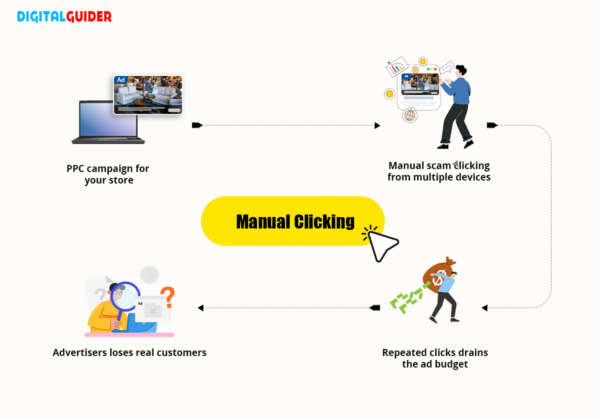
Example showing Manual Click fraud
Automated Bot Clicking
Automated bot click fraud is done using botnets, scripts, or software programs. These bots are designed to behave like real users by clicking ads, scrolling pages, and moving the mouse at random intervals. Bot-driven click fraud can generate thousands of clicks in a short period, quickly draining ad budget, but it is easier to detect due to sudden and abnormal traffic spikes.
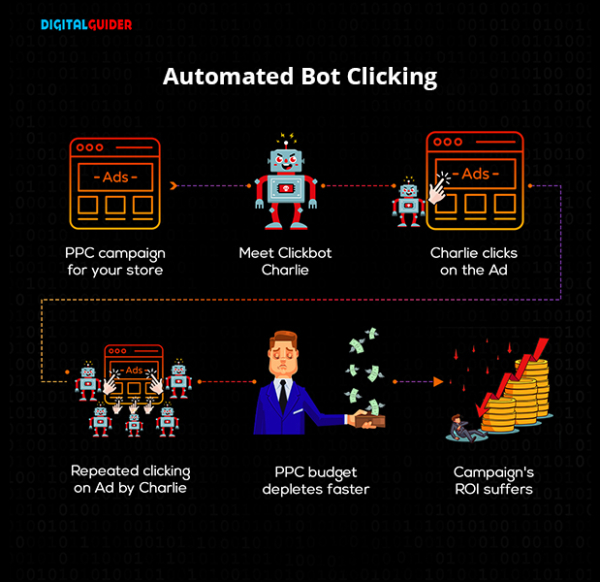
Let’s understand it with a simple example: Imagine you’re an ad agency running a Google Ads (PPC) campaign for an online retail store to drive traffic to its eCommerce website. The ad appears on a popular tech website promoting a special offer.
Now enters Clickbot Charlie—an automated bot created by fraudsters to act like a real user. Clickbot Charlie repeatedly clicks on the ad throughout the day without any intention to buy. These clicks look genuine but never convert. Over time, the ad budget is drained, and the ads stop showing to real customers.
Example of Automated Bot Clicking
How Does Fake Click Affect Advertisers?
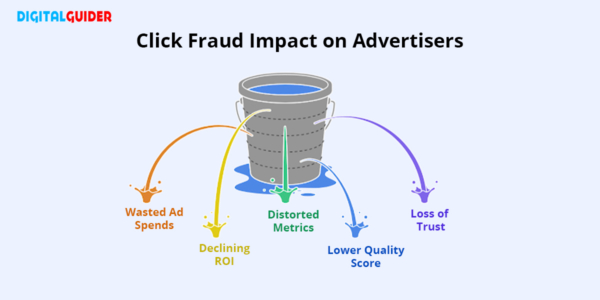
Impact of Click Fraud on Advertisers
As estimated by WebFX, many businesses spend between $1000 & $10000 on Google ads. With such a significant budget at stake, AdWords click fraud can seriously impact advertisers, causing financial losses and operational damage. Click fraud impacts advertisers in several key ways:
- Wasted Ad Spends:
Advertisers pay for fraudulent clicks that bring no real interest, leads, or sales, draining a large portion of their ad budget with zero returns. These losses majorly impact small businesses and startups, leading to limited budgets and fewer growth opportunities. - Declining ROI:
Fake clicks increase the advertising cost and reduce ROI, making campaigns less profitable and sometimes even impractical. As a result, resources are used inefficiently, and it becomes harder to manage or justify ad spend. - Distorted Performance Metrics:
Click fraud manipulates the KPIs (key performance indicators) like click-through-rate (CTR), conversion rates and engagement metrics, making it difficult for advertisers to understand the real user behaviour and optimize ads. - Lower Google Ads Quality Score:
Google’s Quality Score is based on three main factors: expected CTR, ad relevance, and landing page experience. Click fraud attacks all three pillars, causing combined damage. This results in poor engagement signals, lower ad rankings, and higher cost-per-click (CPC).
- Loss of Trust & Credibility:
Beyond ad spend, KPIs, or Quality Score, repeated click fraud can reduce trust in advertising efforts and negatively impact overall brand credibility.
⚠️ Click fraud not only hurts your ad spend, KPIs, and Quality Score but also reduces trust and brand credibility. 📝 It can impact your long-term content marketing strategy and overall brand authority
Final Thoughts
PPC advertising is a prime target for fake clicks or click fraud, especially in highly competitive industries. As digital advertising evolves, fraudsters continue to use more sophisticated methods to exploit PPC systems. Google tracks these fraudulent clicks with automated systems, human reviews, and software to detect & prevent them. But advertisers cannot rely on platforms alone.
Proactive measures and expert PPC click fraud management are essential to protect ad spend and campaign performance.
FAQ
Q1. Does Google protect against click fraud?
A1. Yes. Google has real-time detection systems that automatically block invalid clicks and react to suspicious activity.
Q2. How does Google detect click fraud?
A2. Google uses automated filters, machine learning systems, and manual reviews to spot unusual click patterns and block invalid traffic.
Q3. What are the ways to detect click fraud?
A3. Use click fraud detection tools, monitor unusual spikes in clicks, and track sudden changes in CTR or session patterns.
Q4. How can I report click fraud?
A4. You can report click fraud through the Google Ads “Invalid Clicks” support form by submitting details of suspicious activity.
Q5. Can I get my ad budget back for click fraud?
A5. Yes. If Google verifies the invalid clicks, they issue automatic credits called “invalid activity adjustments.”
Q6. How do I stop fake clicks on Google Ads?
A6. Use IP exclusions, adjust targeting, enable automated rules, and use click fraud protection tools for extra security.
A7. Yes. Platforms like Facebook, Instagram, and TikTok also face bot clicks, fake engagements, and invalid traffic similar to Google Ads.
Q8. How does click fraud affect SEO?
A8. Click fraud doesn’t directly impact SEO rankings but harms ad data, user insights, and paid search performance.
Q9. Is click fraud illegal?
Q9. Click fraud can be illegal, but enforcement varies by state and local laws in the U.S. It is usually addressed under fraud, cybercrime, or unfair competition regulations, with most cases handled through ad platform penalties unless the activity is severe.